

Happy 25th Anniversary to Tori Amos’ sixth studio album Strang Little Girls, originally released September 18, 2001.
Eyeliner—that was pretty much the epitome and extent of makeup when I was in junior high in the late ’80s and high school in the early ’90s. Cover Girl navy or cobalt blue to complement your crunchy perm and sky-high bangs, and then, as the culture seismically shifted with Nirvana’s Nevermind (1991), smudged black eye pencil warmed with a cigarette lighter to give your bedhead and baby barrettes that extra grunge je nais se quoi. (And, of course, a swipe of brown or dark berry lipstick.) During that era, we had to make do without social media influencers showing us how to contour in 28 steps, and we certainly didn’t know how to create blended eyeshadow “lewks.”
So when Kevyn Aucoin’s Making Faces came out in the late ’90s, it was a revolution and a revelation. I first stumbled across the glossy coffee-table book in my college bookstore around ’97, on one of the shelves displaying novelty, non-academic fare near the cash register. I sheepishly added it to my heavy shopping basket full of required course reading that I was about to put on my parents’ tab, feeling a pang of guilt for buying something non-essential since they were already sacrificing a lot to send me to a fancy private school. (After college, I’d end up moving to New York and landing a job in fashion, so my illicit little purchase might have been worth it.)
In the later ’90s, the culture had, once again, abruptly shifted, and what was once flannel-draped waifs and gritty heroin chic suddenly yielded to an unmistakable glam. In 1996, just as the alternative-music bubble burst, Gucci under the direction of Tom Ford began rolling out sleek velvet suits in addition to a sublime Studio 54-inspired collection (Another magazine refers to this Ford era as “post-waif hedonism”) that I would obsess over while flipping through phonebook-thick issues of Vogue on my breaks while working in a restaurant.
A couple years later in 1998, Courtney Love’s Hole would return with the unapologetically glamorous Celebrity Skin (“Oh make me over”), while movies like Party Girl, Baz Luhrmann’s Romeo + Juliet, Great Expectations (Gwenyth Paltrow’s green-themed Donna Karan wardrobe!), and The Last Days of Disco flaunted a much more stylized, unabashedly chic aesthetic than anyone could have ever gotten away with earlier in the decade. Even Lilith Fair was surprisingly stylish, featuring Missoni knits, platform shoes, headwraps, buttery leather jackets, and funky color-blocked jumpsuits.
Making Faces, with its instructions for tasteful contour and sparkly winged eyes, was right on time to coincide with this late-decade pop culture shift. And the sheer number of looks was head-spinning: Kirsty Hume with a hunter-green metallic eye, Trish Goff in a Twiggy-inspired look, Janet Jackson with a dark smoky eye, Jewel with a silver metallic smoky eye, Lisa Marie Presley as a Marilyn-inspired bombshell, our beloved Tori Amos as a Botticelli-esque ‘innocent,’ Demi Moore in a flapper-inspired look, Cher in a glossy-eyed editorial style, and Gwyneth Paltrow as an Audrey Hepburn-type gamine. Aucoin successfully transformed each model and celebrity into a persona that made you look at her in a slightly, or sometimes dramatically, different way.
However, at the same time that this fun, chic, celebratory femininity was beginning to return to the fashion magazines, the runways, the movies, and the music festivals, a macho, chauvinistic masculinity had also begun to muscle its way into the pop culture. In the late ’90s and into the early 2000s, the new post/poser-grunge, faux- “alternative” music movement was full of pissed-off men with shady attitudes towards women. (Think “Nookie” by Limp Bizkit, the creepy “Cool, Daddy Cool” by Kid Rock, “A.D.I.D.A.S” by Korn, etc.). Meanwhile, Woodstock ’99 went down in infamy as “the rise of toxic masculinity”—several rapes were reported at the festival, male concertgoers shouted at Sheryl Crow to show her breasts, and aforementioned misogynist Kid Rock spat out that Monica Lewinsky was a “ho” during his set.
Listen to the Album:
Then, in March 2001, Tori Amos read an article that offered an inside look at the porn industry written by Martin Amis in The Guardian, where one adult film star said she regarded the vagina as “bullshit,” and the ass to be superior. It got Amos thinking about this woman’s likely self-loathing, in addition to how the commodification of sex is often inextricable from violence, debasement, and long-expired notions of a woman’s inherent worth. All of this was particularly personal to Amos; she was a new mother who’d just given birth to a baby girl, Natashya (“Tash”), and she’d begun fretting over the inhospitable world her daughter might grow up in.
As she nursed three-month-old Tash in a rocking chair in her home in Florida, Amos began thinking about a world in which men were the mothers. She conceived of a project whereby she would take songs that had been borne and “mothered” by men, and then rethink them from the point of view of a different woman who would personify each song. She thought that it might help her understand the battle of the sexes better if she could look at women as men viewed them, and then reflect it all back through her own experiences and morality.
''I said, `OK, let's really turn over these stones,''' Amos told the Boston Globe in 2001. ''Let's look at this a little more closely. Let's crawl behind the men's eyes and hang in their heads. And then let them crawl back over that bridge into the skins of these different women and see how they heard what they had written. You take the man's seed, you plant it in the womb of the voice of the woman, and the consummation happens there. This album has a Y chromosome in it.''
Since very early in her career, Amos had made it almost her signature to reinterpret other people’s songs. It was something she had become particularly adept at while playing in piano bars in Washington, D.C., as a teenager in the late ’70s and early ’80s, while the political power players did their wheeling and dealing. (She liked to play Rickie Lee Jones’ “The Last Chance Texaco” whenever the Big Oil lobbyists were in town.) And her covers of songs like Nirvana’s “Smells Like Teen Spirit,” the Rolling Stones’ “Angie,” R.E.M.’s “Losing My Religion” and many others that she performed in concert (Joni Mitchell’s “A Case of You,” Led Zeppelin’s “Thank You”) became fan favorites throughout the ’90s.
So, creating an entire album of covers just seemed like a natural next step. She also had already developed the habit of mentally creating characters for her own songs, and referring to them as “girls,” and so this project was an organic offshoot of that quirk.
She decided, however, that she wouldn’t select most of the songs herself. Instead, she put together a “laboratory of men,” consisting of male friends who suggested songs they believed might work. This laboratory also included her band for the album—drummer Matt Chamberlin, guitarist Adrian Belew (formerly of King Crimson), Beck bassist Justin Meldal-Johnsen, and Jon Evans. “Straight men, gay men, all sorts of men contributed ideas,” Amos explained. “It was tricky to assemble this material because a lot of the songs just didn’t work. But the men were my control group. They brought the songs to me that meant something to them as men.”
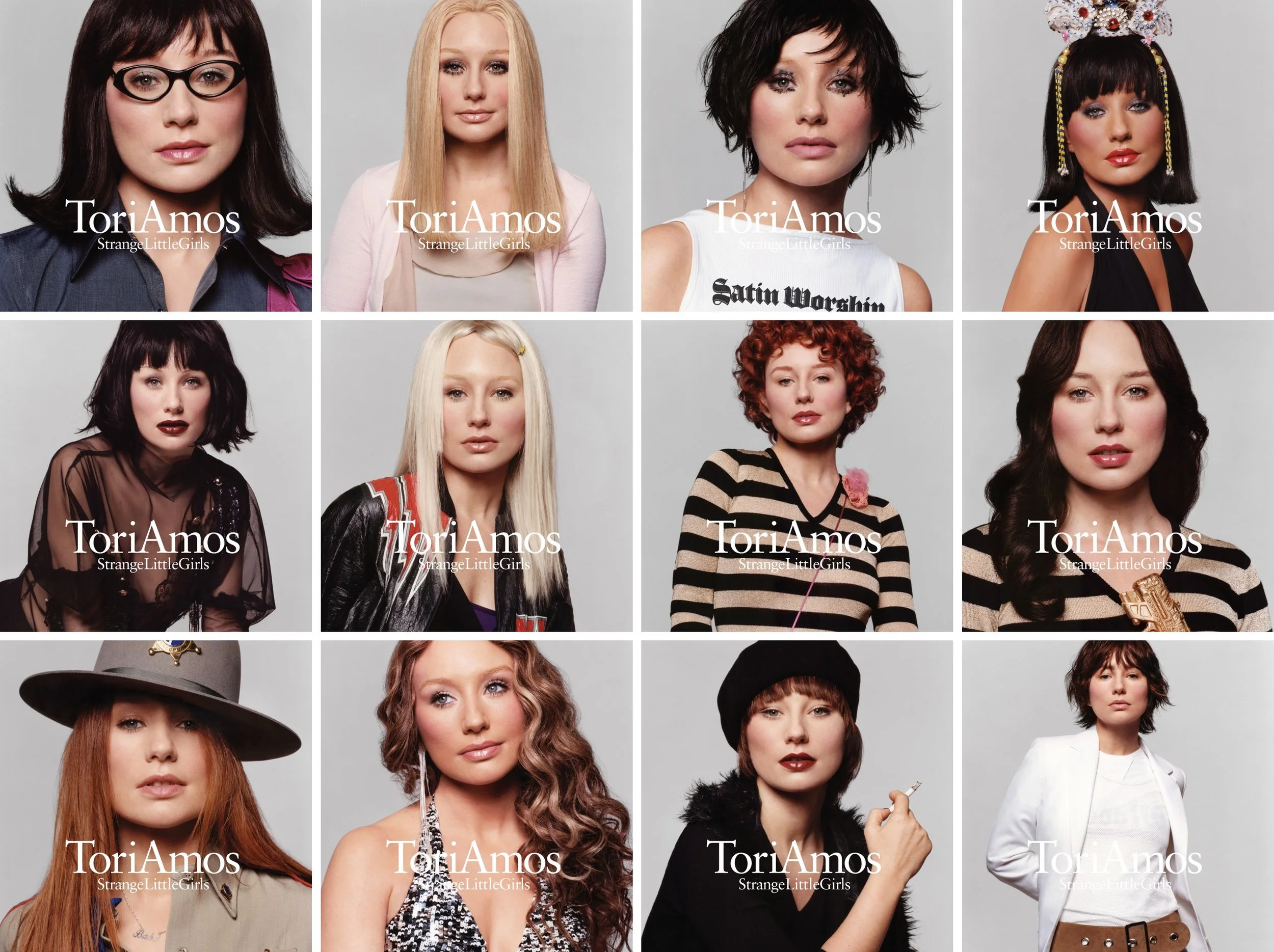
Amos and longtime collaborator Karen Binns, a fashion super-stylist and creative director, began working on the visual component of the album. Since Amos had already worked with Kevyn Aucoin on Making Faces, they naturally decided to team up with the “legendary face transformer,” as Amos fondly refers to him, and the three toiled for months on visual representations of the 12 songs represented by 13 different characters (the album includes a set of twins). Amos then recruited graphic novelist Neil Gaiman, a longtime friend, to write a short story about each character for the album booklet after consulting with both the “laboratory of men” about the songs, as well as the visual team. And in this way, two seemingly clashing aspects of Y2K-era culture—exultant femininity and fraught masculinity—were married under one shrewd, heady concept.
Throughout the process, Amos didn’t have much contact with the writers of the songs. “I kept my interpretations under my hat until the eleventh hour because I was not seeking approval,” she told the website RedDirect.com. “I’m not having a relationship with the song mothers—the male writers—I’m having a relationship with their song children. My loyalty was to the integrity of the work, not to the composers.”
Strange Little Girls spans 30 years of rock history, and covers a diverse swath of male artists, from Eminem to the Boomtown Rats, Lou Reed to Slayer, 10cc to Depeche Mode and the Beatles. The album opens with the Velvet Underground’s “New Age.” The song’s album version, which appears on 1970’s Loaded, is about an aging actress engaging in all manner of seedy, reckless ’70s amor. However, instead of that version, Amos chose one that had appeared on the band’s live album the year prior, with different lyrics and a more introspective vibe. Amos’ interpretation renders it sonically fuller-bodied, with lots of buzzy, punctuating guitar riffs by Adrian Belew reminiscent of a ’70s stadium sound. The song is represented visually by a dark-haired librarian-type with wispy bangs and thick horn-rimmed glasses. "She's a writer," explains Amos, "an observer. She's doing research; she's documenting like an Encyclopedia Britanica of life and experience. Her big line is, 'Well I'm doing research.'"
“It’s just about passion,” Amos asserted to the Orange County Register. “I love the idea that when this song came out [in 1970] it was part of a new freedom movement. Freedom from this yoke that had been around mankind, womankind—the Martin Luther Kings and Gloria Steinems of the world having cut holes in walls built up in suppression. Yet now we’re in a place 30 years later … [and] you’re seeing hostility take hold again, this malice against women—women agreeing to be demeaned.”
The next track, Eminem’s “’97 Bonnie & Clyde,” is absolutely, undoubtedly the flagship track on the album. The song had become a bit of dancefloor jam at the end of the ’90s, despite the fact that it was a disturbing fantasy whereby the character Slim Shady kills his wife, stuffs her in the trunk of his car, and travels to a lake with his young daughter to dispose of the body. Unlike everyone blissfully grooving to the beats and ignoring the lyrics, Amos cared deeply about the dead wife. So instead of adopting the perspective of the murderous Slim Shady, Amos inhabited the viewpoint of the woman in the trunk, who’s mostly concerned with comforting her daughter, while also slyly throwing shade at her traitorous husband: “See, honey, there's a place called heaven and a place called hell / There's a place called prison and a place called jail / And Dada's probably on his way to all of ‘em, except one.”
In the mostly spoken-word delivery, Amos manages to sound both bone tired and convincingly faux-cheerful. To record the verses, Amos crawled inside a small, confined box and imagined she was in the trunk of a car while whispering into a microphone. The song’s orchestral flourishes lend it a cinematic poignance, and a deep lingering sadness.
In the next song, “Strange Little Girl” by the Stranglers, Amos imagines the daughter in “’97 Bonnie & Clyde” all grown up. Amos felt the Stranglers were “sexy songwriters,” mostly because they were sophisticated Brits who weren’t “football hooligans” (ha!). Her admiration for the band shows by turning an original that’s slightly chilly and synthetic into something careening, flirtatious, sunny, soaring, and fun. Like, you can imagine this strange little girl, represented visually by a punk girl with a choppy black bob and smeared eyeliner, skateboarding down a suburban street and stopping everyone in their tracks. It’s definitely my favorite track on the album.
Amos’ cover of Depeche Mode’s “Enjoy the Silence” is much more straightforward, albeit infused with a little more introspection and melancholy than the original, but, honestly, not all that interesting. She imagined it as a nod to “Silent All These Years” on her solo debut, and it indeed does have that effect. The song is visually represented by a dark-haired showgirl wearing an ornate headpiece. “I call her Isis. She might moonlight over in Vegas,” Amos explains. “She's the oldest of the showgirls there and has been around awhile. There's a mothering quality in her, she sees the other women who come through the door and get extorted. She sees who the puppeteers are, and she sees when they're lying there bleeding."
Enjoying this article? Click/tap on the album covers to explore more about Tori Amos:
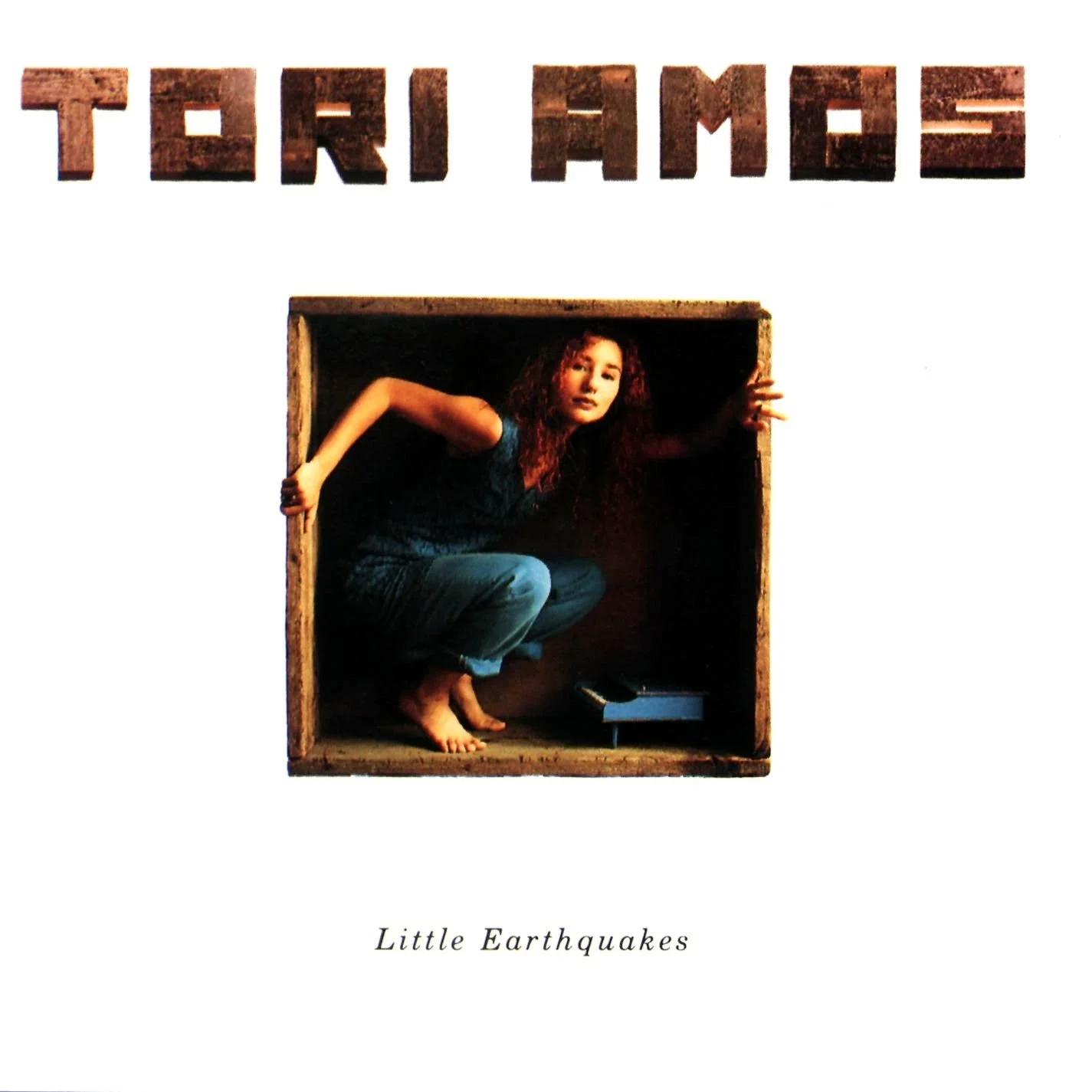

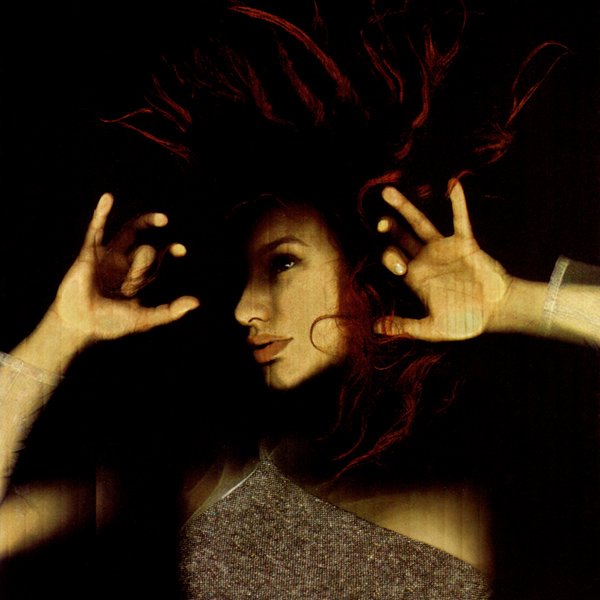

Although the unreliable narrator of 10cc’s “I’m Not In Love” clearly is in love despite his dickish and manipulative protestations, Amos’ spare rendition stripped of emotion, with understated industrial beats and metallic screeches courtesy of Belew, imagines a different internal register. “She's a little fetish girl—she's into BDSM,” Amos says of the black-haired, dark-lipsticked character. “It's all about power with her. And she’s not really in love; she really isn't. She was at one time and she’s having a different adventure in life. She will walk down many roads."
“Rattlesnakes,” another favorite of mine, is originally a twangy, rollicking offering by Lloyd Cole and the Commotions. Amos slows it down a bit, visually representing her rendition with a platinum blonde in a KISS jacket. “I loved the way he [Lloyd Cole] was so aware of the pain that she was in for her never-born child,” said Amos, who suffered several miscarriages before giving birth to Tash. “And he was able to, I think, feel her in a way that sometimes I haven’t been able to feel her.”
Amos represents Tom Waits’ “Time” with a curly-haired redhead who strongly resembles Little Orphan Annie, despite the fact that, to her, the song clearly represents a somber subject matter—the point of view of death. “She's death,” Amos asserts. “I think everybody gets to pick how they see death. So, to me, she is the Grim Reaper, and I saw her. Because time is ticking.”
The mood then shifts dramatically with a throbbing, swishing, wild, and nearly unrecognizable version of Neil Young’s “Heart of Gold.” It’s very weird and totally unexpected, but I like it a lot.
"Here are our twins,” Amos says of the song’s visual representatives. “They're economic espionage gals—their saying is, 'It's not glamorous, it's just business. They infiltrate corporations and access information and send it somewhere else. Good or bad, it depends what side you're on. They're not out protesting with a sign, they're playing chess with these corporate big boys.”
While the Boomtown Rats’ “I Don’t Like Mondays” is an almost journalistic telling of the real-life, pre-Columbine 1979 school shooting by a teenager named Brenda Spencer, Amos tells the tale from the point of view of a policewoman who was charged with executing Spencer at the scene before she killed more children. This isn’t factual—Spencer surrendered and went to prison—but it’s an interesting angle, mostly because it hints at something untold.
"This is told from the point of view of the Texas Ranger [who] goes to the school, finds the first body in the stairwell, then finds the girl who's killed everybody and kills her,” Amos explains. “[The Ranger] is licensed to do this; you would think that she's justified in her act, but she's having a difficult time with it because she doesn't think this particular girl is a bad seed." Amos’ compassionate take has a basis in reality: Although Spencer’s crime was horrific, she was living in poverty with her father, with whom she slept on a single mattress on their living room floor, which was strewn with empty alcohol bottles. Spencer would later say she’d been subjected to total neglect by her mother, and that her father regularly sexually abused her.
Amos expands the theme of rampant, out-of-control gun culture in America with a cover of the Beatles’ “Happiness Is a Warm Gun.” She described it to Rolling Stone as “very much this Frank Zappa-inspired, nine-minute sort of a backdrop for the Second Amendment argument.” It features samples of George Bush soundbites on gun control, as well as her own father, Reverend Edison Amos, preaching his own views on the Second Amendment. It’s an interesting soundscape, albeit much more of a conceptual think piece than a track to bop to on a road trip.
Slayer’s “Raining Blood,” represented by a pert redhead in a black beret holding a cigarette with a precarious ash, was suggested by bassist Justin Meldal-Johnsen, mostly due to the fact that every other genre besides metal was appearing on the album. Slayer loved what Amos did with the song, and sent her a huge shipment of “God Hates Everyone” T-shirts in thanks.
The album ends with Joe Jackson’s “Real Men,” which Amos used as a meditation on why some women wish to be submissive to men. Interestingly, the song is represented visually by the most androgynous woman of the bunch, with short natural brown hair and no makeup. "She’s an androgynous being, like a seahorse,” Amos says. “Her essence is anima/animus combined, of the joining of two in one. It's a woman who has really integrated her animus. And this is what she projects to the world. Neil Gaiman is convinced she's a he, but I don't agree. I think she's androgynous."
At the beginning of 2026, Amos released a 25th anniversary vinyl reissue of Strange Little Girls, featuring a few B-sides of unreleased covers from the sessions. In a very grim twist of irony, Neil Gaiman’s contributions were seemingly removed from the album. In 2024, several women accused Gaiman of serious sexual misconduct, with a former nanny eventually suing Gaiman for rape and him and his ex-wife Amanda Palmer for human trafficking, although these lawsuits were eventually dismissed. “If the allegations are true, that’s not the Neil that I knew, that’s not the friend that I knew, nor a friend that I ever want to know,” Amos told The Guardian in 2024. “So in some ways it’s a heartbreaking grief.” She has not spoken publicly on the matter since.
Although Strange Little Girls was nominated for two GRAMMYs, promotion of the album suffered due to the fact that it was released so close to September 11th. Amos was in New York on that fateful day preparing for the Strange Little Tour, her first one-woman show in approximately seven years, when her tour manager rushed into the room, grabbed the remote, and turned on the television. “When the second plane hit, it was clear,” Amos recalls. “It was not confusing. Jesus Christ, we are under attack.”
The following year, Amos would explore America’s post-9/11 grief on her album Scarlet’s Walk (2002), but in the meantime Strange Little Girls seems to have gotten somewhat buried under all that collective grief. It’s therefore one of Amos’s most underrated albums, and it definitely deserves a more considered listen, particularly because it’s so daring.
Although the seed of Strange Little Girls began with songs by men, it’s really in the end, as it always is with Tori Amos, all about the girls. ''A woman said to me that this [album] is like my little archetypal United Nations,” Amos mused. “And maybe it is, because if you look at the different women, there are some that hold the Athena essence, some that hold the Aphrodite essence, some that hold the Demeter, some that hold the Persephone. It's all there.''
Listen:
