
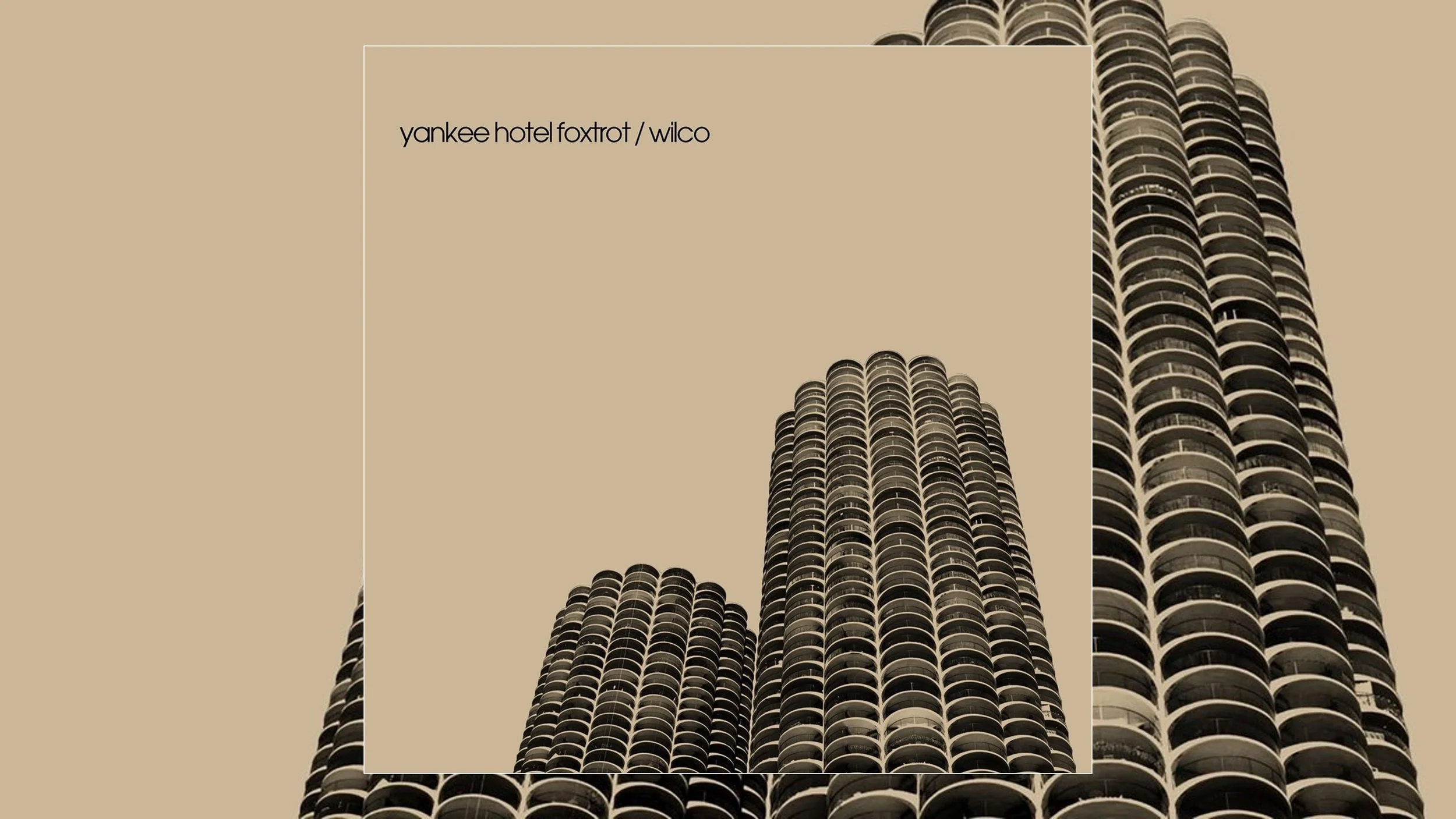
Happy 25th Anniversary to Wilco’s fourth studio album Yankee Hotel Foxtrot, originally released independently via streaming September 18, 2001 and via retail, courtesy of Nonesuch Records, April 23, 2002.
In The Art of Fiction: Notes on Craft for Young Writers, John Gardner argues that good fiction requires a “vivid and continuous fictional dream…in bad and unsatisfying fiction, this fictional dream is interrupted from time to time by some mistake or conscious ploy on the part of the artist. We are abruptly snapped out of the dream, forced to think of the writer or the writing. It is as if a playwright were to run out on stage, interrupting his characters, to remind us that he has written all of this.”
Wilco is always threatening to run out on stage. In Sam Jones’ documentary I Am Trying to Break Your Heart, which documents the creation of Yankee Hotel Foxtrot and all of the record label brouhaha that followed, multi-instrumentalist Jay Bennett says, “We just wanted [the record] to not sound like a little folk ditty, y’know? So, we wanted to have some sonic weight under all that…something kind of weird and fucked up.”
This instinct to destroy the folk impulses at the heart of Wilco’s music predates Yankee Hotel Foxtrot; Summerteeth’s (1999) “Via Chicago” is a perfect three-chord folk song that the band explodes with crashing drums and guitar feedback to simulate the El train. The version from songwriter Jeff Tweedy’s solo album Together at Last (2017) captures its folk essence, but on a Wilco record, a beautiful folk song is not allowed to live.
But, this reimagining brings the threat of breaking up the vivid and continuous dream; one could accuse Wilco of using smoke and mirrors to compensate for undercooked songs. In folk music, after all, having a bad song is inexcusable. The problem with experimentation is that it can lead to artists overthinking, overcomplicating, and running out on stage to interrupt the actors. The line between intentional deconstruction and obnoxious pretension is extremely thin and crossing it will yield recordings that tear at the very fabric of the song, rendering it worthless. Wilco has been guilty of this in the past—I prefer the sparse version from Together at Last—the consistent success of the experimentation on Yankee Hotel Foxtrot and its direct contributions to the vivid and continuous dream is what makes it such a singular achievement.
Listen to the Album:
The band carved away at the core of the songs, then added so much seemingly unnecessary nonsense, that the whole record was transformed into a mirror version of itself. There are some days when I feel that Yankee Hotel Foxtrot is a perplexing, byzantine labyrinth, and other days when it feels like, as Anthony Fantano put it, “a sweet little album.”
Opener “I Am Trying to Break Your Heart” is, at its core, a three-chord folk song. But it stretches out nearly seven minutes, a frayed, instrumental backbone pushing its way to the fore. Each verse and each break iterates on what came before; the first verse is sparse, the second introduces guitar, the third brings in the drums from the breakdown between the verses, and so on. By the final verse, Tweedy is bellowing over an indifferent soundscape, only the bowed string bass keeping the original song’s harmonic foundation intact. The track is stable—the verses are uniform in their construction—but the foundation is ever-shifting. It is both completely normal and completely bizarre.
The core of the record is Jeff Tweedy’s voice. It is a singular instrument, a yearning thing, always on the verge of cracking, giving these fifty-two minutes their gravity. In the hands of another vocalist, the plaintive “Radio Cure” would lose its desperation; the enigmatic instrumental of “Reservations” would lose its anchor; even “Jesus Etc.” wouldn’t find its lilt. The fragility of Tweedy’s singing is malleable and develops new contours as its instrumental backdrop shifts. It brings meaning to the chaos.
While the songs themselves get substantial mileage out of the band’s experimentation, it’s the transitions between songs that benefit the most from their expansion beyond the usual folk instrumentation. “Ashes of American Flags” has a full minute of instrumental outro, evolving slowly in a landslide of noise, before resolving with a few piano notes that cue the transition to “Heavy Metal Drummer.” “Ashes” proper lacks a defined ending, Tweedy just stops singing and the band and studio take over. The song is both ongoing and over, so when “Heavy Metal Drummer” starts up, we don’t even know where we’re coming from anymore. Twin feelings of stability and disorientation define Yankee Hotel Foxtrot.
I barely know what this record is. It isn’t trying to be anything in particular; it rejects folk rock and experimental labels in equal measure. You can’t accuse Wilco of messing up their folk record with nonsense, because they didn’t make a folk record. All they have is one vivid and continuous dream.
Listen:
