
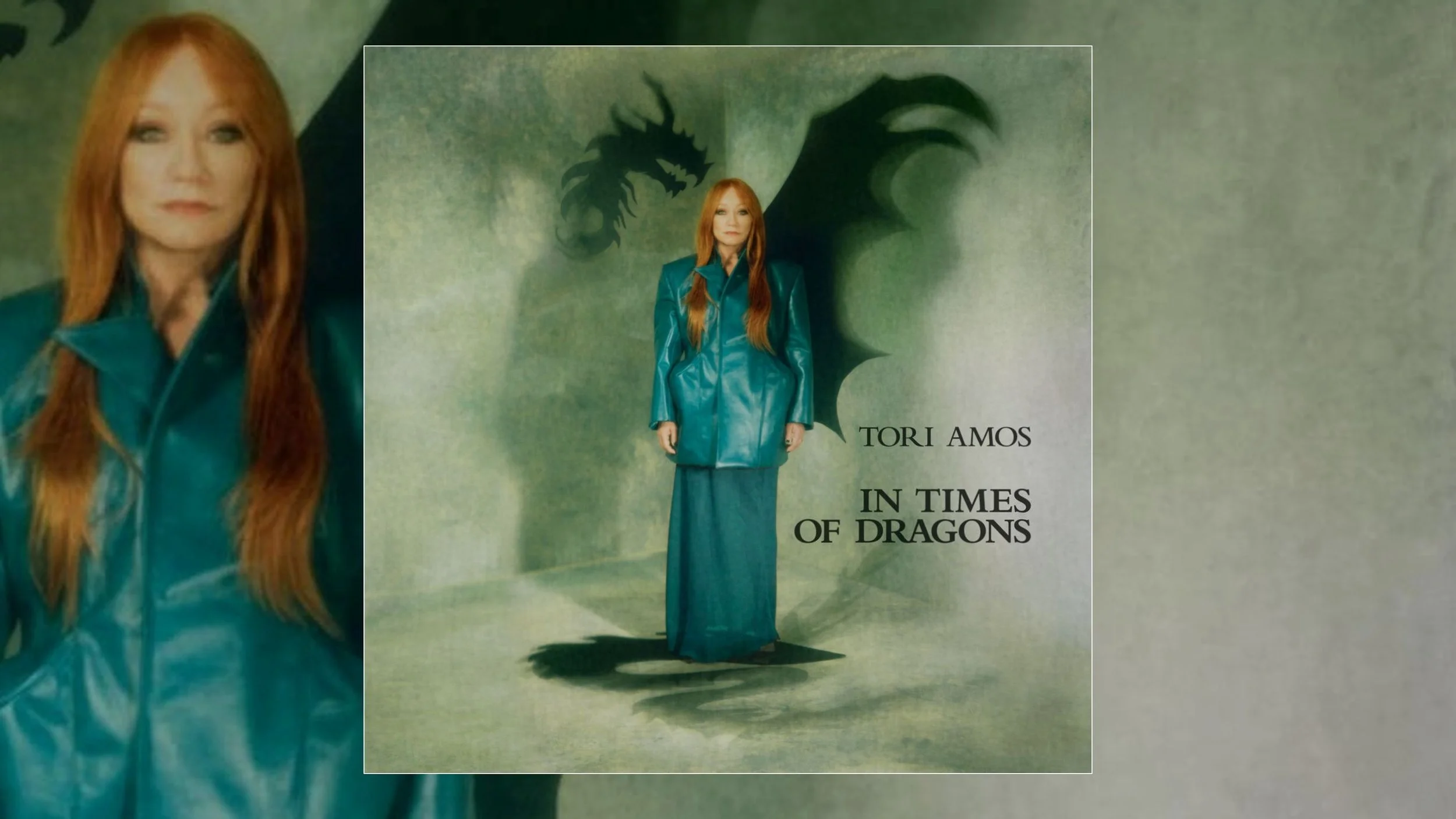
Tori Amos
In Times of Dragons
Fontana
Listen Below

Tori Amos has never been afraid to marry the personal with the political. When she was only 13 years old, she began performing for the politically powerful in piano bars all over Washington, D.C. Under the watchful eye of her Methodist minister father, Amos began learning to both shrewdly and sensitively read the room during her first regular gig at a Wisconsin Avenue gay bar. Her father was surprisingly low-key about the whole arrangement, declaring, “There is no safer place for a 13-year-old girl than in an all-gay bar.” After a while, she moved on to other hotel bars in the city, further honing her craft and figuring out when she could get away with, say, playing Rickie Lee Jones’ “Last Chance Texaco” to a roomful of Big Oil lobbyists.
Her years as a happy-hour pianist played out during the Koch-led Libertarian movement and Reagan’s presidency, and she had a front-row seat to what she describes as “something dark occurring.” “By the time I was 17, I was playing in a hotbed of conservative thinking on its rise to power,” she writes in her 2020 book Resistance: A Songwriter’s Story of Hope, Change, and Courage.
By the time she released her debut Little Earthquakes in 1992, she was taking on the patriarchy with the harrowing “Me and a Gun” about her own sexual assault, as well as songs like “Silent All These Years,” about the heavy toll of repeatedly swallowing one’s truth, and “Girl,” about breaking away from other people’s crushing expectations (“She’s been everybody else’s girl / Maybe one day she’ll be her own”). She then served as the first spokesperson for the Rape, Abuse & Incest National Network (RAINN), the largest anti-sexual violence organization in the United States. Her 2002 album Scarlet’s Walk dealt with post-9/11 politics and American life in the George W. Bush era. And she’s continued to critique and criticize conservativism and its most recent dark, twisted expression in the Trump era.
“Being in opposition to something is to be in a position of power,” she asserts. “It’s not simply reactionary. Defiance can be active and can be the genesis of something. You don’t want to play the victim. You want to have conviction. Because make no mistake: we are living in a moment of crisis. Of unprecedented crises.”
Spanning 17 tracks, Amos’ latest release In Times of Dragons takes the form of an epic, weaving the tale of a woman trapped in an abusive marriage to a slimy, reptilian billionaire husband (modeled perhaps after Peter Thiel, Elon Musk, or Donald Trump himself) and critiques the authoritarian odiousness of our current oligarchy through this allegory. As in Scarlet’s Walk, the heroine winds up embarking on a cross-country journey, where we meet a gay witch from Brooklyn in “Provincetown,” Amos’s usual collection of savvy Southern girls, anti-ICE activists in “Ode to Minnesota,” and a feminist biker gang in “Gasoline Girls.”
Like so many of us living through the sick joke of this current regime, Amos seems at many points on In Times of Dragons at a loss for words and solutions. The opening track “Shush” opens with foreboding drums and dark, ominous piano, and ends with Amos singing, “I know a girl who wrote ‘Silent All These Years’ / Where is she now, where is she now?” Her voice has that beautiful weather-worn, whiskey quality that comes with age and passing time and she sounds legitimately perplexed and crestfallen.
Listen to the Album:
I was an early adopter of Amos’ music, discovering Little Earthquakes upon its release when I was 15 and then sticking by her up to Scarlet’s Walk when I was 25. After that, I moved on to other artists and other genres, not because Amos had strayed from what I had loved about her, but because I think I wanted to preserve my coming of age and young womanhood in those early records. Amos had captured the feelings of that time so perfectly that taking her any deeper into my adulthood felt almost dangerous.
There’s something very comforting about reconnecting with her through this record, though, when we’re both women of a certain age grappling for understanding and hope and meaning at a time when all of these things seem in short supply. “Where am I, where am I?” Amos picks up the question she left off with on “Shush” on the following track, the titular “In Times of Dragons.” “Backed into a corner/ I know that I’m changing / Once I was beauty and I now am the beast,” Amos sings. She seems determined to explore her role in all of this mess, like so many of us have felt compelled to do in Trump’s second term, even if it’s difficult sometimes to look in the mirror—particularly as white people or privileged people or people who have just taken too many things for granted and become stagnant in the status quo.
The mood brightens with “Provincetown,” jangly and tinged with harpsichord, reminiscent of 1996’s Boys for Pele. “Go on girl, grab the lifeline / Build a bridge for those left behind,” Amos urges, accepting responsibility, but with trepidation: “Will I freeze or fawn, will I fight or flight?” Here in Provincetown, our heroine runs into the aforementioned Gay Witch from Brooklyn, who tells her about the Gasoline Girls in a mountain town, and a high priestess who will lead her through a vampire reunion in New Orleans. And so the adventure begins.
“St. Teresa,” one of my favorite tracks, serves synthy, smoky ’80s soundtrack vibes, and I can’t help but think of some of the moodier, mist-heavy montages in, say, Desperately Seeking Susan or Running On Empty. Meanwhile, “Gasoline Girls” is plucky and soaring and fitting of a feminist motorcycle gang—and is just so stereotypically ‘Tori’ in the best possible way. Stalked by henchmen of her lizard-y husband, our heroine stops somewhere in the mountains for the night and is given shelter by the Gasoline Girls, who gather together to sing raucously around the fire.
“Fanny Faudrey” is another fun, bouncy romp featuring a vaudevillian, rollercoaster-ride tale about a 19th-century feminist who runs off to the sea. Meanwhile, showcasing gorgeous vocal harmonies by Amos’s daughter Natashya Hawley, “Strawberry Moon” is wistful and celestial, meditating on the protection of a Celtic god while the heroine continues on her journey. “Pyrite” serves up a little bit of disco funk, while our gal has her tarot cards read by a high priestess in a New Orleans vampire speakeasy and contemplates fiery revenge. “Blue Lotus” blends harpsichord and piano, and provides brooding atmosphere to the protagonist’s decision to give up her scars and let go of some of her pain.
“Stronger Together,” once again featuring harmonies by Natashya Hawley, borrows Hillary Clinton’s 2016 campaign slogan for its title and seems to imagine a time when we’ve made it past our current nightmare. “And we could and we did / And we could together,” Amos sings, apparently to her own daughter. “It’s ok, you’re safe here / Daughter, dear / Yes we could and we did together.” Despite its obvious twinge of sadness, it’s a song of hard-won triumph.
The album ends on “23 Peaks,” with the sound of winds whipping gently through the mountains. It’s glacial and peaceful and its atmospheric synths offer the sensation of summiting. The heroine asks the dragon queens to remove the wings piercing her back and ease her burdens. Instead, she’s led to accept that she’s instead herself become a dragon queen. It’s, obviously, a little Game of Thrones, but the sheer beauty of the instrumentation keeps it from becoming cheesy. Instead, there’s beautiful catharsis.
“Come on, nobody really needed me in the Obama years. [On this album,] the Lizard Demon [character] is based on real people. It’s an amalgamation of men. We’re not mentioning names,” Amos told Rolling Stone. “If you’re going to document our times, the only way is through allegory, I think, to allow other people in so they can join the story.”
Really, though, the overall message is perseverance without cynicism. “I can’t control what they’re doing in New York, in London, in Paris, in D.C., but I can control how I respond to it,” she told Paste. “I can control whether I allow that to bury my heart, whether I allow that to suffocate my heart and my love.”
Notable Tracks: “23 Peaks” | “Gasoline Girls” | “Provincetown” | “Shush” | “St. Teresa”
LISTEN:
