
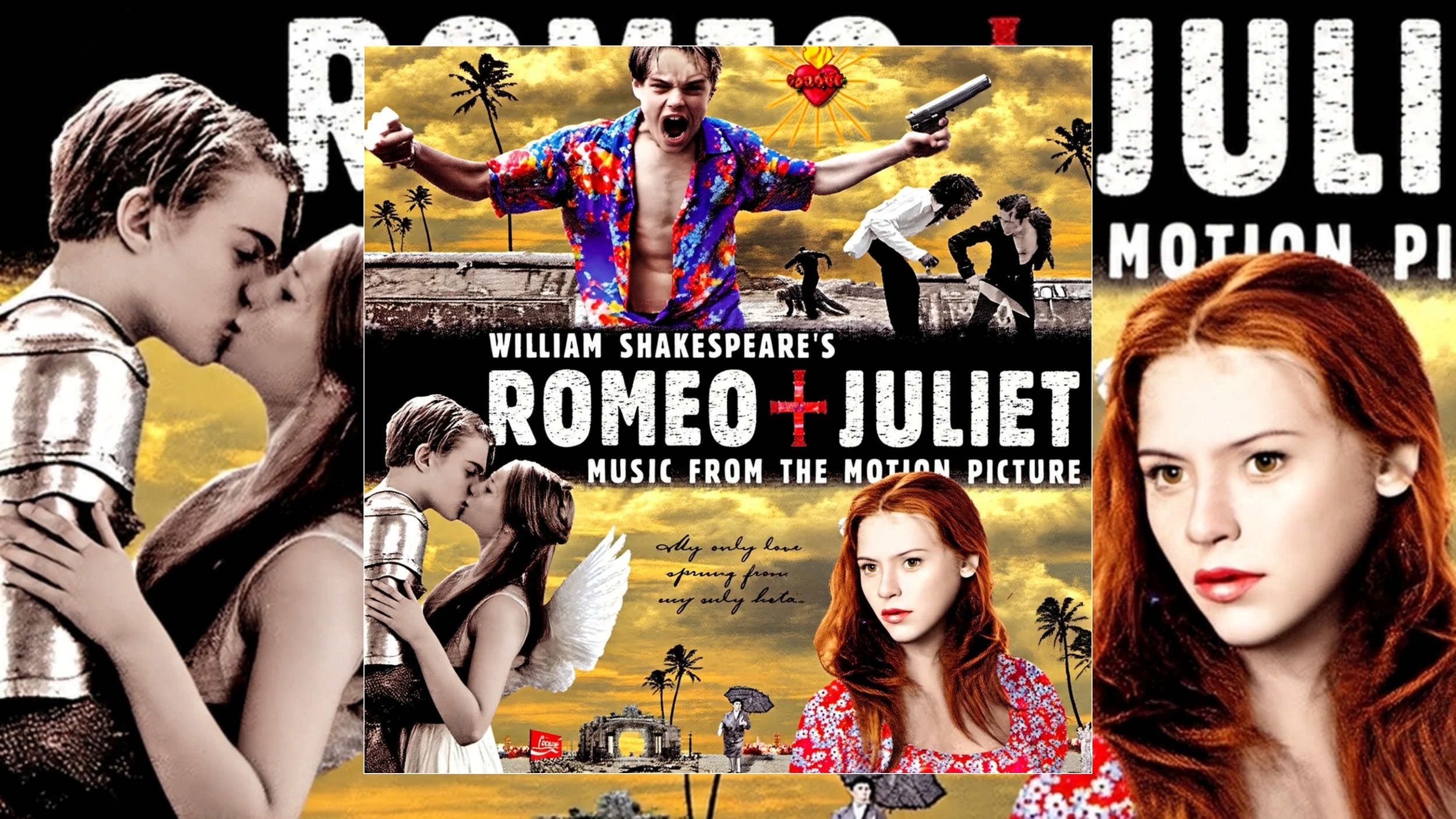
Happy 30th Anniversary to the Romeo + Juliet Soundtrack, originally released October 29, 1996.
The final image we see of Romeo and Juliet in Baz Luhrmann’s Romeo + Juliet is not the pale, lifeless bodies of two suicidal teens lying in a church, but the star-crossed lovers kissing underwater, seemingly crystallized forever in a peaceful, quiet, self-contained moment. Instead of death and inevitable decay, we’re left with the vitality and tranquility of young love. In fact, the underwater scenes that increasingly come to represent the couple’s private world in the film came to Luhrmann when he began recalling his own adolescence. “My father used to talk a lot and we’d be in the pool and I’d just go underwater to hide from him. It was always so peaceful,” he told Arts Beat LA in 1996.
The film, which is otherwise a dizzying technicolor kaleidoscope of MTV-esque images and a mashup of old Hollywood and postmodern movie tropes, depicts the relationships Juliet and Romeo have with their own parents as tedious, confusing, and, ultimately, overbearing. “Their parents are like a Busby Berkeley musical on acid and it’s coming at them all the time and it won’t shut up,” Luhrmann explains. “When you get to Paul Sorvino [as Juliet’s father] in a dress, you just think please—no more. Next thing, Romeo is underwater—click—silence. It’s not a big symbolic thing, but Romeo and Juliet escape into water. They use water for silence and peace and their ‘There’s a place for us’ moments.”
I first saw the film not long after it came out in 1996, and it seemed tailor-made for my inner Shakespeare nerd; in high school, I’d taken two years of a Shakespeare elective with Ms. Bednarz, one of my all-time favorite teachers, and had also starred in a production of A Midsummer Night’s Dream. Even better, the film was bursting with the visual language of my early-’90s, late-Gen X teen years—Duran Duran’s “Come Undone” video (the fish tank, the moody underwater scenes), Nirvana’s In Utero (Juliet’s angel wings, the film’s collage/decoupage effects), Boyz N the Hood (Los Angeles gang culture), and Vanilla Ice’s neon ode to muscle cars and Miami thug life (“Rollin’ in my 5.0, with my ragtop down so my hair can blow”).
By that point, my teenage years were almost in the rearview—I was 19 and in the midst of a gap year between high-school graduation and university. I was working at a restaurant, going clubbing every night, and traveling all over Europe, where I had lived on an American army base in Germany my whole life, during the Cold War and its aftermath. But, really, the chief aim of this gap year was to end my own epic love story before it ended in a tragedy—not in a double suicide like Romeo and Juliet, but more like a teen pregnancy or some awful ’90s version of a tradwife.
It had started when I stepped out of a car in the rain, and it was going to end with boarding a plane to the United States. I’d been raised by a feminist who had married at 19, and she’d told me she’d break both of my legs if I didn’t go to college. I knew she had a valid point.
Still, I found myself quietly weeping throughout the film. When asked if he believed love was the same then, in 1996, as it was when Shakespeare wrote the play, Luhrmann answered affirmatively. “Yes. I think everything human is the same at all times. I don’t think the human condition changes,” he said. “The conditions around us change, but what makes us human beings does not change.”
Listen to the Playlist:
Not everyone falls in love as a teenager. In fact, most people probably date casually, go to Homecomings and the prom with a cast of bit players they feel lukewarm about and, eventually later on in adulthood, finally fall in love with a capital L. But for those of us who do fall headlong, wildly, and recklessly in love when we’re very young, it’s an experience that never quite leaves you. That indelibility is the universal truth of Luhrmann’s Romeo + Juliet—stylized the way someone might have Sharpied it on a late-20th century desk or locker or notebook.
Prior to taking on Shakespeare, Luhrmann had made his directorial debut with 1992’s Strictly Ballroom. Not long after, he couldn’t stop thinking about how Shakespeare himself would make a film in the 20th century; he wanted to examine the Bard’s approach to writing for the theater and translate it into directing a film—that was the concept. The idea then took deeper root when Luhrmann saw a Neil Armfield production of Twelfth Night that set Shakespeare’s play in the modern environment of Club Med, featuring Latin music and champagne handed out to the audience. Rather than using affected English accents, the actors used their own accents and made the language their own.
Luhrmann decided that his project, too, would use the original language in much the same way. “And so I pitched this, and it went horrendously wrong,” he told VPRO Cinema. “Because executive Peter Rice, who now practically runs [20th/21st Century] Fox and is a dear friend, he was so worried that they’d be freaked out that I wanted to use the original language. He said, ‘Great, I love it, Baz, but just don’t mention the language.’”
Luhrmann was ultimately able to convince the studio to take on the project by conducting a videotaped workshop in his native Australia, which he couldn’t have done without Leonardo DiCaprio’s total belief in his vision. Luhrmann knew little about the young actor, but he’d seen photos of DiCaprio and thought he had a rock star quality, a James Dean vibe, a Kurt Cobain essence—something he couldn’t even fully describe—that would make him the perfect Romeo. And once DiCaprio began to act the part, Luhrmann discovered that he was every bit a natural. “He had such an innate ability to take the language, stay within the iambic, and embrace it and make it his own,” Luhrmann observes. “He believes what he says. You believe him.”
DiCaprio was so excited about the idea of the film that he and his friends ended up flying economy class to Australia—paying their own way—in order to create a trailer of sorts that would show the studio what the movie was to be about. “We videotaped the workshop and when they saw the young lads running around in Latin costumes and suits, they finally got it—‘It’s kind of about gangs,’” Luhrmann recalls.
Once the project got the green light, Luhrmann was then faced with finding a Juliet who could hold her own opposite DiCaprio. He first auditioned Natalie Portman, who was only 13 at the time—the same age that Juliet is supposed to be in the play. Although DiCaprio looked young for his age, he was 21 by the time the movie was made, which meant the whole thing was going to come across incredibly sordid. "Fox said it looked like Leonardo DiCaprio was molesting me when we kissed," Portman told the New York Times in 1996.
Fortunately, for the sake of the film, Luhrmann aged up the characters, and began searching in earnest for a Juliet who could be youthful and naïve, whilst possessing a certain emotional maturity, and also looking age-appropriate beside DiCaprio. It was a tall order. “And then Jane Campion [director of The Piano] said, ‘Have you seen this girl on My So-Called Life? She’s so mature for her age,’” Luhrmann remembers. “Claire Danes. I met Claire Danes and what was great was that, like Juliet, she was wise beyond her years.”
As for some of the other characters, Luhrmann decided to modernize them in particularly delightful ways. Juliet’s suitor Count Paris, played in an understatedly hilarious manner by Paul Rudd, is given the humdrum, pedestrian name “Dave Paris” in the movie. Friar Laurence, portrayed by Pete Postlethwaite, sports a ginormous back tattoo (an intricate Celtic cross) and is surprisingly hot for a middle-aged man of the cloth.
Meanwhile, John Leguizamo plays Tybalt like a debonair bullfighter who also drives a low rider. "I was sexy in that motherfucker. I was sexy as a motherfucker," he boasted to Entertainment Tonight this past summer.
And, perhaps most memorably, Mercutio, played by Harold Perrineau, is depicted as a gender-fluid Black man who attends the Capulets’ soirée in full-on drag. “First, there’s no question that Mercutio’s in love with Romeo, which does not mean he’s gay in an ‘out’ kind of way,” Luhrmann explains. “But he’s definitely jealous of Romeo’s love for Juliet. Second, he’s a flash of lightning character whose energy is going to get him killed. So, when they go to the costume party, he’s the one who’s going in a dress, and he was so incredibly flamboyant, so much fun.”
The film was shot on a tight budget and, to that end, the cast and crew headed to Mexico—Mexico City and Veracruz—with both economy and the movie’s Latin aesthetic (meant to evoke a hybrid of Miami and Brazil) in mind. It ended up being an adventure, to say the least. “First let me say I would not swap a day that I spent in Mexico for anything in the world. It was the most adventurous time,” Luhrmann asserts. “Having said that, it is true we were there months longer than we needed to be. We had hurricanes that wiped out the set. We all got sick. Shooting shut down for a week while I had a temperature of 110.”
But probably the craziest thing that happened was when the movie’s makeup artist, Aldo Signoretti (most famous for having worked with Fellini), was kidnapped by a group of bandidos who demanded $300 in ransom to get him back. One of the film’s crew members went to a hotel to meet them with the wad of cash, and the bandidos grabbed the money and threw Signoretti out of their car, breaking his leg.
As for some of the other unfortunate events, Luhrmann tried to embrace them and use them in the film. For example, the storm in which Mercutio dies, after cursing Romeo with “a plague on both your houses,” was a hurricane that destroyed the set. “For a budget of ours, which is between $15-17 million, you can’t achieve that short of massive CGI’s,” Luhrmann says, finding the silver lining.
Luhrmann knew from the beginning that the soundtrack would be an important element of the film, and therefore he recruited Massive Attack producer Nellee Hooper to curate it. Luhrmann approached Hooper after becoming aware of his work on Björk’s “Venus As A Boy,” and, alongside composers Craig Armstrong and Marius DeVries, Hooper also helped compose the score.
Shakespeare often used popular music of the Elizabethan era in his own productions, and therefore it was decided that modern pop music would play a similar role in the film. 1996 was, however, sort of a strange time for popular music; the grunge and alternative rock that had dominated the first half of the decade was dying down, and so many of the more successful and memorable soundtracks of the mid-’90s—Empire Records, Clueless, Trainspotting, Stealing Beauty—all seemed to embrace a much more eclectic mix of genres. Romeo + Juliet was no exception, including everything from the syrupy sweet “Lovefool” by the Cardigans, Radiohead’s melancholic “Talk Show Host,” Des’ree’s lovelorn “Kissing You,” Stina Nordenstam’s twee “Little Star,” and the dark, trip-hoppy “#1 Crush” by Garbage.
“Nellee’s always been a great cultural curator,” asserts Justin Warfield, whose band One Inch Punch was included on the soundtrack after he met Hooper through mutual friends in London. “We were going out to clubs and then back to his for an afterparty. The songs that ended up on the soundtrack were being beta-tested in the living room at 5 a.m. When I saw the movie, I was like, ‘This is the sound of that summer in London.’”
In Romeo + Juliet, there’s an intoxicating interplay between the film’s two extremes—the frenzied, grandiose spectacle and the vulnerable, hushed intimacy of its romantic moments. The soundtrack is necessary to both, and it succeeds as an independent listen specifically because it offers a collage of, and meditation on, the emotions the film has already wrought. You might not remember exactly when “Little Star” appeared in the movie, but you remember the specific feeling on the rollercoaster that it evoked.
The soundtrack opens with Garbage’s sauntering, swaggering “#1 Crush,” which at first just sounds vaguely edgy and dangerous and sultry until you realize that it’s about an obsessive, stalkerish kind of love. Then you gradually come to realize that these two crazy kids, Romeo and Juliet, barely knew each other for 24 hours before they decided to get married. (The life expectancy in Elizabethan times was significantly shorter, so I guess there was less time to waste, but, you know, it’s still a little…unsettling?)
Next up is Everclear’s “Local God,” which is a loping ode to being a dude who hangs out in a pack of dudes: “I feel just like a local god when I’m with the boys / We do what we want, yeah we do what we want.” It evokes the Montague boys, their perfectly draped Hawaiian shirts, and Leonardo DiCaprio’s highlighted foppish mop. Not to be a total snob, but if this song weren’t tied to this movie, it would simply be representative of a specific kind of brainless, post-grunge, mid-’90s bratty bro-rock. But because it is tied to this movie, I kind of like it.
The mood immediately shifts with the warm, shimmery “Angel” by Gavin Friday, which sets the anticipatory, romantic mood for the big costume ball at the Capulets’ mansion. It’s very Claire Danes gazing starry-eyed at the moon on the balcony, DiCaprio looking like a teenage dream even before Titanic officially made him one, and lots of quietly exploding golden fireworks.
And then we get some whiplash with One Inch Punch’s industrial-rap mashup “Pretty Piece Of Flesh,” which the Montague boys sing as they’re about to engage in a shootout at a gas station with the Capulet gang. The song lends a strange, steely postmodern feel to the collection, reflecting the sense of not knowing exactly where—or when—we are in Romeo + Juliet, just that it feels familiar and distinctly urgent.
And then, my god, here comes Des’ree’s “Kissing You.” There’s no way you can hear this song and not relive the aquarium scene, that sublime moment when Romeo is engrossed in watching the neon fish in all their tranquility, and then suddenly there’s Juliet’s eye, framed by jagged coral, and then suddenly her young, open, beautiful face. It’s an unforgettable scene of innocence, sweetness, and vulnerability. And Des’ree’s heartfelt ballad captures the sentiment beautifully.
Just when you’re about to melt into a puddle of tears, the Butthole Surfers come galloping in with “Whatever,” evoking a gloomy Spaghetti Western. It’s road dust on the windows, static on the radio, and a grim determination to keep on going.
The mood changes abruptly yet again with the saccharin disco groove of the Cardigans’ “Lovefool,” a happy-yet-mopey pop confection about craving the presence of one’s beloved more than the love itself. It’s a perfect addition to the soundtrack, simply because it reminds us that, no matter how seriously we take Shakespeare, Romeo and Juliet are teenagers, and teenage love is often goofy as hell, no matter how pure or exquisitely portrayed.
Next, Kym Mazelle’s version of Candi Staton’s “Young Hearts Run Free” offers an updated version of some actual disco of historical ’70s ilk, and it serves as the perfect backdrop to Mercutio’s joyous drag performance at the Capulets’ costume party. Meanwhile, Rozalla’s Eurodance hit “Everybody’s Free (To Feel Good)” takes the song out of Ibiza and gives it the ballad treatment by young Quindon Tarver, the baby-faced choirboy who appears at several points in the film and charmed audiences with his impressive pipes.
Mundy’s “To You I Bestow” is jangly, Irish-accented, and starts out abrupt and grating, but then turns swoony and deeply heartfelt. “Kiss me and tell me it’s not broken,” is the chorus that we know will end in the film’s irreparable tragedy. It’s followed by Radiohead’s pensive, atmospheric “Talk Show Host.” “I want to, I want to be someone else or I’ll explode”—it’s an opening line reminiscent of “Creep,” and its defiant self-loathing anchors the story in a distinctly Gen X milieu.
Stina Nordenstam’s “Little Star” starts out acoustic and twee, barely strummed, a tiny lullaby that slowly flowers into a jazzy, waltzing expanse. (It’s the kind of song you want your crush to put on a mix tape.) The soundtrack then ends with The Wannadies’ “You And Me Song,” a perfect closer that explodes into a dizzying, exuberant ode to first love—like riding the Tilt-A-Whirl, or taking your fortieth lap around the roller rink, or barreling down the highway, hair billowing in the breeze.
“When you’re fifteen, you’re likely to do something stupid. You know?” muses Luhrmann of his—and Shakespeare’s—masterpiece. “Most of us survive that and we grow up and we understand that love is really like a dangerous sports car that you’ve got to learn to drive, otherwise you end up going over the edge of the road on it. And I think those of us that survive look back upon that story with a kind of warm nostalgia. We think, ‘Oh yeah, I remember that.’ That’s part of the appeal.”
Listen:
