
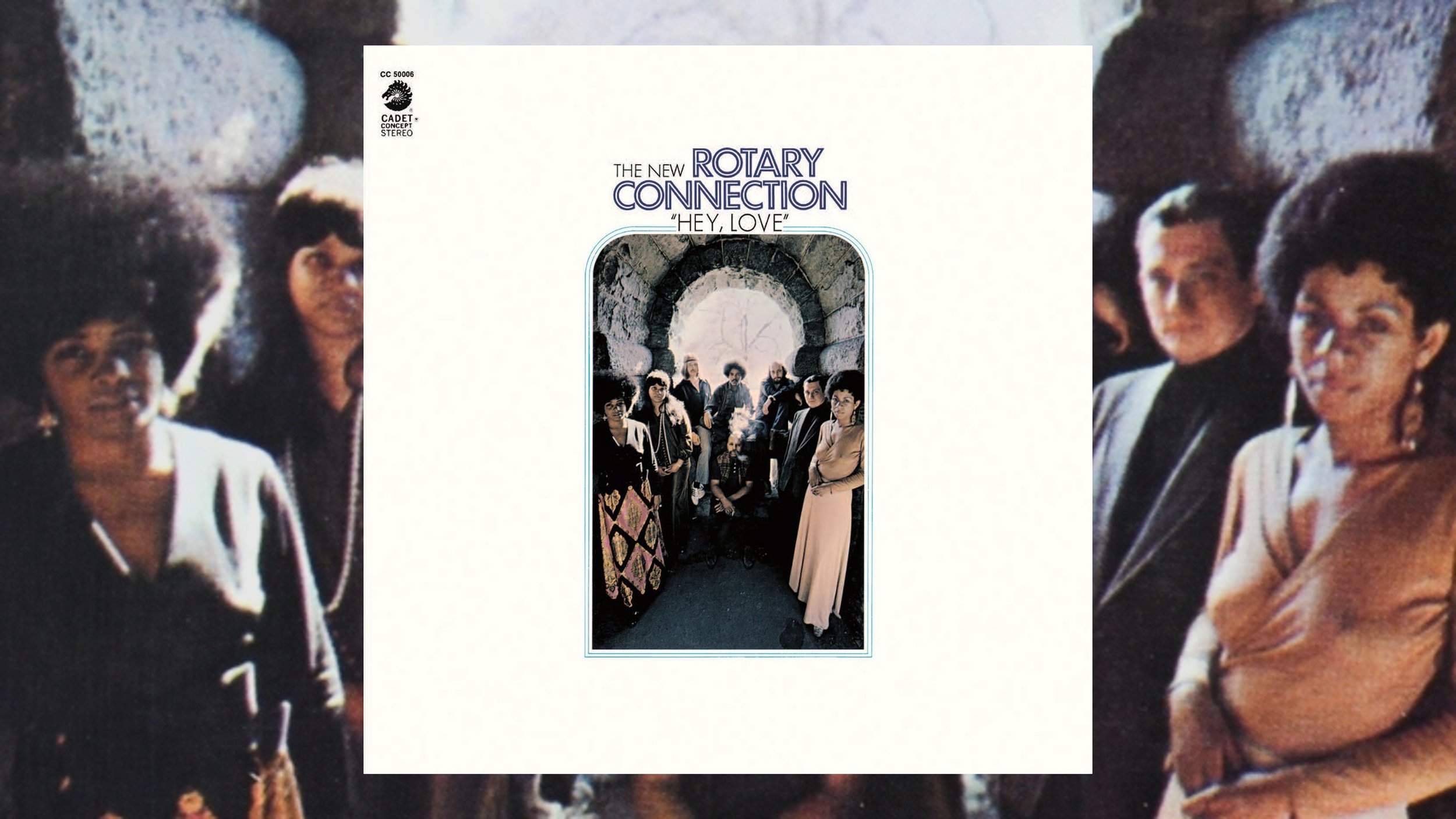
Happy 55th Anniversary to Rotary Connection’s sixth & final studio album Hey, Love, originally released in August of 1971 (specific date N/A).
The story of Chess Records is essentially a history of mid to late 20th Century America. Lejzor and Fiszel Czyz were brought to the US by their parents from Poland in the late 1920s, when they were both young children. Having anglicized their forenames to Leonard and Phillip and their surname to Chess, they were part of the huge wave of European immigrants that entered the US in the first half of the twentieth century. Settling in Chicago, their father Joseph became a “businessman,” embroiled in the Prohibition era liquor business, under the iron fist of Al Capone. As Phil and Leonard emerged as adults in post-war Chicago, they chose the record business as a more legal, but equally shady venture.
Initially, they specialized in RnB but they soon became most associated with blues music, drawing upon the musicians who had poured north during the Great Migration (go and grab a copy of Isabel Wilkerson’s incredible book The Warmth Of Other Suns if you want to know more). Many of these musicians had come to Chicago from Mississippi—as the character Stack from Ryan Coogler’s modern classic Sinners says, “Chicago ain’t nothin’ but Mississippi with tall buildings.” The roster of talent was incredible—Muddy Waters, Etta James and Howlin’ Wolf were but three. Perhaps most importantly of all though, was the presence of Willie Dixon. He wrote, produced and played on countless records—he was the creative center that others revolved around.
When Marshall Chess (Leonard’s son) followed in the family business, he saw that the music world was changing and tried new things, like trying to reinvigorate the blues. As the label created subsidiaries and changed the names thereof, one thing remained though—the wisdom to use the very best talent available to run the show. As Willie Dixon was to the blues, so Charles Stepney was to later output.
Chief among the new directions Marshall wanted to explore on the label was a soulful psychedelia that drew from the “alternative” movement of the late 1960s, played by Chess session players and local rock musicians alongside vocalists that included a receptionist from the record company, all of which was concocted under the assured, inspired guidance of Stepney.
Rotary Connection emerged in 1967 with a self-titled debut that was, to put it bluntly, gloriously, riotously bonkers and was followed by two more albums that didn’t quite make waves in the same way. With a changed lineup and slightly changed name (The New Rotary Connection) they returned in 1971 with their best, and final, album Hey, Love.
Of course, I’ve been a little disingenuous by describing one of the vocalists as a receptionist. The iconic Minnie Riperton had, by now, released her debut solo album Come To My Garden (1970) and so you might be forgiven for thinking that she would dominate vocal proceedings here on Rotary Connection’s swansong. But that debut hadn’t set the world alight (it would gather praise more readily in retrospect) and the vocal duties are much more evenly spread.
Listen to the Album:
It is strange to come to the album after having discovered Riperton’s solo work—when I listened for the first time, I expected it to be filled with lead vocals from the future superstar in the making. But she’s often found to be providing astonishing color in Stepney’s wonderful arrangements with her incredible range and soulful soprano. Instead, vocals are shared by Dave Scott, Kittie Haywood and Shirley Wahls and all three of them shine in ways that make you wonder where they went after the band parted ways.
Binding it all together is the genius of Stepney. Not content with writing the majority of the songs (with occasional input from Richard Rudolph), his arrangements are dramatic and capable of such ecstatic highs, that at times it feels like the listener is undergoing Damascene transformation. Some of the more outrageous and calculatedly bonkers stuff from earlier Rotary Connection albums has been culled and he revels in the chance to show the full gamut of his considerable talents.
The major theme of the album, as befits the era it grew out of, is “peace, love and understanding” and the string and heavenly vocal arrangements only serve to underscore that. On album opener “If I Sing My Song” there’s more than a hint of Bacharach and David to the horn arrangement and the earliest example of the swooning strings that appear throughout.
Dave Scott’s voice is the major player on the first half of the album and on “The Sea And She” it dominates a song that sounds like it belongs in the musical “Hair”—that archetypal “flower power” vibe runs through it. The first part of “Hanging Round The Bee Tree” sounds like something that Sade might produce until around the two-minute and fifteen-second mark, when the orchestration breaks free and sends things skyward—Stepney’s arrangements are so beautifully intense.
Towards the end of the album is a delightful take on Terry Callier’s folk sound on “Song For Everyman,” replete with wondrous backing vocal arrangements and on “Hey, Love” there’s further proof of Stepney’s ability to create piano hooks that stay long in the memory. And yet all these beauties pale in comparison to the two towering behemoths that sit astride the album like giants.
When I prepare to write one of these retrospectives, I grab a notebook and a pen or pencil and listen intently. As each song passes, I scrawl ideas, reactions and thoughts (both new and old) into my notepad and then begin to type. As I sit here looking at my notes for both “I Am The Black Gold Of The Sun” and “Love Has Fallen On Me,” all I can see is a series of exclamation points. I feel like that overenthusiastic text messager in all our lives who punctuates every single sentence with a wild array of exclamation points—but those two songs are worth every single one of them.
“Love Has Fallen On Me” was written by Stepney and Lloyd Webber, a Chess writer, and features a piano line for the ages with the most delightful vocal arrangements you could ever wish for. I can pay no higher praise than to say I prefer this over Chaka Khan’s more famous cover. Do you know how insanely good something has to be to not be improved by Chaka Khan singing it? There’s certainly a looser texture to the original here and, as throughout the album, Stepney’s genius for vocal arranging is on display.
The pinnacle though is the otherworldly and incandescently magnificent “I Am The Black Gold Of The Sun.” It’s really difficult (and decidedly inconvenient!) to put into words how much I love this song. That the delicate Spanish guitar gives way to furious scuzzed-up guitar work is but one of the many reasons I love it. I’m assuming that Phil Upchurch is playing the guitar, though I am not sure. But whoever it is, it is funky, nasty and enthralling in its entirety.
And then there are the vocals! Dave Scott takes lead and towers above it all, even finding time for a laugh that sounds like an omnipotent God gazing down at his puny subjects, impressed with his own powers. The euphoria of the backing vocals is astonishing and combined with everything else is enough to make you believe in divine intervention.
As time goes by, I long for more people to take the path that I have in coming to recognize Charles Stepney’s genius. Certainly, thanks to his hard-working family, there have been events recently to commemorate and awaken people to his unique talents but, still, he merits so much more recognition. Yet despite all my love for Stepney, the success of this album is undoubtedly a combination of his genius, an outstanding band and vocal talents capable of almost anything. Do yourself a favor, play this album and float heavenwards.
Listen:
