
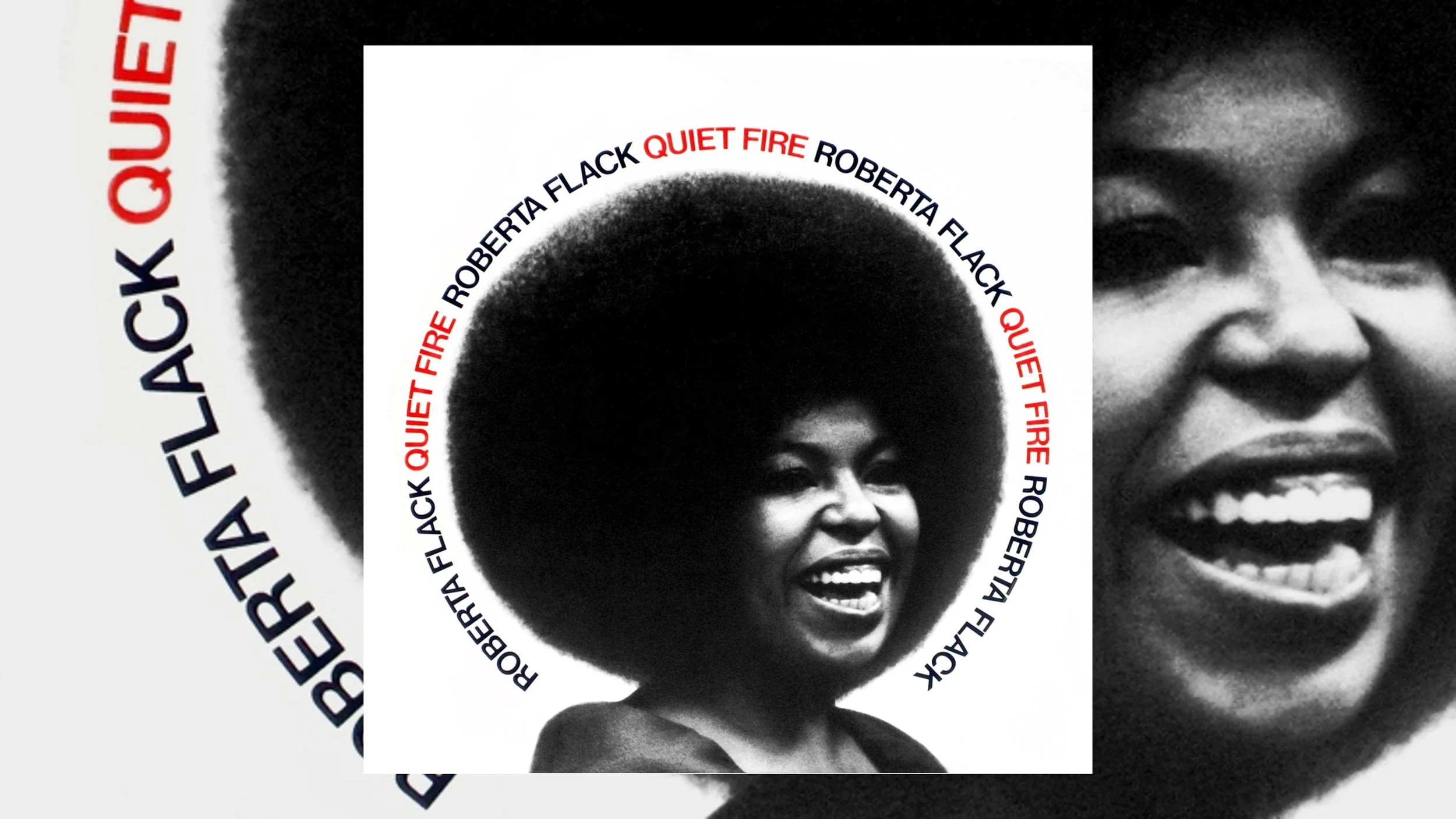
Happy 55th Anniversary to Roberta Flack’s third studio album Quiet Fire, originally released in November 1971.
There is something almost confrontational about the gentleness of Roberta Flack. At a time when musical greatness was frequently measured through vocal athleticism, theatrical excess and the capacity to overwhelm an audience, Flack pursued something considerably more demanding. She understood that a voice could communicate its greatest truths without raising its volume, that a piano could expose the emotional complexity of a lyric, and that silence, when placed with sufficient intelligence, could become an instrument of extraordinary consequence.
Released in November 1971, Quiet Fire, her third studio album, remains among the most compelling examinations of that philosophy. Fifty-five years later, its sophistication feels almost provocative, particularly in a musical culture increasingly conditioned to mistake immediacy for substance.
Produced by Joel Dorn and recorded across Atlantic Recording Studios, Regent Studios and The Hit Factory in New York City, Quiet Fire arrived during an extraordinarily fertile period in American music. Soul was becoming increasingly adventurous, jazz musicians were reconsidering traditional structures, and popular songwriting was beginning to accommodate more complicated expressions of intimacy, politics and personal uncertainty. Flack occupied these musical disciplines with an assurance that made their distinctions seem largely irrelevant.
Her classical training provided the technical authority, but it was her understanding of human behavior that made the performances truly remarkable. Flack never appeared particularly interested in demonstrating what her voice could accomplish. She was more concerned with what it could reveal.
The album opens with "Go Up Moses," a composition credited to Flack, Jesse Jackson and Dorn, immediately establishing that Quiet Fire would not confine itself to romantic introspection. Drawing upon the biblical language of liberation and the African American spiritual tradition, the recording carries an unmistakable political consciousness. Its rhythmic insistence and gospel character connect the struggle for freedom with the social upheavals of contemporary America. Flack's performance possesses authority without becoming declamatory, recognizing that conviction need not surrender its musical intelligence.
Her interpretation of Paul Simon's "Bridge Over Troubled Water" is an altogether different proposition, and one that deserves to be celebrated. Extended beyond seven minutes, the familiar composition becomes an almost private meditation on devotion and emotional responsibility. Where Simon & Garfunkel's recording builds towards an expansive declaration of reassurance, Flack approaches the material through patience and considered phrasing, unlike any other version I have heard. The arrangement allows individual sentiments to settle before introducing another, transforming a widely recognized song into something profoundly personal, hauntingly beautiful and utterly exquisite.
Listen to the Album:
That ability to reconsider established material without disrespecting its origins remains fundamental to Flack's artistry. She understood interpretation as an intellectual and emotional undertaking, a responsibility, if you like, rather than an opportunity to embellish someone else's achievement.
Gene McDaniels' "Sunday and Sister Jones" introduces a darker narrative sensibility. Its portrait of mortality and human connection is delivered with an unsettling composure, the understated musical treatment allowing the story's implications to emerge without unnecessary sentimentality. Flack resists the temptation to instruct the listener how to feel, trusting the composition's inherent sadness and the intelligence of those receiving it.
Jimmy Webb's "See You Then" offers another example of her remarkable sensitivity to lyrical ambiguity. The performance considers separation without treating it as an occasion for exaggerated despair. There is dignity in its emotional uncertainty, an acknowledgement that affection can survive even when circumstances make its continuation impossible.
One of the album's most revealing reinterpretations comes with Carole King and Gerry Goffin's "Will You Still Love Me Tomorrow." Originally recorded by The Shirelles in 1960, the composition had already established itself as an enduring examination of sexual vulnerability and the uneasy relationship between desire and commitment.
Flack approaches the song from the perspective of someone who understands the consequences of its central question. Her phrasing introduces hesitation where another singer might seek reassurance, allowing the uncertainty to become increasingly uncomfortable. The result is devastating precisely because she refuses to manufacture devastation. Released as the album's only single, backed with "Go Up Moses" in December 1971, it reached #76 on the Billboard Hot 100.
The Bee Gees' "To Love Somebody" is given equally thoughtful treatment. Flack's extended interpretation draws attention to the emotional imbalance within the lyric, particularly the loneliness of loving someone whose understanding remains painfully incomplete. The arrangement moves with deliberate restraint, allowing the tension between longing and resignation to develop organically.
"Let Them Talk," written by Sonny Thompson, introduces a welcome change in temperament. Its blues inheritance provides Flack with an opportunity to exercise a more conversational authority, suggesting a woman sufficiently comfortable in her own decisions to disregard the judgements of others. There is an appealing directness to the performance, although the album's consistently measured pacing occasionally risks diminishing the contrast between its individual compositions.
Closing with Van McCoy's "Sweet Bitter Love," Flack delivers one of the record's most stirring performances. In just over six minutes, she examines the contradictions of romantic attachment with an almost uncomfortable clarity. Love is neither idealized nor condemned. Instead, it is understood as an experience capable of offering extraordinary tenderness while inflicting equally profound disappointment. Her vocal control becomes inseparable from the song's emotional meaning.
The production throughout Quiet Fire deserves particular recognition. Dorn's sympathetic approach preserves the intimacy of Flack's performances while allowing the arrangements sufficient musical complexity to reward repeated listening. Her piano playing remains integral to that relationship, establishing harmonic and emotional foundations rather than merely accompanying the vocals.
The contributions of musicians including legendary jazz bassist Ron Carter and backing vocalist Cissy Houston (mother of the late Whitney) further demonstrate the caliber of the recording environment. Carter's rhythmic intelligence and Houston's gospel-rooted vocal experience belong to a musical conversation in which individual virtuosity serves the collective interpretation. Nothing feels unnecessarily ornamental.
Commercially, Quiet Fire reached #18 on the American Billboard album chart and subsequently earned Flack a GRAMMY Award nomination for Best Pop Vocal Performance, Female. Yet its importance cannot be adequately explained through chart positions or industry recognition.
The album preceded the enormous mainstream success of "The First Time Ever I Saw Your Face" and "Killing Me Softly with His Song," recordings that would establish Flack as one of the defining popular vocalists of the 1970s. What Quiet Fire demonstrates is that the artistic principles behind those achievements were already fully formed.
Her subsequent influence can be heard in the emotional precision of Sade, the interpretative intelligence of Anita Baker and the intimate, jazz-informed approach of contemporary artists such as Lianne La Havas. Within neo-soul, particularly, Flack's refusal to separate musical sophistication from emotional accessibility helped establish a vocabulary that successive generations would continue to explore.
Following her death in February 2025, revisiting Quiet Fire carries an additional poignancy. Yet reducing the album to an exercise in remembrance would diminish its considerable artistic independence. Flack's achievement was never dependent upon nostalgia, nor does her music require the sentimentality that so frequently accompanies the reassessment of departed artists.
Fifty-five years after its release, Quiet Fire remains an unusually mature account of what it means to love, question, endure and occasionally accept the absence of resolution. Its greatest distinction is Flack's refusal to simplify those experiences for the convenience of an audience. She recognized that the most difficult emotions rarely announce themselves with any particular grandeur.
Sometimes they arrive quietly, remain longer than expected, and change our understanding of everything that preceded them.
Listen:
