
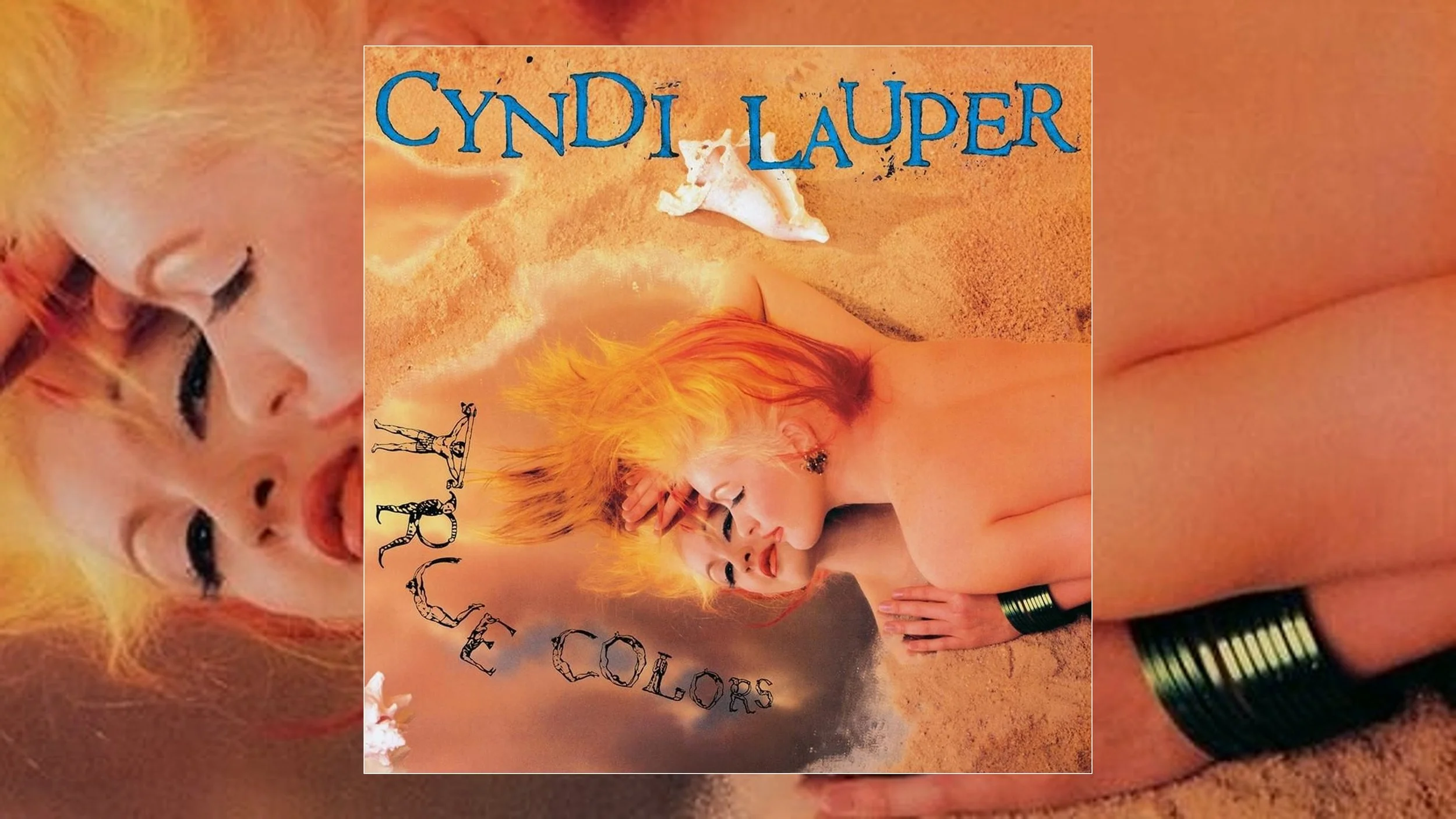
Happy 40th Anniversary to Cyndi Lauper’s second studio album True Colors, originally released September 15, 1986.
Forty years later, the most revealing thing about Cyndi Lauper’s True Colors may be how little interest it has in repeating the record that made her famous. In 1986, that was hardly the safest decision. She’s So Unusual (1983) had turned Lauper into an international phenomenon, selling in extraordinary numbers while making her voice, clothes, humor and wonderfully elastic relationship with pop convention instantly recognizable.
The industry wanted proof she could do it again. Lauper responded by making something more exposed, more unsettled and considerably more adult.
Released on September 15, 1986, True Colors captures an artist discovering that enormous success does not necessarily bring certainty. Produced by Lauper with Lennie Petze, the album carries a fascinating tension between confidence and emotional disarray. There is chaos and angst roaming through these songs, but also the exhilarating force of someone realizing she has earned the right to say something. If She’s So Unusual introduced Lauper as an explosion of personality, True Colors asked what existed beneath it.
“Change of Heart” makes that distinction immediately. Its upbeat introduction gives way to a muscular, guitar-heavy arrangement, with Nile Rodgers bringing characteristic precision and The Bangles adding backing vocals. Yet the production never feels overly polished. Lauper attacks the song vocally, stretching syllables and allowing frustration to become part of its rhythm. That closing guitar passage remains tremendous, pushing the track towards an almost rock-like release.
“Maybe He’ll Know,” originally recorded during Lauper’s Blue Angel years, reaches further backwards. Its doo-wop inflections and Billy Joel’s backing vocals create a deliberate conversation with 1960s pop, while Lauper sings with an ache that prevents nostalgia from becoming decorative. She understood something fundamental about older popular music: beneath all those immaculate harmonies were frequently songs about waiting, wanting and humiliation.
That emotional exposure deepens considerably with “Boy Blue.” Written for a close friend who was dying of AIDS, it is difficult to separate the song from the period in which it appeared. Lauper does not turn grief into spectacle. Her vocal sounds bruised, at points almost resistant to the melody carrying it forward. In 1986, when AIDS was still surrounded by grotesque levels of fear, misinformation and moral judgement, such tenderness had cultural weight.
And at the center of this album sits its namesake, “True Colors.”
Billy Steinberg and Tom Kelly wrote it, but Lauper somehow made the song inseparable from herself. The arrangement is exquisitely restrained, allowing space around a vocal that abandons much of the eccentricity people had come to expect from her. She does not overpower the lyric. She protects it. That distinction changed everything.
Listen to the Album & Watch the Official Videos:
For many listeners, particularly those who felt different before they possessed the language to explain why, “True Colors” became something more intimate than a hit record. I was a child approaching my teenage years when it arrived, and it spoke to something in me that I could not yet process. Only much later did I understand how the song had quietly accompanied me through complicated years, when identity, belonging and self-acceptance were still taking shape. Great music sometimes reaches us before we understand what we need from it. “True Colors” did that for me and many others.
“Calm Inside the Storm” follows with an intriguing contradiction built into its title and arrangement. Written by Lauper and Rick Derringer, it is restless rather than serene, its emotional temperature shifting beneath the surface. Lauper’s voice is especially effective when she allows its natural rasp to interrupt the sweetness, a reminder that vulnerability on this album is rarely presented neatly.
Her decision to record Marvin Gaye’s “What’s Going On” was equally revealing. For an artist only two albums into her solo career, taking on something so culturally revered could have been disastrous. Instead, Lauper approaches it without attempting imitation. The production belongs unmistakably to the 1980s, but her performance respects the song’s moral seriousness. The unexpectedness is precisely what makes it work.
“Iko Iko” provides another excursion into musical history. Its apparent simplicity disguises a far more complicated cultural lineage, and Lauper treats its rhythmic language as something wonderfully physical. “The Faraway Nearby,” with Aimee Mann on backing vocals, is stranger still. There is an almost country-like contour to parts of it, filtered through synthetic textures that make geographical distance feel emotional rather than literal.
“911” introduces nervous humor into the album’s second half, its frantic construction sounding like anxiety translated into pop mechanics. Lauper has always understood that wit and distress can occupy the same sentence, sometimes because one is necessary to survive the other. “One Track Mind” closes the record in gloriously concentrated 1980s form. Synthesizers, percussion and futuristic studio textures pile together without apology, ending True Colors not with resolution but momentum.
The album reached #4 on the Billboard 200 and sold around seven million copies worldwide, impressive figures that nevertheless existed beneath the colossal commercial shadow of She’s So Unusual. Yet judging True Colors merely as the second chapter of Lauper’s sales story misses its significance.
Lauper helped expand the possibilities of what a female pop star could look, sound and behave like in mainstream culture. Her visual identity was theatrical without being passive, funny without diminishing her intelligence, feminine without asking permission from conventional ideas of desirability. Annie Leibovitz’s album photography understood that complexity. Lauper could be colorful without being frivolous, eccentric without becoming a novelty.
More importantly, her advocacy would prove that the compassion heard on True Colors was not a marketing device. Her enduring relationship with the LGBTQ+ community gave the album’s title song an extraordinary second life, one that continues decades beyond its original chart run.
At forty, True Colors sounds like the point where Cyndi Lauper decided fame was less interesting than meaning. It is imperfect, occasionally unruly and stylistically restless, which is precisely why it remains so compelling. You can hear youth colliding with responsibility, celebrity colliding with conscience, and a remarkable voice discovering that its greatest power might not be how loudly it could sing, but whom it was willing to sing for.
For those of us fortunate enough to hear it in 1986, its anniversary carries another truth. We did not simply watch Cyndi Lauper find her voice. In ways some of us would only understand years later, her fearlessness helped us find ours.
Listen:
