
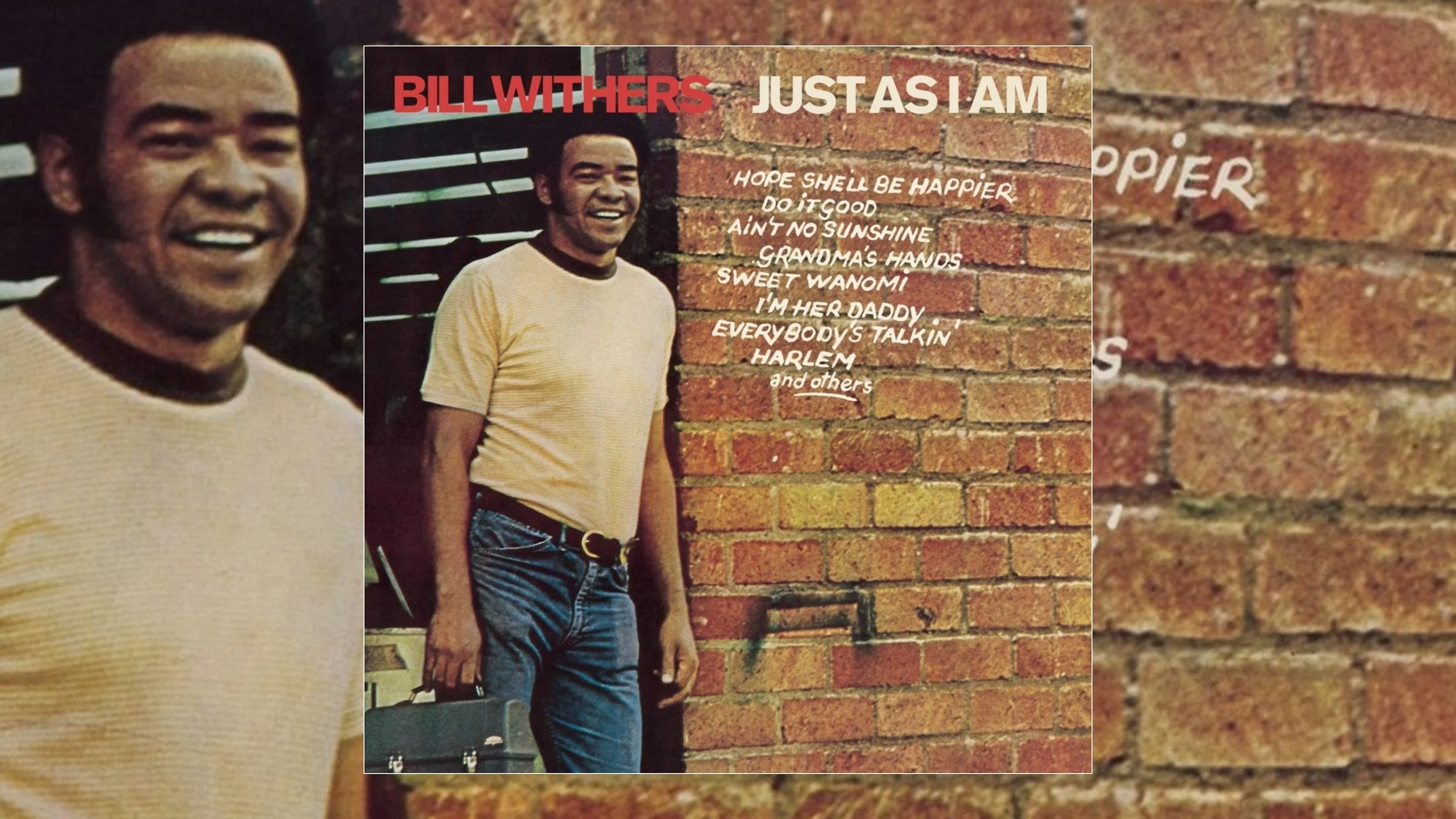
Happy 55th Anniversary to Bill Withers’ debut album Just As I Am, originally released May 1, 1971.
In the early 1970s, the R&B/soul landscape was crowded with polished performers, artists shaped by years of touring and perfecting their craft. To say Bill Withers’ arrival on the scene was unconventional is an understatement.
He worked nine years on assembly lines installing toilet seats in Boeing 747s before ever entering a recording studio. Upon arriving at Sussex Records in 1971 to record Just As I Am, his debut album, he brought his working-class life story with him. You could even hear it in his songs. This debut album became one of the most subtly groundbreaking releases in music history.
Staying true to his blue-collar roots, Withers kept his job at the factory after the release of the album. In 1972, in an interview with Clayton Riley, he said, “I don’t take much of it seriously, you know? I mean, look, I’m really a factory worker. That’s a real job. This thing I’m doing now, hey, it’s a break, just a break. I don’t expect to be here very long.”
After hearing Withers’ demo tape, Sussex Records owner Clarence Avant signed him and hired Booker T. Jones, the keyboardist and leader of Booker T. & the M.G.’s to produce the album. The inspired pairing of Withers with Jones, who possessed a deep knowledge of spare, groove-centric Southern soul, was a masterstroke. Members of the Watts 103rd Street Rhythm Band were the main musicians for the album, with an appearance from Stephen Stills. There was no attempt to fit Withers into a mold. He created his own. The production offered Withers the freedom to deliver a voice free from pretension.
“Harlem,” the opening track, sets the album’s direction. With its understated arrangement—a reliable guitar riff and a rhythm section that propels forward without haste—Withers delivers a candid narration of the complexities of Black urban life. The music unfolds the way a good conversation does: naturally, without performance. The conversational intimacy that became Withers’ signature is fully present from the opening track.
Then comes “Ain’t No Sunshine.” Looking back over fifty years, it’s difficult to truly understand the startling impact this song had in 1971. The song is barely three minutes long, built around a minimal guitar riff and a descending bass line. The song’s heart holds a moment unlike any other in pop music, where Withers repeats “I know, I know, I know” twenty-six times, suggesting the profound sorrow of loss has rendered words insufficient.
Listen to the Album:
In 2004, Withers told Carl Wiser of Songfacts, “I was going to write something there, but there was a general consensus in the studio. It was an interesting thing because I’ve got all these guys that were already established, and I was working in the factory at the time. Graham Nash was sitting right in front of me, just offering his support. Stephen Stills was playing and there was Booker T. and Al Jackson and Donald Dunn - all of the MGs except Steve Cropper. They were all these people with all this experience and all these reputations, and I was this factory worker in here just sort of puttering around. So when their general feeling was, ‘leave it like that,’ I left it like that.”
The repetition is the meaning. It mirrors how grief functions in reality: obsessively, in a loop, without any sign of healing. The song won a GRAMMY Award for Best Rhythm & Blues Song, but its legacy far exceeds the award. Its status as one of the most covered songs stems precisely from its ability to tap into a universal feeling through a decision that is profoundly and unyieldingly specific.
“Grandma’s Hands,” the album’s second enduring masterpiece, captures a sentiment distinct from the devastated longing heard in “Ain’t No Sunshine.” The song is a portrait of his grandmother, rendered through the specific, physical image of her hands. It’s a contemplative piece about heritage, memory, and the lasting impact of those who raised us.
The other tracks on the album maintain the quality of the standout songs, though they don’t quite reach the same level. This is typical for debut albums, which often showcase an artist exploring their potential. “In My Heart” and “I’m Her Daddy” are solid soul tracks, and “Better Off Dead” shows a dry, ironic aspect of Withers’ style that would become more prominent in his later work. “Hope She’ll Be Happier” is a breakup song that avoids bitterness, focusing instead on a wounded yet sincere desire for the other person’s happiness.
The significance of Just As I Am stems from both the excellence of its standout tracks and the cohesive sensibility that ties the entire album together. Withers crafted songs about actual life: loss, work, family, memory, the difficulty of loving someone over time. His background as a working man was not incidental to his art; it was the source of it.
Just As I Am remains remarkable for being the place where he announced himself completely. He arrived knowing exactly who he was and the album title delivers on that message.
Listen:
