
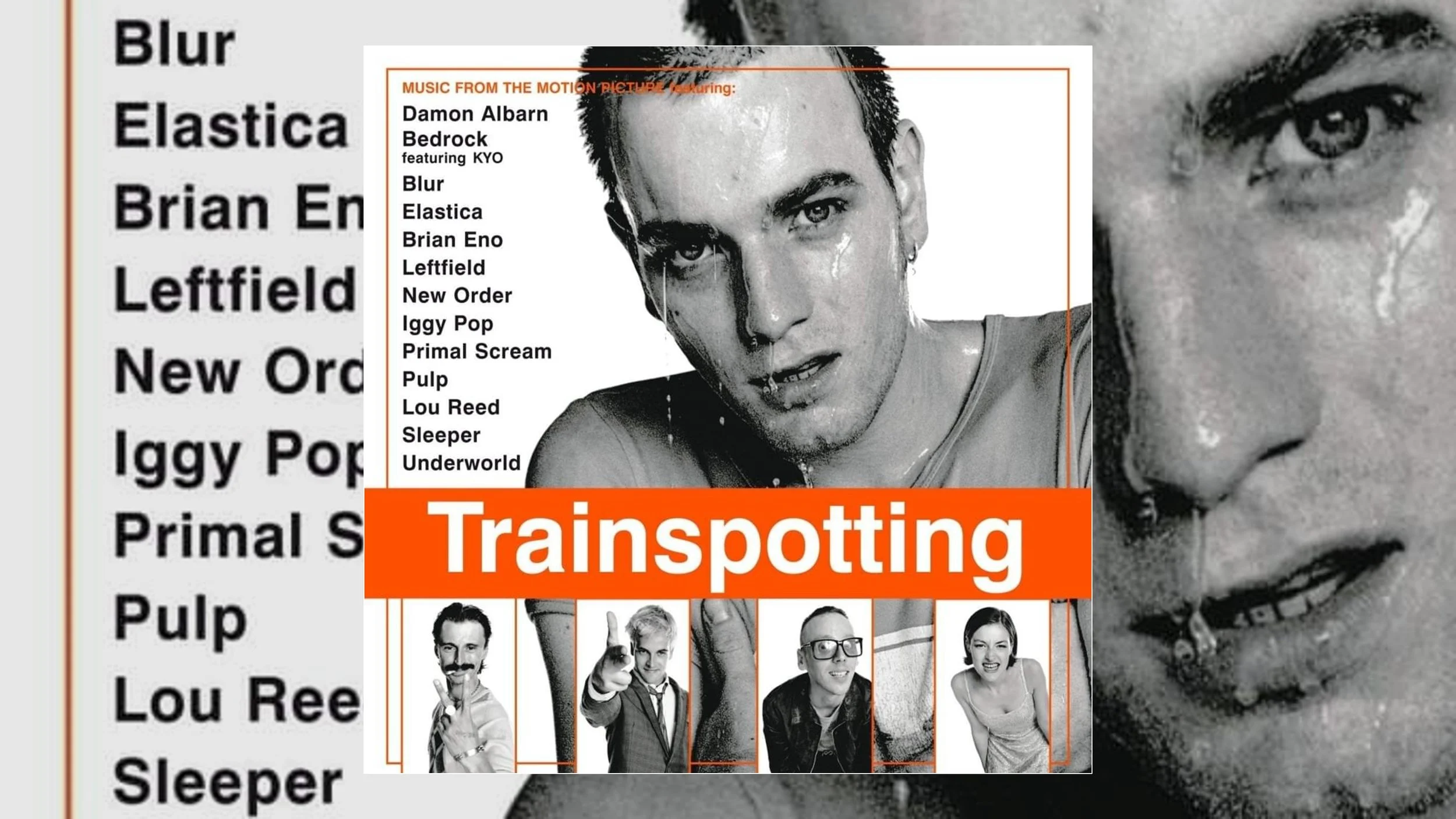
Happy 30th Anniversary to the Trainspotting Soundtrack, originally released in the UK February 19, 1996 and in the US July 9, 1996.
In 1995, Trainspotting production designer Kave Quinn guides a camera crew into her studio to show off some of the visual inspiration she’s been collecting for the upcoming film. Every inch of the walls is crowded with gritty black-and-white photos of heroin addicts shooting up in squalor, along with more artsy color-saturated photos of the same. The vivid watercolor greens and blues will later be seen in drug dealer Swanney a.k.a. Mother Superior’s crumbling flat as Sick Boy helps Alison shoot smack into a vein, while baby Dawn crawls unattended through the apartment—a foreshadowing of the death-by-neglect that will soon befall the infant, one of the movie’s most harrowing yet memorable scenes.
Quinn then walks over to a giant photo album on her desk and flips through more photos—shots of healthy, dewy, energetic young men playing football (soccer), shocking only in their stark contrast to the drug-shooting images. “I think these images reflect the very sort of positive, ‘up’ images of Trainspotting,” she says. “The sort of camaraderie or friendship of the people in the film. Sort of ‘team spirit,’ a group of friends—and that’s what the film is all about.” And then Quinn summarizes her guiding principle: “I want to make it very stylized, but at the same time, not very ‘arty.’”
In 1996, when Trainspotting finally hit the theaters, the movie opens with a scruffy, pallid, gray-clad Mark Renton (Ewan McGregor) running from police as Iggy Pop’s “Lust for Life” blares over Renton’s now-famous “Choose life, choose a job, choose a career, choose a family” speech. The camera then suddenly ricochets to a colorful soccer match, where the whole gang of addicts and ruffians—Renton, Spud, Sick Boy, Tommy, and Begbie—are engaging in wholesome sportsmanship.
That artful yin and yang, that careful threading of the needle between sordidness and exuberance, would allow Trainspotting the chutzpah of arriving as a heroin movie a mere two years after Kurt Cobain’s death without committing the faux pas of glorifying drugs, or falling into the trap of depressing the hell out of its audience like Christiane F. before it. It’s a film that doesn’t lie about just how pleasurable heroin can be—or otherwise no one would get hooked on it—while depicting unflinchingly the destruction, disease, and death that inevitably follow.
But really the film was an event mostly because it captured—particularly via its soundtrack—the heady European post-grunge zeitgeist of the mid-’90s, and all the fun we were having across the pond just as the American alternative-music bubble burst. “It was an exciting time in Britain—you know, the music scene was really kicking off, and it was a great time to be starting off doing anything in the arts,” recalls Ewan McGregor.
The movie captured a less mainstream version of what Vanity Fair would herald on its March 1997 cover as “Cool Britannia,” a tribute to the exploding Britpop phenomenon featuring a sultry cover photo of Oasis’ Liam Gallagher and then-girlfriend Patsy Kensit tangled up in Union Jack bedsheets. (And as is celebrated in Trainspotting via vivid sports scenes and raucous pub interiors, a beer-soaked, football-worshipping “lad” culture went hand-in-hand with Britpop, with Blur and Oasis even competing in publicized football matches with the likes of Robbie Williams.)
Probably the coolest, most honest, and most endearing element of Trainspotting, however, was that it depicted the musical diversity of that mid-’90s moment rather than trying to capture one electrifying “scene,” when there were actually a diffuse many. Director Danny Boyle had fallen in love with the electronic-music outfit Underworld, and so, beyond capturing the newness of Britpop alongside throwbacks from Iggy Pop and Lou Reed (representing the crate-digging a lot of us started doing when grunge died), Trainspotting pens a love letter to the technicolor rave culture happening in nightclubs and warehouses across Britain and a reunifying Europe.
“The world’s changing. Music’s changing. Even drugs are changing,” Diane, Renton’s love interest, declares at his lowest point of stagnation in Trainspotting. “You’ve got to find something new.” And suddenly London, Renton’s adopted home where he’s decided to become a real estate agent, becomes a rave courtesy of Ice MC’s “Think About the Way.”
Despite this cheesier fare, however, Underworld is the group that serves as Trainspotting’s electronic-music backbone. “This Underworld album had come out, dubnobasswithmyheadman, and I said to [screenwriter] John [Hodge] and [producer] Andrew [Macdonald] at the time, ‘That’s the soundtrack of the film!’” Boyle recalls. “And I think they were a bit alarmed at one point, because they thought, ‘It’s all going to be that?’ But it was the pulse of the film in a way.”
In the midst of all this pulsing zeitgeist, there was also the inevitable fact of so-called “heroin chic,” the mid-’90s fashion-editorial craze that had replaced the “supermodels” (best represented by the voluptuous denizens of George Michael’s “Too Funky” and “Freedom! ’90”). The birth of heroin chic arguably began when Mario Sorrenti, then himself a young model, began taking photos of his ethereal, fragile-looking girlfriend Kate Moss, which captured the attention of Calvin Klein. As the ’90s wore on, Sorrenti’s younger brother Davide then honed the aesthetic, choosing a stable of ever-thinner models to capture a moodiness, a melancholy, and, increasingly, a darkness that would come to be associated with the decade’s growing fascination with heroin addiction, which Davide’s own girlfriend/muse Jaime King was in the throes of at the time.
“When I met Mario, the way that fashion photography was done at that particular time was it was very glossy. It was all about these big Herculean girls, big hairdos, big shoulder pads,” recalls photo agent Mutale Kanyanta in See Know Evil, a documentary about the Sorrentis and the heroin chic aesthetic. “And there was a movement from Europe, which basically had a whole group of younger photographers who were influenced by the grunge movement here [in the United States]. The emerging sensibility was kind of a reaction to an existing establishment.”
These new, frailer girls were first known simply as “waifs,” until the darker subject matter finally tipped the aesthetic into the grittier moniker “heroin chic.” By 1997, President Bill Clinton was speaking out against the trend not long after Davide Sorrenti’s death (caused mostly by a hereditary blood disorder, although he also had a small amount of heroin in his system).
“We’ve seen reports that many of our fashion labels are admitting flat-out that images projected in fashion photos in the last few years have made heroin addiction seem glamorous and sexy and cool,” Clinton said. “And as some of the people in those images start to die now, it’s become obvious that that is not true. […] The glorification of heroin is not creative, it is destructive. It’s not beautiful, it is ugly. And this is not about art, it’s about life and death. And glorifying death is not good for any society.”
Perhaps it was a sense of responsibility in this vein that inspired screenwriter John Hodge to pass over the beginning of Irvine Welsh’s 1993 novel Trainspotting—which begins with the character Sick Boy going through withdrawal—and to instead pluck Renton’s “Choose life, choose a job, choose a career, choose a family” from deeper inside the novel for the film’s unforgettable opening scene. “I remembered the monologue that he had halfway through, and thought maybe we should begin with that up front,” Hodge recalls. “It feels like such a powerful exposition of his credo.” Although the novel itself is episodic and features many characters—some likeable and others not so likeable—Hodge chose Renton as the film’s narrator specifically because of his positivity and perseverance: “Renton is kind of funny and rebellious and cool and intelligent and all that, and so he seemed like the obvious choice.”
Producer Andrew Macdonald had first become familiar with the novel when a friend gifted it to him for Christmas, telling him she thought it would make a great film. Macdonald, Boyle and Hodge had just finished making the film Shallow Grave and were searching for their next project. Boyle thought the book was “un-fucking-believable.” Hodge agreed, but he was skeptical because it was very non-linear and could be difficult to adapt into something more story-like.
“Actually, what he [Hodge] did with it, he got through that barrier of drugs, which is normally such a turnoff in movies,” Boyle asserts. “I think what John did is very literary as well—if you look at the movie, it’s full of words. There’s a lot of dialogue and a lot of voiceover. Endless voiceover, which we were influenced and inspired by Goodfellas—to feel free about being very wordy with the film.”
Irvine Welsh believes Hodge did the novel justice. “For me, I wanted it to capture the excitement and verve of being young in quite a potentially hazardous environment, but still with that idea that there are all sorts of possibilities ahead, even if your current circumstances aren’t particularly brilliant,” he told Vice in 2016. “It was the first film that said about drugs, ‘This can be really good fun, even though it can be really dangerous.’ I think you have to do that. ‘Just say no’ doesn’t work; you have to show both, the highs and the lows. You have to show why people get involved in that in the first place. To me, it’s self-evident why people take drugs.”
Ewan McGregor had starred in Shallow Grave, and Macdonald and Boyle handed him the script for Trainspotting while they were at Sundance promoting the film. McGregor was Macdonald’s and Boyle’s first choice, though Hodge wasn’t sure he was a fit for the part. So McGregor set out to convince all three men that he was the right person for the job. He disappeared for a while. He’d had long hair, as he appears in Shallow Grave, and a regular build. And then he came back six weeks later and he was rail thin and had shaved his head—his interpretation of the heroin addict Renton. Needless to say, he got the part.
Excitement had already been building for Trainspotting with a stage play that had become a cult hit in Scotland. Ewen Bremner had been playing the part of Renton in that performance, but was offered the part of Spud for the movie. “At the time, I was a bit nonplussed,” he admits, adding that he’d felt the script was “a designer version of the novel that lacked authenticity.” “I was kind of snobby about it,” he says.
Kelly Macdonald, a recent high school graduate, was working in a restaurant in Glasgow and met up for lunch with a friend who worked at the record store on the corner. He told her someone had come into the shop and was handing out fliers announcing that the makers of Shallow Grave were looking for new talent for their film Trainspotting. He handed her one of the yellow fliers, which queried, “Are you the new Patricia Arquette or Kate Moss?”
She had never acted before and was painfully shy, but she still decided to attend auditions at a local university. Boyle remembers seeing her in the hall and thinking, “Yeah, that’s her.” He wanted an actress who could look 19 (as Macdonald was at the time), but who could also be believable as 15 or 16. He felt that using someone unknown would make the character’s age reveal more of a surprise in the film. (Diane being underage was kind of shrugged off in 1996, and would no doubt cause much more outrage today.)
For tragic figure Tommy, they chose Kevin McKidd, an actor who was able to masterfully portray Tommy’s slide from the most “normal” of the friends into an insatiable addict who ultimately dies of toxoplasmosis complicated by AIDS. This happens after Renton steals a homemade sex tape from Tommy’s flat, Tommy’s girlfriend breaks up with him in exasperation, and the despondent Tommy begs Renton for a shot of smack to ease his heartbreak. “Tommy is potentially just going to be a normal, straight guy,” McKidd observes. “He’s into going to the gym, he’s into shagging. I mean, that’s his main thing—he’s into shagging his girlfriend. He’s seen as the ‘straightest’ out of the five of them.” Tommy’s downward spiral seems laughably overwrought, until you realize that this is truly how it can, and often does, happen in real life.
Boyle saw Jonny Lee Miller in Hackers and recruited him for Trainspotting after meeting him and being impressed with his Sean Connery impression. And even though everyone initially imagined the bar-brawling Begbie as a large, physically imposing beast of a man, Robert Carlyle was given the part after Boyle contemplated the character a little more deeply and came to the conclusion that “No, small psychos are better.” On set, Carlyle urged Boyle to encourage the use of heavy Scottish accents, both because that’s the way they’re written in the book and because he wanted the movie to reflect a Scottish authenticity and pride.
To ensure the authenticity of the shooting-up scenes, the cast forged a relationship with Calton Athletic, a group of recovering addicts in Glasgow’s East End who, in an approach similar to Narcotics Anonymous, used group support rather than tools like methadone replacement to kick heroin. Calton Athletic even has a cameo in the film, portraying the opposing football team in one of the opening scenes. During other scenes, the group advised the actors on how to realistically portray drug use—the cooking of the heroin, the tying up, the shooting up, the orgasmic high, the coming down, and the eventual sickly withdrawal.
McGregor and Boyle even attended a few of their meetings. “I watched these guys, these hard Glasgow characters, be incredibly supportive and sensitive with each other,” McGregor remembers. “I met guys who had just finished using heroin that day and you could see the desperate look in their eyes, and guys who had been off heroin for 25 or 30 years. Any notion I had about taking heroin in preparation for the film—when I met those guys, I felt it would be really disrespectful to them. I got everything I needed from them, and I didn’t need to go through it myself.”
Welsh’s novel is full of references to punk and post-punk trailblazers, and so it seemed natural to Boyle and Andrew Macdonald to reach out to David Bowie about the soundtrack. The novel is actually set during a period in the early-to-mid ’80s—the characters are washed-up punks—and so Boyle and Macdonald had the idea of combining older music with newer music to pay tribute to the novel while still setting the film in the present day (the mid-’90s). Bowie declined contributing a track, but he helped secure very generous deals with some of his collaborators—Lou Reed and Iggy Pop, for example—to fit Trainspotting’s modest budget.
The soundtrack opens as it does in the film with Iggy Pop’s strutting, careening “Lust For Life,” reviving the career of the godfather of punk, who had his own well-publicized struggles with heroin and who, like Renton, had loving parents who did everything in their power to try to ween him off of the poison. For that reason, the song is the perfect accompaniment to Renton’s “choose life” monologue, foreshadowing his (hopefully permanent) abandonment of the drug life and his bad-influence friends at film’s end.
Former EMI A&R rep Tristram Penna helped compile the soundtrack and had a sixth sense that “Lust For Life would provide the right energy. “I’d always been a huge clubber in London—indie clubs, gay clubs, whatever clubs as long as there was great music—and Iggy Pop’s ‘Lust for Life’ had always been a huge club hit since the BatCave days,” he recalled to Dazed. “So I knew it would get the adrenaline rushing if used in the opening.”
Another Bowie collaborator, Brian Eno, provided the next track with “Deep Blue Day.” Initially, Boyle and Macdonald wanted to use Bowie’s “Golden Years” for the ‘Worst Toilet In Scotland’ scene, but went instead with Eno’s tranquil, ambient composition, which contributes to the beauty and peacefulness of a scene that starts out incredibly gag-inducing (chocolate was used to create the “feces” clogging the toilet, so at least it smelled good on set).
Primal Scream’s “Trainspotting” is a chill, trippy, 10-minute instrumental collaboration with DJ Andrew Weatherall that Primal Scream frontman Bobby Gillespie pitched to Irvine Welsh himself. “We heard they had made a movie of Trainspotting, but they had, like, Blur, Elastica, and Pulp [for the soundtrack],” he told SPIN. “We were like, ‘Wait a minute, man, we’re the junkie fucking band! And we’re working class!’” They gave Welsh the track, and he managed to sneak it into the movie at the last minute.
Sleeper’s faithful and reverent rendition of Blondie’s “Atomic” is a nice addition that marries Britpop with the original punk DNA of the novel, while New Order’s shimmery, sun-dappled “Temptation” brings us into the early ’80s where the novel actually begins. Iggy Pop re-enters with the slinky, smoky, swaggering “Nightclubbing,” followed by Blur’s melancholy piano ballad “Sing” (from 1991’s Leisure) set perfectly back-to-back with Lou Reed’s maudlin “Perfect Day,” which plays with beautiful irony over Renton’s overdose scene. (While Blur has representation with two tracks on the album, Oasis missed out because Liam Gallagher thought the film was literally about trainspotters.)
Pulp is my idea of the perfect Britpop band (mostly because Jarvis Cocker is so wonderfully wry), and their silly, head-bopping “Mile End” is an excellent accompaniment to the scene where Begbie, who’s on the lam, comes to stay with Renton in his filthy flat in London—“It smelt as if someone had died / The living room was full of flies / The kitchen sink was blocked / The bathroom sink not there at all.” Bedrock’s “For What You Dream Of” provides some trancey progressive house, while Elastica’s “2:1” is a good representation of the band’s gritty, more punk-leaning take on Britpop.
Unlike some of the soundtrack’s other electronic fare, Leftfield’s “A Final Hit” is less nightclub banger and more just ambient trippy-ness to chill out and smoke weed to (I’m not complaining). Meanwhile, Underworld’s “Born Slippy” is just a behemoth—the kind of song that can still make me feel like I’m in a chilly warehouse surrounded by flashing strobe lights and kids with glow sticks even when I’m really just on the treadmill (which is the most excitement those of us pushing 50 get these days).
Perhaps anticipating the nostalgic melancholy that would come with listening to the soundtrack decades later, the album ends with Damon Albarn’s “Closet Romantic,” an old-timey track full of la-la-las that pays tribute to James Bond movies (à la Sick Boy) and somehow conjures the image of old people futzing around their outdated, badly-wallpapered living rooms—or something like that.
Robert Carlyle, a.k.a. Begbie, firmly believes that Trainspotting was made to stand the test of time. “There are people who might watch it and think it’s a drug film—a pro-drug film. But, in my opinion, it’s one of the best anti-drug films ever made,” he muses. “Some people might look at it 10 years after and think, ‘This is a record of the times’; it’s a history piece suddenly. The soundtrack certainly helped.”
Listen:
