
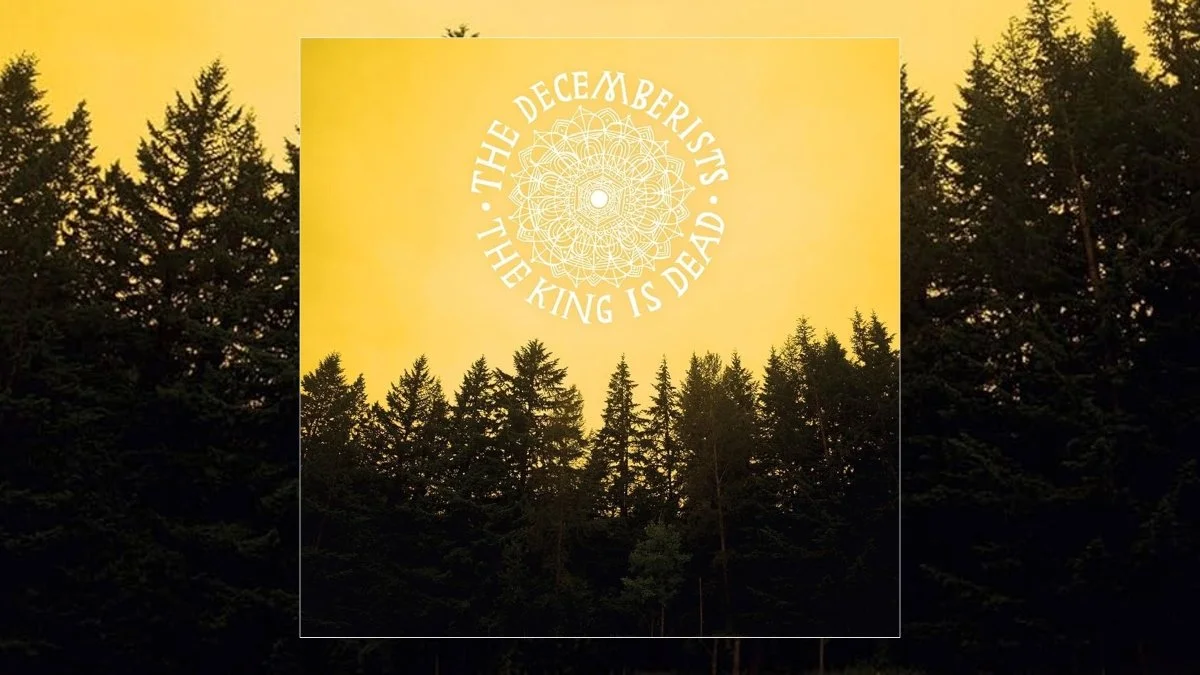
Happy 15th Anniversary to The Decemberists’ sixth studio album The King Is Dead, originally released January 14, 2011.
“Here we come to a turning of the season.”
So begins The King Is Dead (2011), the Decemberists’ back-to-basics record. After achieving enormous critical success with the intricate, somewhat conceptual The Crane Wife (2006), and then doubling down on complexity with mixed results on The Hazards Of Love (2009), the band returned to jangly acoustic guitars, simple arrangements, and jaunty melodies.
One explanation for this twist is that The Decemberists realized that they had jumped the shark and now it was time to be bold in a different way: rely less on spectacle and embrace the challenges that simpler songs and arrangements present. We’ll get to that explanation in a bit. But it’s hard to ignore that The King Is Dead also came at a fraught moment in alternative music history: Stomp Clap Hey.
I’ll cop to this right now: I was sixteen when the first Mumford & Sons record came out and I thought it was cool. As a kid who liked Neil Young and The Jayhawks, it was exciting to me that there were new bands writing music with acoustic guitars and getting attention for it amidst a pop music landscape dominated by the Black Eyed Peas. (While we’re making confessions: I will now admit that “Boom Boom Pow” is pretty fun.)
But circa 2026, Edward Sharpe and the Magnetic Zeroes, Mumford and Sons, Of Monsters and Men, and the Lumineers are getting quite the cultural re-appraisal, accused of being reactionary slop that implicitly argued “authenticity” or “earnestness” came via suspenders and mandolins rather than electronica. The genre’s uplifting quality now feels like millennial cringe. People with whom I played “Little Lion Man” on acoustic guitars in 2010 now claim to have never liked Mumford & Sons. Sure, whatever.
Stomp Clap Hey is mockable because of the shallowness of its optimism: its theory of unification was in the joy of a catchy chorus and not the hard work of cultivating shared wisdom. It came at a time when many of us simply believed that everyone having a Facebook account would lead to the toppling of autocracies and a global community. If we had actually gotten the interconnected utopian future that I was promised in my late teens, “Ho Hey” perhaps would be thought of as a major positive turning point in musical history. Instead, most of it has aged rather poorly.
But when I listen back to that period’s quasi-mainstream acoustic music, one record does hold up: The King Is Dead. Yes, the cultural winds were blowing in the direction of simplicity and neo-folk (and certainly helped drive the record to #1), but this record has a few things that its contemporaries lacked.
Listen to the Album:
The first is an honest-to-god embrace of the pastoral. It’s actually quite hard to compare thee to a summers’ day, but when done well, a lyricist can cook up hard-won insight. Twin tracks “June Hymn” and “January Hymn” drill down on what the “turning of the seasons” really means—the isolation of winter and the joy of an approaching summer. “June Hymn” is particularly emotional as lyricist Colin Meloy reflects, in the bridge, on becoming nostalgic for this very summer when he is older. By slowing down and dwelling on the subject, he captures something true and doesn’t need to try too hard to tell us that it’s true. We just know that it is.
The second distinguishing factor of The King Is Dead is realism. While opener “Don’t Carry It All” implores the listener to “bear your neighbor’s burden within reason,” and “This Is Why We Fight” invocation of “avarice” invokes the early Obama era (and #OccupyWallStreet) motif of a shared economic future, The King Is Dead has much more to say that generic hopey-changey stuff.
There’s the narrative ode to a dying shipping industry in “Down By The Water” (including all-time-great lyric “I was just some tow-head teen / feeling round for fingers to get in-between”). “Calamity Song” is a quirky apocalyptic hoedown (whose music video is a faithful adaptation of a scene from Infinite Jest) while “Dear Avery” is the simple, melancholy plea of a parent hoping their child will return from war. In each of these tracks, the issues that motivated the cultural search for a brighter future (financial crisis, climate change, U.S. wars in Iraq and Afghanistan, respectively) are given their due. This anchors the record’s few turns to optimism in actual material concerns, rather than vague good vibes.
The last crucial element to the record’s staying power is the performances. Jenny Conlee’s harmony vocals are propulsive on “Don’t Carry It All” but mournful on “Dear Avery,” while her accordion gives “June Hymn” its elegance. Nate Query’s gorgeous, thick bass tone is close to the front of the mix throughout the album, giving “Rox In The Box” and “This Is Why We Fight” their spirit and groove. Chris Funk, ever the utility player, fills in a humble banjo support role on “All Arise,” and indispensable bouzouki on “Calamity Song.” And, of course, drummer John Moen’s crashing introduction to “Down By The Water” is one of the band’s defining sounds.
As I write this, it is an unseasonably temperate January day. Even if I was not working on this article, I probably would have reached for The King Is Dead for my afternoon listening as the sun dips downward. It will be cold and rainy again tomorrow, but that feels less important as I give “June Hymn” another go-round. A record whose warmth in a difficult moment feels stirring, real, timeless. I don’t know if we’ve really come to a turning of the seasons, but I can be convinced for forty minutes. Long live the king.
Listen:
