
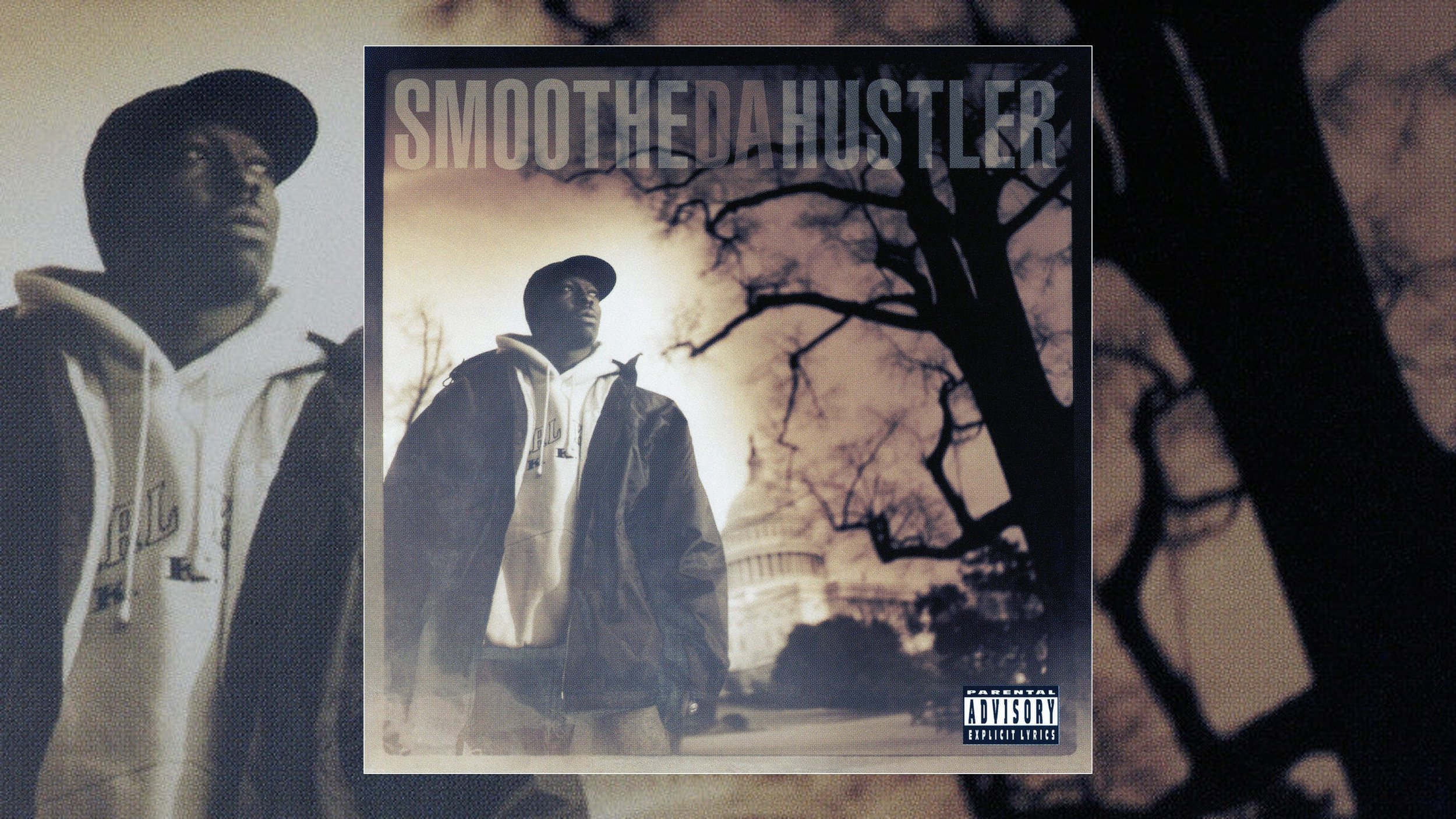
Happy 30th Anniversary to Smoothe Da Hustler’s debut album Once Upon A Time In America, originally released March 19, 1996.
Damon “Smoothe Da Hustler” Smith is an emcee who made his name in between a pair of important eras of New York hip-hop. The Brownsville, Brooklyn native came along a little after the vaunted classes of 1993/94, which saw the introduction of artists like Wu-Tang Clan, Nas, and Black Moon. But he also slid in just before the eruption of the genre’s shiny suit era.
Smoothe was just ahead of his time, releasing a well-loved anthem, but not quite achieving the kind of record sales and financial windfall bestowed upon the era’s top rappers. He was well-respected by peers like The Notorious B.I.G. and Jay-Z, even if he didn’t reach their level of commercial success. Once Upon A Time In America, released 30 years ago, presents a picture of a time when hip-hop was a legit means to escape a life of crime, rather than a tool to get millions of Instagram followers.
Smoothe’s first appearance on record was on an independently released 12-inch single through Nexx Level Records released in 1994. It was a split single, also featuring the track “Run” by Da Punisherrs, a crew who sounded a lot like Onyx. Smoothe’s “Hustlin’” is the clear standout on the 12-inch, as Smoothe raps about finding ways to make his money in the streets of Brownsville through whatever extra-legal means are required. D/R Period’s production work, featuring bluesy guitars, a slightly menacing piano, and high-pitched whistles, give the song an eerie feel. “Hustlin’” sounds distinctly “street,” but in a different way than the tracks D/R had done with fellow-Brownsville residents M.O.P. that same year on their debut album To the Death (1994).
Soon after the single’s release, Smoothe signed with Profile Records, He was championed by “Ill” Will Fulton, an A&R with the label who would go on to executive produce Once Upon A Time. The first thing Profile did was re-issue “Hustlin’,” so it would receive a wider audience. Though this single received love, it was the B-side, “Broken Language,” that fans, critics, and fellow artists really latched on to.
“Broken Language” really captured the straight-gutter spirit of mid 1990s New York hip-hop. Though a much glossier sound would soon become the genre’s accepted aesthetic, it’s nice to remember a time when a track as grimy as “Broken Language” became so beloved. The song is nearly four minutes of straight lyrics by Smoothe and his brother, Tywone “Trigga Tha Gambler” Smith, without a hook. The beat, again produced by D/R Period, features the manipulation of one piano note, striking repeatedly at different tones, creating a staccato rhythm.
The star of “Broken Language” is the chemistry that Smoothe and Trigga share. They trade short verses and lines, building off of each other’s rhymes and energy. Their “broken” delivery is especially notable, as they each spit short, clipped phrases and lines, each often preceded by “The.” Smoothe delivers his rhymes in a powerful flurry, rapping, “The corner stander, the style crammer / The takeover-spot, block commander / The Glock-on cock-handler /The razor-spitter, human disgrace getter, the fast-dough cashflow getter.” Portions of the song would be awarded “Rhyme Of The Month” in The Source.
Listen to the Album:
“Broken Language” helped Smoothe build strong buzz leading up to the release of Once Upon A Time. It certainly helped Trigga, who signed a deal with Def Jam before Smoothe’s album was released. D/R Period produced nearly the entire album, creating a distinctly East Coast, street-oriented project.
The central theme of Once Upon A Time is staying on the grind. Whether it’s making money through selling drugs or creating music, Smoothe maintains a laser-like focus. Smoothe touches on a lot of similar themes that Jay-Z would explore on Reasonable Doubt (1996), released months later. In that sense, Smoothe comes across as a grittier version of Jigga.
Smoothe begins the album on a grandiose note with “Fuck Whatcha Heard,” riding the triumphant horns, strings, and piano taken from the breakdown of Grover Washington Jr.’s “Lover Man.” Smoothe introduces the audience to his commitment to achieving success by any means, while dismissing those who doubt his prowess. “N****s talk out they turn and out they ass too,” he scoffs. “N***a, who asked you?”
Smoothe continues to focus on the strength of his hustle on the album’s aptly titled second single, “Hustler’s Theme.” With D/R Period replaying portions of Curtis Mayfield’s “Freddie’s Dead,” Smoothe operates as the “subliminal criminal,” ruling the streets on the strength of his might and lyrical skill. “I sleep with enemies, injuries I cause intentionally,” he raps. “N****s that mention me, I got shit locked like the penitentiary.” He also breaks down dispersing his rhymes like he’s selling crack, months before Foxy Brown would do the same on Nas’ “Affirmative Action.” His math proves to be better in his version.
Smoothe spotlights the talent of his longtime friend, Kenneth “DV Alias Khrist” Scranton on a few tracks. DV was a talented singer, flexing a distinct and powerful baritone, but he was also adept at rapping, effectively functioning as the Brownsville version of Nate Dogg. DV appears most prominently on “Dollar Bill,” the album’s third single, sharing equal time with Smoothe on the track. He provides the hook, contributes ad-libs, and delivers a pair of eight-bar verses. The pair contemplate the necessity of cash to help power their dreams, with Smoothe rapping, “Where am I slacking, Black? Nah, business headed on this cheddar / C.R.E.A.M., legal money schemes invested in stocks and better.” D/R Period again shows his musical chops, this time recreating Isaac Hayes’ “Walk On By.”
DV later provides ad-libs to the gothic “Murdafest,” another of the album’s highlights. Smoothe holds court over his soldiers and promises swift vengeance against any who oppose him in the streets or on the mic. “Battle me? I dare y’all,” he flows, “because I prepare y’all the welcome mats, and welcome acts to the show to watch me tear y’all.”
Like many of his contemporaries, Smoothe also excels at being introspective, weighing the psychic and physical costs of living through illegal means. He chronicles his upbringing on “Never Die Alone,” going from slanging crack to recording music. Smoothe explains how his stature as a dealer continued to grow on the streets, viewing it as a necessary evil to feed his family. He always recognizes the ever-present danger in the streets, but still continues his grind, rapping, “Who’s to say that I was promised today anyway? / So hey, I do what I gotta to get a play.”
Smoothe covers similar ground on “Only Human,” a mellower track inspired by the Jeffrey Osbourne song of the same name. The song is reminiscent of The Notorious B.I.G.’s “Everyday Struggle,” and Smoothe revealed in a later interview that Biggie told him that he should have released the song as a single. Throughout the song, Smoothe’s hardscrabble lyrics and gruff delivery contrast well with the ’80s R&B leanings of the beat.
The best part of Once Upon A Time comes when Trigga joins Smoothe to form a formidable tag team on tracks. “My Brother My Ace” functions as the informal sequel to “Broken Language,” with the pair of brothers laying waste to the mic over a pulsating and haunting track. But while “Broken Language” has become emblematic of the mid-’90s era, “My Brother, My Ace” is, for my money, the superior song.
For one, both Smoothe and Trigga have grown stronger on the mic and their wordplay more intricate. The pair often construct the lines so that they’re mirror images of each other, working backwards from where the other started. “Any crews that refuse rules and regulations,” Trigga raps. “Get reincarnated in twos on sets. N****s, I’ll move with threats.” Smoothe answers with “Threats I’ll move with, bruise shit, mentally confuse and lose shit / Shit lose and confuse. Mentally, shit bruise a crew slick.” Hearing the song still gives me chills.
Even with the reasonable success off Once Upon A Time, Smoothe still hasn’t released a proper follow-up album in the subsequent three decades. Though Smoothe kept his buzz by appearing on tracks with artists like Nine and Blahzay Blahzay, Profile Records functionally folded not long after Once Upon A Time’s release; the label only put out a handful of other full-lengths during 1996 and early 1997.
Smoothe then headed to Def Jam Records and seemed to find some success there. He wrote for Foxy Brown early in her career, and continued to pen raps for other artists on the imprint. He also recorded the extremely dope “My Crew Can’t Go For That,” with Trigga and DV, for The Nutty Professor (1996) soundtrack.
Def Jam shelved Trigga’s solo album Life’s a 50/50 Gamble before it could be released. The brothers subsequently migrated to Tommy Boy Records, recording under the name the Smith Bros. Though a full-length never saw the light of day on Tommy Boy or any other label, the brothers have continued to record and release 12-inch singles independently, including a few on their own imprint, SMG Records. The brothers also joined Ice-T and others to form the group SMG (Sex, Money, Gunz) to record a project, which didn’t see the light until Ice-T dropped it via his Bandcamp.
Thirty years later, the vision of New York City that Smoothe Da Hustler captures across his debut album still resonates, especially since it’s a work that seems largely uncompromised by designs of crossover appeals. There’s undeniably genuine sentiment that’s lacking in so much mainstream hip-hop these last few years. The drive to hustle to survive exists in all eras, and few manifested that passion like Smoothe.
Listen:
