
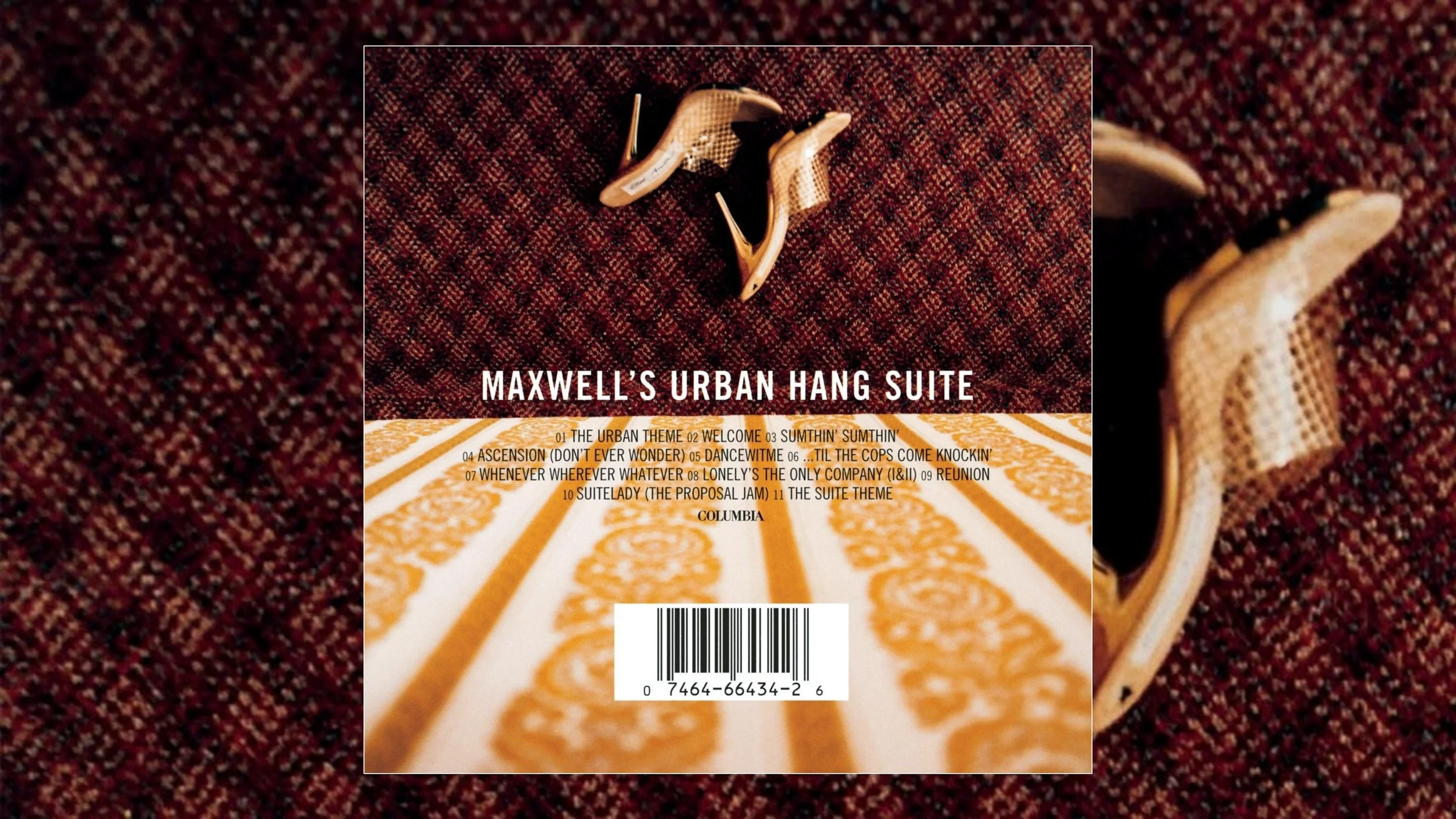
Happy 30th Anniversary to Maxwell’s debut album Maxwell’s Urban Hang Suite, originally released April 2, 1996.
In preparing to write about Maxwell’s Urban Hang Suite, I have (of course) read more about its genesis and been reminded of the people who aided in its creation and its subsequent impact on the movement it was part of. Amongst all of that, I was struck by the recurrence of a notion that it was a quintessentially “New York”: record. Birthed in the coffee shop culture of a New York City on the cusp of Mayor Rudy Giuliani’s controversial “civic cleanup” that hastened gentrification and targeted the vulnerable, it was a slice of soul crafted for years by an artist intent on seeing his vision made clear.
I didn’t buy the album immediately upon its release in April of 1996 and I most certainly didn’t buy and enjoy it in the sprawling, urgent, metropolitan behemoth of New York. I purchased it once I had returned home to where I grew up having graduated from university, sometime during the summer of 1996. I discovered and fell in love with the album in a small rural town in the Peak District of the UK, at a time when I yearned to be anywhere but where I found myself.
It speaks to the universality of music that something so rooted in a particular place could transcend it and connect with someone in a completely different place. As an overthinker, I’m often loathe to think even slightly about why I like a record at the time I fall in love with it, lest I kill the feeling with my unnecessary ruminations. But now, with 30 years (really?!?) distance between its release and writing this, it’s pretty clear to me why it persists in my affections.
Reading Dr Susan Rogers’ book (yes, Prince fans, that one) This Is What It Sounds Like really crystallized my thoughts and feelings about the music I love—the music that hits me more often than anything else has organic instrumentation and textures. Maxwell’s Urban Hang Suite arrived in marked contrast to the music that filled airwaves and charts at the time—it is defiantly rooted in an organic soul aesthetic that inevitably drew comparisons to the powerhouses of 1970s soul like Marvin Gaye.
Listen to the Album:
But the organic sounds never really left soul music, our ears were just turned to other things forced into our consciousness by radio stations and record labels in search of the “here and now” of a hit record. In talking about his debut with Okayplayer, Maxwell cited the influence of British acts, saying, “the whole Black British thing was really powerful to me because they really did their own thing.” Robbed of a viable ecosystem to flourish and largely shunned by a mainstream record business, Black British acts were indeed left to their own devices and continued to pursue a more organic sound. By 1994 (the year Maxwell began work on UHS), UK legend Omar had released two albums of stellar organic soul music.
Perhaps the most notable British influence though was Sade. This is hardly surprising given band member Stuart Matthewman’s practical work on the album, but Urban Hang Suite operates at similar laid-back paces as well as sharing an organic texture with the British band. Beyond musical influence, Maxwell also shares an approach to stardom with Sade. Both acts appear, drop new records, perhaps tour them and then disappear minding their own business and staying elusive—get in, get out and leave ‘em wanting more.
Alongside the organic textures, the other thing that ensures it stays close to my heart is the version of love and desire it espouses. Just as the organic sounds were noticeably different from what was popular at the time, so Maxwell’s approach to affairs of the heart was by turns coy, suggestive and swooningly romantic—a marked difference from those prevalent sounds on the radio. I’m not ashamed to say I’ve always related to that approach to love much more than any other way—just promise you won’t ask my wife of almost 20 years if it persists.
The beginnings of the album came as Maxwell worked in coffee shops in 1994 (just a year after Meshell Ndegeocello’s Plantation Lullabies debut) and recording was completed in March 1995. Yet it was another year before it would see light of day—further proof of its quietly revolutionary nature, as record labels hesitated over its merits. In order to save on recording costs, Maxwell planned sessions copiously so that studio time was maximized, quietly going about his business. His business was aided not just by Sade’s Matthewman, but also by Leon Ware and Melvin “Wah Wah” Watson—key contributors to Marvin Gaye’s I Want You (1976). And that perhaps is the key sonic touchstone on UHS, beyond Maxwell’s own artistry.
Watch the Official Videos:
The concept of the album is the story of a love affair from initial attraction to proposal and marriage. The first half of the album hits a sexy midtempo groove from the off before the second half luxuriates in seductively slow love songs performed to perfection by the angelically voiced Brooklynite. That no one ever found out who the inspiration for the work was is further evidence of his desire to simply let his music do the talking. Concept albums are always brave as they require such sustained levels of interest and commitment to the cause. That bravery is proven by starting the album with an instrumental—who does that when you have a voice capable of such elegant beauty to share with the world?
In the face of an onslaught of hip-hop inflected R&B during the mid-1990s, Maxwell’s Urban Hang Suite provided an antidote to the bristling hubris and machismo that threatened to take over. Despite his unbearably handsome features (no, your eyes are green), the songs insisted that he would treat his lady right and that he was not above begging for the object of his affections to heed his overtures. It was devoid of bravado and that appealed to me much more than the alternatives on offer—to put it bluntly, he offered a version of masculinity that chimed with me much more readily.
Listen:
