
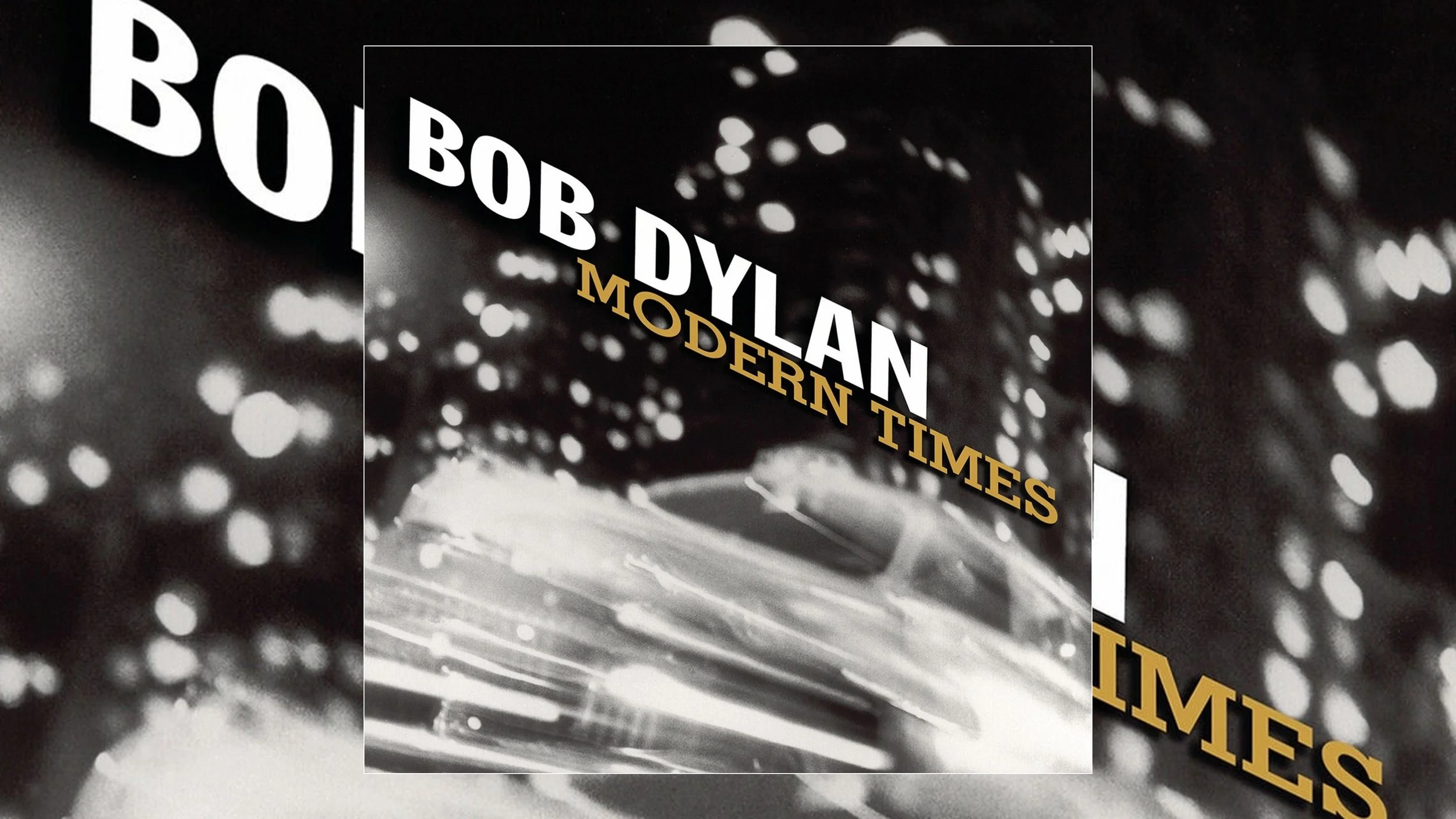
Happy 20th Anniversary to Bob Dylan’s thirty-second studio album Modern Times, originally released August 29, 2006.
What’s the point?
Let’s say you’re Bob Dylan in 2006. You made Highway 61 Revisited (1965). You changed the face of popular music worldwide six-ish times. You wrote more than a handful of modern standards. Your name, with the suffix “-esque,” is a common adjective in the music press. You’ve experimented with form and genre and re-written your own songs countless times. Your most recent album is the acclaimed Love & Theft (2001), a mature work that features the shaggy and mysterious feeling from your best early stuff. You’re having a late-career resurgence at 65 years old, and you decide to make…Modern Times.
This choice puzzles me because Modern Times is, in some ways, a “back to basics” record. This is the kind of move a band usually makes when they jump the shark on something too conceptual or weird and decide to re-embrace their roots. But Love & Theft (and its 1997 predecessor Time Out of Mind) are the better “back to basics” records. The basics were already gotten back to. So, what’s this one about?
Modern Times goes a step even further back in Dylan’s origin story, to the music that inspired him in the first place. There’s not a lot of tomfoolery or risk-taking in form or instrumentation on Modern Times. The gravitas of “Mississippi” and the spunk of “Honest with Me,” both from Love & Theft, are largely gone. Fealty to genre seems a much greater priority this time; it seems like the point is not to make a Bob Dylan record, but to have Bob Dylan make a blues record. The debts that tracks like “Rollin’ and Tumblin,’” “Someday Baby” and “The Levee’s Gonna Break” owe to blues standards—and the oft-cited justification that borrowing is part of the blues—clarifies this idea that Dylan is trying to live the spirit of the blues on a record called… Modern Times.
But…why? Truly, what’s the point of doing that? Because this is Bob Dylan, there’s probably a weird and enigmatic reason that I’ll never find. But, the simple answer of “old man makes nostalgic record” is too boring to be true. So, where’s that leave us? I’m guessing that, in the blues, Dylan found a vehicle to say the thing he felt needed to be said.
We open with “Thunder on the Mountain,” which is the album’s most rocking number. It sets the stage with dark portents: there’s a war on, after all, and by 2006 politicians are already abdicating responsibility: “Thunder on the mountain heavy as can be / Mean old twister bearing down on me / All the ladies in Washington scrambling to get out of town / Looks like something bad’s gonna happen / Better roll your airplane down.” Dylan switches to their voice in an earlier verse, saying he’s going to “recruit my army from the orphanages” while praying to St. Herman, the patron saint of the Americas. He’s painting an apocalyptic vision (a motif that goes all the way back to “A Hard Rain’s A-Gonna Fall”) while promising that he’s on our side: “Gonna forget myself a while, gonna go out and see what others need.”
Listen to the Album & Watch the Official Videos:
So, this record is not for Dylan. This record is for us. When hard times came again, Dylan dug into his bag of tricks and turned down the self-serving enigmatic ones and said, “Let’s just play the blues.”
From this perspective, everything shifts into focus. While Dylan had mostly aged out of firebrand political lyricism that drove The Times They Are A-Changin’ (1964), he was still marshaling his ability to feel the pulse of America and find something we need. The most obvious manifestation of this ethos on Modern Times is “Workingman’s Blues #2.” The overtly political lyrics (“the buyin’ power of the proletariat’s gone down”) are paired with a simple, beautiful melody, a combination that evokes the feeling of a shared hymn.
The blues classics on Modern Times then fulfill their traditional role—giving hardship a name, a metaphor, for the audience to share. “Someday Baby” and “The Levee’s Gonna Break” are given crisp renditions; the unfussy arrangements keep the focus on the song and Dylan’s snarling vocals. The record isn’t trying to impress us with thrilling new arrangements or performances; it’s saying what it needs to say and then it gets out.
But things change with the album closer, “Ain’t Talkin,’” which describes (and sounds like) a haunting midnight stroll through the city. Dylan finds that his attempts to heal the country are slipping: “I’m a’tryin to love my neighbor and do good unto others / But oh mother, things ain’t goin well.” He gets attacked from behind, contemplates slaughtering his enemies, and eventually finds that the mystic garden he used to go to for solace is gone. Things have fallen apart. By the end of album, Dylan has reached into the very bottom of his bag of tricks and come up empty. That’s what makes The Times They Are A-Changin’ different from Modern Times; something about 2006 made Dylan less sure of the power of the mystic garden, or of his power to channel it.
It’s a stark contrast to, say, Springsteen’s approach; four months earlier, he had released a rip-roaring compilation of working-class folk tunes as his own way of addressing wartime despair. Optimism has never been Dylan’s thing, so the difference between the two of them is understandable. And while I’ll admit to being partial to Springsteen’s approach, there’s something to be said for grieving the power of a shared history to galvanize the American people. Modern Times mourns a musical idiom by giving it another good try, because if it’s in your bones, that’s how you grieve stuff anyway. For those who are attached to this music, Dylan gives us a careful, loving rendition.
Listen:
