
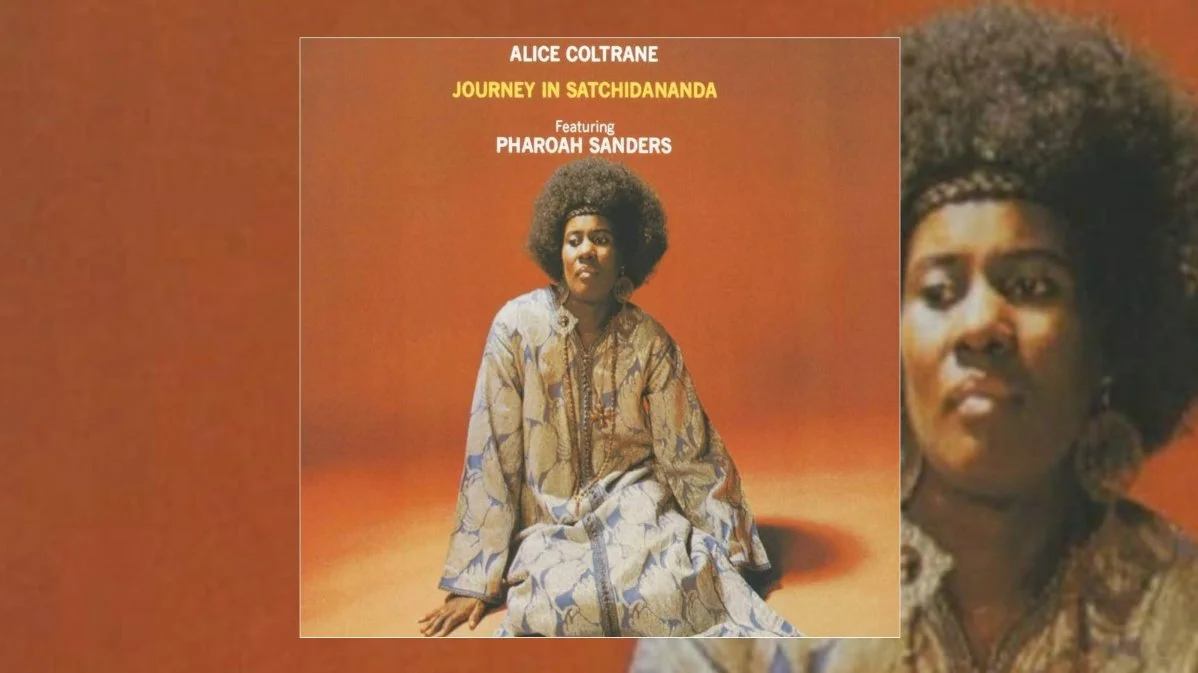
Happy 55th Anniversary to Alice Coltrane’s fourth studio album Journey In Satchidananda, originally released in February 1971.
Alice McLeod was born in Detroit in 1937 and soon developed a love and talent for music—by the age of 9 she was playing organ at the Mount Olive Baptist Church. Her teenage years in Detroit saw her add classical piano playing to her ever-growing list of talents and by 1960, aged 23, she was in Paris playing piano with Bud Powell. A couple of years later though, when she was playing in New York with the Terry Gibbs quartet, her life changed forever.
It was 1963 when Alice met the trailblazing saxophonist and composer John Coltrane and their connection was instant, deep-rooted and all-encompassing. Before Coltrane was even officially divorced from his first wife, Naima, he and Alice had had two children—there was, seemingly, no time to waste. John had already experienced a spiritual transformation when he kicked his drug habit and emerged clear and reinvigorated in 1957, but his music had yet to truly reflect the unbridled spirituality that he would become famous for—he’d taken giant steps but had yet to reveal a love supreme.
The relationship between John and Alice was partially based on a shared understanding of and interest in the divinity associated with Indian philosophies. Alice replaced McCoy Tyner as the pianist in John’s band and that sense of the divine began to reveal itself more and more in the band’s music.
However, the urgency with which the couple had started a family would prove to be a tragically prescient act, as John passed away from liver cancer in 1967. Grief fell on Alice with the weight of lead, as she found herself cast aside from the physical manifestation of her genius husband. Insomnia struck, visions assailed Alice and weight fell from her fragile frame—the abyss of grief threatened to swallow her whole. In the depths of despair Alice met Swami Satchidananda and her recovery began, enveloped in the universal love that the Swami professed and practiced.
Once a measure of equilibrium had been achieved, Alice set out on expressing her new reality through her music. In 1968, A Monastic Trio was released, followed by Huntington Ashram Monastery the following year and Ptah, the El Daoud in 1970.
In 1971 though, she released what probably stands as her most well-known achievement as a band leader, the genre-defining Journey In Satchidananda. Consisting of five tracks, the first four were recorded at the Coltrane home in Dix Hills, New York in November 1970 and the other one was recorded live at the Village Gate in Greenwich Village in July of the same year. By Alice’s side, just as he had been with his mentor John, was Pharoah Sanders (among others), whose own forays into spiritual jazz had begun to take flight too.
Listen to the Album:
For her solo work, Alice did not abandon the piano entirely (see “Something About John Coltrane” for evidence of that), but her harp began to take a prominent role in her compositions and performances. Alongside Dorothy Ashby, Alice Coltrane established the harp as a sophisticated, though rare, presence on jazz records (a line continued to this day by players like Brandee Younger) and here, on Journey In Satchidananda, she revels in its sweeping, crystalline beauty.
In describing the album, it’s probably best to leave it to Alice herself. In the liner notes for the album, she wrote, “I hope this album will be a form of meditation and a spiritual awakening for those who will listen with their inner ear.” I cannot claim that it has provided a spiritual awakening for me, but it has, without a doubt, offered me a gateway to moments of meditation and calm, in ways other albums have not.
As you might expect on an album devoted to a Hindu monk, the instrumentation shifts slightly away from the usual fare of a jazz record. Alongside Alice’s beautiful harp and piano playing, are Sanders (on various woodwind instruments), Cecil McBee and Charlie Haden on bass, and Rashied Ali on drums. But beyond those usual suspects, Vishnu Wood plays the oud on “Isis And Osiris,” Majid Shabazz adds a variety of percussive flourishes and Tulsi Sen Gupta plays the tamboura (a simplified sitar). The eastern influence is right there from the first note and is present throughout, adding new inflections to jazz’s lexicon.
Of course, coming from a musical genius like Alice, hot on the heels of her work with her late husband, there is complexity. It is experimental and modal in nature, but it is also incredibly accessible—an amazing balance to bring to a new direction. The stately pace of the title track is a conduit to inner peace, exalted by Sanders’ playing on the soprano saxophone. When Coltrane’s harp enters the fray, it takes the track heavenwards, ascending gracefully. The contrast between the subtle drone of the tamboura and the sparkling magnificence of the harp is sublime.
Throughout the five tracks here, one of the most striking things is a feeling of circularity that permeates. Perhaps in relation to the Hindu belief of “samsara” (of death and rebirth), there is a feeling that this is neither beginning nor end, but rather a way to stay rooted in the present, the here and now. Whatever it is, whether it’s the basslines or the drone of the tamboura, it captivates and holds me.
The final track, “Isis And Osiris” is noticeably sadder than what has preceded it. The story of Isis and Osiris is a hugely important story in the development of Ancient Egyptian mythology. It tells of Osiris’ murder by his brother Set, who then takes the throne for himself. The story continues with Isis (Osiris’ wife) restoring her husband’s body to conceive a child, Horus. This tale of immortal love obviously speaks to the relationship between Alice and John and her feeling that the love continues despite his physical form being absent. This is borne out by her continued commitment to her journey—one that lasted her entire life and found her becoming a spiritual leader too.
Journey In Satchidananda is one of the most important spiritual jazz albums of all time and calms, soothes and elevates all at the same time—what more could you need in trying times like these?
Listen:
