
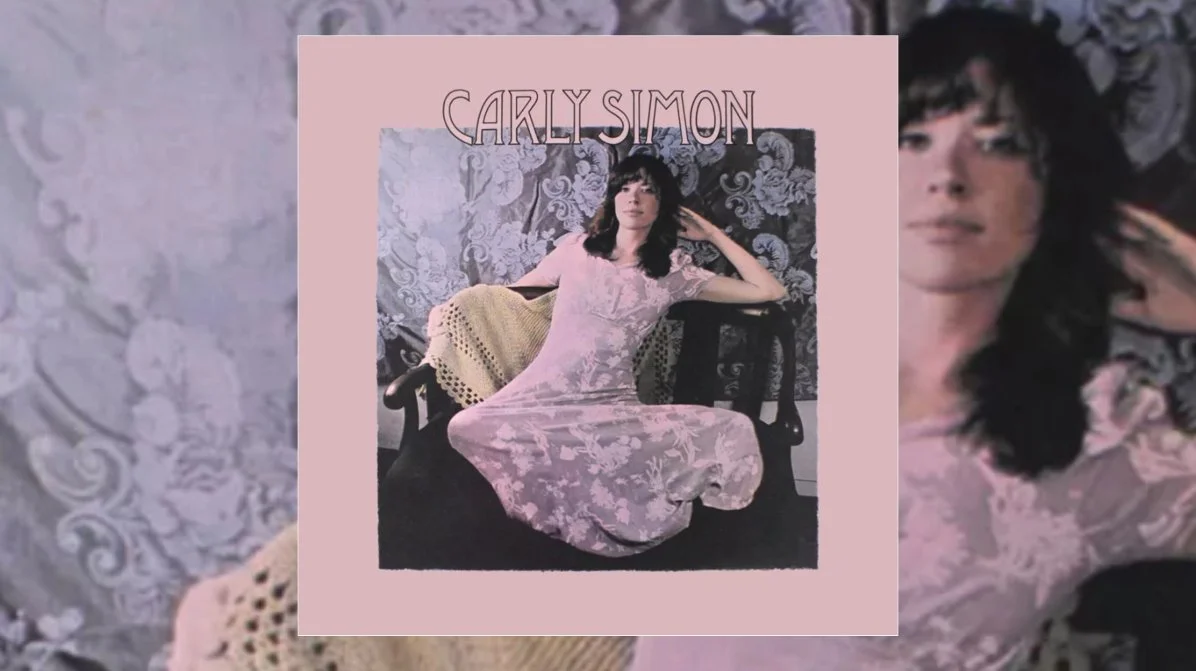
Happy 55th Anniversary to Carly Simon’s eponymous debut album Carly Simon, originally released February 9, 1971.
Fifty-five years on, and Carly Simon still refuses to behave like a debut. It doesn’t reach for attention or announce ambition. It simply exists—fully formed, emotionally literate, and quietly defiant. This wasn’t about asking for permission; this was a record that arrived already knowing what it had to say, grounded in emotional intelligence and an unshowy kind of resolve. This was Carly Simon raw and new, but not tentative, someone walking straight in, clear-eyed about who she was (and is) and prepared to live with the consequences of saying so out loud.
Released in 1971 and recorded at New York’s Electric Lady Studios with Eddie Kramer at the helm, the album introduced a voice that would come to redefine what emotional intelligence could look like in popular music—particularly when articulated by a woman who refused to soften her questions for comfort.
Kramer’s production is crucial precisely because it doesn’t announce itself. Known for volume and spectacle elsewhere, here he chose restraint, giving Simon room to breathe rather than pressing her into polish. Folk rock provides the framework, but the real substance lies in what’s left unsaid. The arrangements are patient. Acoustic guitars sound tactile rather than decorative; piano lines arrive like thoughts mid-sentence. Simon’s voice is present and unvarnished—not elevated, not disguised, never sweetened into compliance. This is an album uninterested in seduction. Its priority is clarity, even when clarity exposes doubt.
That ethos is embedded immediately in “That’s the Way I’ve Always Heard It Should Be”, one of the most emotionally radical opening statements of its time. Co-written with Jacob Brackman, the song doesn’t argue against marriage so much as examine it under a harsh but necessary light. Simon sings from inside the uncertainty, not as an observer but as someone actively resisting the pressure to resolve it. There’s no crescendo of rebellion here—just a steady refusal to mistake expectation for inevitability. In allowing ambivalence to stand on its own, Simon made space for an interior conflict that popular music had rarely granted women. That such a song became the album’s only single—and earned a GRAMMY Award nomination in the process—suggests just how deeply it struck a nerve.
“Alone” follows with devastating understatement. There is no performance of loneliness, no melodrama to dress it up. Instead, Simon renders solitude as a familiar state—navigable, known, and quietly instructive. Her phrasing is economical, already demonstrating a writer’s instinct for how silence can amplify meaning.
“One More Time” and “The Best Thing” continue this inward gaze, tracing desire and self-awareness without urgency. These songs aren’t chasing resolution; they’re interested in process—the pauses, the backtracking, the moments where certainty fails to arrive.
Listen to the Album:
“Just a Sinner,” written by Moogy Klingman, closes side one with a deliberate shift in tone. Its rougher emotional texture broadens the album’s scope, reminding us that Simon was never interested in presenting herself as refined or absolved. Imperfection isn’t a flaw here; it’s a condition of being human.
Side two opens outward with “Dan, My Fling,” another Brackman collaboration that captures infatuation with wit rather than illusion. Light on its feet but sharp in its observation, the song understands the difference between intensity and permanence—and has no interest in confusing the two. It’s playful without being naïve, and confident without bravado.
Momentum—emotional and existential—becomes the album’s quiet preoccupation through “Another Door” and “Rolling Down the Hills.” Change isn’t framed as victory; it’s something that happens whether we’re ready or not. That sense of inevitability culminates in “Reunions,” co-written with Bill Mernit and Kramer, and arguably the album’s emotional center. It’s easy to see why it was Andrea Simon’s favorite. Memory here isn’t sentimentalized; it’s active, alive, capable of tenderness and ache simultaneously. Simon sings with extraordinary restraint, allowing the weight of connection and distance to exist without commentary. Nothing is forced. Everything lands.
The closing track, “The Love’s Still Growing,” written by Buzzy Linhart, refuses neat resolution. Love, Simon suggests, isn’t something achieved but something ongoing—inconsistent, unfinished, still unfolding. Ending the album on that note feels exact. There is no final statement, only continuation.
Simon’s cultural impact cannot be separated from this debut’s quiet insistence that a woman’s interior life was worthy of serious attention. Simon did not frame introspection as fragility, nor uncertainty as failure. She documented emotional complexity without apology, and without theatrics. In doing so, she widened the emotional vocabulary of pop music and altered its expectations. When she won the GRAMMY for Best New Artist, it wasn’t just recognition of talent—it was an acknowledgment that the landscape had shifted.
More than five decades later, Carly Simon remains striking in its confidence to trust the listener. It doesn’t explain itself. It doesn’t chase approval. It simply tells the truth as it understands it, and leaves space for the listener to do the same. That act—understated, resolute, and still resonant—is the album’s enduring power, and the foundation of a legacy that continues to matter.
Listen:
