
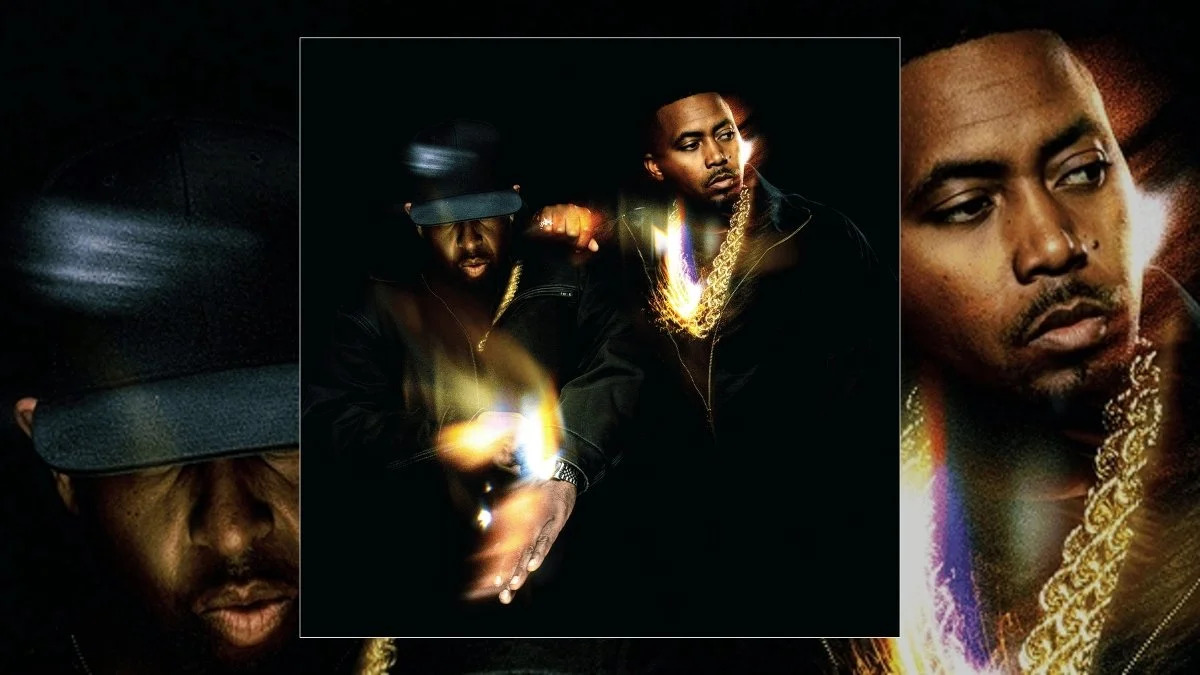
Nas & DJ Premier
Light-Years
Mass Appeal
Listen Below

Sometimes I think about an article The Onion published in 2013 titled “There Are People In the World Who Are Concerned About Current State of Hip-Hop.” The snarky premise was to skewer then-late-thirtysomething hip-hop heads about the fears of getting old and the music they grew up on changing with the times. It also mocked the backlash towards popular Southern rappers of the time (Gucci Mane, Lil Wayne, Rick Ross, etc.) and posited that this sentiment towards fearing for the genre’s well-being had been a part of hip-hop since 1988.
Over a dozen years later, and there’s still a lot of talk about the genre’s well-being. Some of the discussion is even academic. What has remained is a continuing market for “golden age hip-hop.” The late thirtysomethings ridiculed in The Onion article are now late fortysomethings (or even early fiftysomethings), often at the height of their earning power. Besides paying their mortgages and searching for ways to put their kids through school, they can, and often do, spend their money on the passions of their teens.
With the constantly shifting state of technology and the proliferation of streaming services that makes nearly all music available to everyone, it’s easier than ever for artists from any era to record new music and disseminate it to their fans. This, of course, includes rappers best known for making their names during the late 1980s and early to mid-1990s.
Which is where Mass Appeal’s Legend Has It… series comes in. The indie label announced the series earlier this year, touting a lineup of seven albums from seven great Golden Era hip-hop artists/groups. The public face of the series (and the label) is Nasir “Nas” Jones, one of the most skilled and respected hip-hop artists ever. Legend Has It… is a shot of adrenaline straight to the hip-hop head’s soul: a celebration of the culture in the wake of its protracted 50th anniversary celebration and a demonstration that the legends of the genre are still a force within the culture. It is designed to show that the older heads still had it, and the current state of hip-hop is just fine.
I’ve heard all seven of the albums in the Legends Has It… series; I reviewed a pair of them earlier this year. A couple are decent enough. Others are really good. One is even great. But, in some sense, the six other albums served as a prelude to the last entry in this year’s series: Light-Years by Nas and Chris “DJ Premier” Martin.
Light-Years is an album over three decades in the making, as the pair have long had amazing chemistry together. Premier produced three tracks on Nas’ debut album Illmatic (1994), as well as other songs throughout the Queensbridge-born rapper’s career. Some of these songs, like “NY State of Mind,” “Memory Lane,” and “Nas Is Like,” are still considered among the best songs in Nas and Preemo’s respective catalogues. Shoot, some are considered the best hip-hop songs ever recorded.
A collaborative album between the two seemed like it would be hip-hop nirvana: an emcee and a producer, each considered to be the best in their respective fields, coming together to hopefully record a towering achievement. It seemed like an increasingly possibility all the way back in 2006, when Nas and Preemo graced the cover of the long-defunct Scratch magazine.
Listen to the Album:
Throughout the subsequent two decades, the potential album was often talked about, but never materialized. Nas teased it again while in the midst of his amazing six-album run with Hit-Boy that occurred in the early 2020s. Now it is a reality. And we finally get the answer to the question of whether the duo can meet the sky-high expectations for the project.
Light-Years is not a genre redefining album, but it doesn’t need to be. It’s really good. It’s comfortably the second best album in the Legend Has It… series. It’s also an album that reaches for greatness, even if it doesn’t quite achieve it.
But there is very much to like about Light-Years. I can appreciate an album that is centered on the celebration of hip-hop in total. Nas and Preemo commemorate many facets of the culture, from the obvious to the obscure. On the mic, Nas is as skilled and nimble as ever. In terms of subject matter, he not only focuses on reveling in the power of the music that’s given him his career, but also further expounds on one of the central themes of his aforementioned six-album run with Hit-Boy: his own longevity as an artist.
Nas lays everything out on the album-opening “My Life Is Real,” recounting his plan through the Legend Has It… series and celebrating his impact to a “haunted piano.” Nas affirms his commitment to keeping things raw on “Welcome To The Underground,” where he assures his fanbase that fortune and fame have never changed his commitment to representing the voiceless. “I lead and you just go with it,” he raps. “The one who clash with the whole system / Since I entered the scene, I just roll different.”
There are also a lot of conceptual tracks featured on the album. And sequels to beloved songs in his discography. Mileage may vary on some of these. Nas has never been a particularly subtle emcee and that lack of subtly doesn’t work for everyone. Personally, I’m of the belief that in the case of Light-Years, sentiment trumps the occasional uneven execution. Nas has been a powerful and recognizable voice both inside and outside the realm of hip-hop, and his decision to use his voice on this album to advocate and educate deserves to be lauded.
Premier holds up the production end of Light-Years admirably as well. Many of the tracks sport Preemo’s signature style, but sound appreciably different than anything he’s released before. Occasionally he uses a technique that he utilized during the recording of the PRhyme albums with Royce Da 5’9”—fellow gifted beat-maker Marco Polo has said that he put together original recordings for the express purpose of Premier sampling them specifically for Light-Years.
Preemo has also freely acknowledged that his production work on this album might not be for everyone. In an Instagram post, DJ Premier explained that Light-Years is “dedicated to the day 1 HIP HOP purists. If you missed living in that era that’s fine. Ask a veteran what it was like. We have the answers.”
The pair give students of hip-hop the answers on songs like “Writers,” an extremely comprehensive, and often esoteric, dedication to graffiti writers throughout history. Nas stresses the importance of this oft-forgotten element to hip-hop development, while name-checking graf writers from across the country and the globe. Another highlight is “Pause Tapes,” where Nas explains in intricate detail the lost art that many aspiring rappers used in order to create instrumentals to rap over.
Some of the conceptual tracks are straightforward: “Junkie” features Nas likening his and Preemo’s passion for hip-hop as an addiction to the backdrop of orchestral strings. With “Nasty Esco Nasir,” Nas opens the track with a duel between two of his 1990s monikers, Nasty Nas and Nas Escobar a.k.a. the “two types of villains that live in my mind.” They verbally joust before things descend into violence, allowing for Nasir to close the track by breaking down his life outside of his rap career.
Nas and Preemo also pay tribute to hip-hop’s early years through Light-Years’ production. “It’s Time” features a slick chop of a sample from The Steve Miller Band’s “Fly Like An Eagle,” as Nas describes the wisdom he’s acquired during his lifetime. Preemo digs into his Ultimate Beats and Breaks bag on “GiT Ready,” executing a skillful flip of Wilson Pickett’s “Engine No. 9,” but the lyrical content doesn’t really land. Nas starts with an interesting premise: how his street background has strengthened his investment acumen. However, anointing himself “Mr. Crypto Currency Scarface” will not age well.
The aforementioned sequels also provide some interesting moments. “NY State of Mind Pt. 3” contrasts the New York that Nas portrayed on Illmatic with its current gentrified reality, as well as the growth and maturity of himself and his immediate crew. It also directly invokes the Billy Joel song of the same name, with Nas riffing to the vocal from the O.G. track between verses. The use of Joel’s vocals doesn’t quite fit the menacing vibe of Preemo’s track, but if you watched Nas detail his reverence for Joel in the And So It Goes documentary series, it makes sense.
“Sons (Young Kings)” is the poignant sequel to “Daughters” from Nas’ Life Is Good (2012). Whereas Nas spoke from the perspective of a father raising a young woman on the former, “Sons” puts the spotlight on mothers’ efforts to help and nurture young men. “3rd Childhood” is a sequel to the Preemo-produced “2nd Childhood” from Stillmatic (2001). With “3rd Childhood,” Nas addresses the false perception that hip-hop is solely a young person’s game, maintaining that the artform should be allowed to grow and mature along with the artists who have been rapping for decades. Preemo’s decision to recreate the exact scratches from the previous installment is an inspired one.
Some of the album’s best moments come when Nas and Preemo put together no frills hip-hop shit. Nas partners with longtime collaborator AZ on “My Story Your Story,” continuously passing the mic back and forth over a laidback guitar and keyboard sample. “Shine Together” has a similarly smooth feel, as Nas reflects on his impact and success, vaunting his own work ethic as what sets him apart. “'Cause when my name is mentioned, it's why the game be shifting / When you lames drop, the people remain indifferent.”
Light-Years’ best track is the all-too-brief “Madman.” Nas and Preemo make the most of the track’s brief runtime that spans slightly more than two minutes, with Nas dropping raps like a man possessed to a thumping bassline and atmospheric keys. “The winner's circle, I remember the win was respected,” he raps. “And we championed for those who had came and collected.”
It may be hard to divorce Light-Years from the weighty expectations that it inherently carries, but it’s perfectly acceptable for two all-time greats to simply deliver a pretty dope album. The album doesn’t signal a seismic, cultural shift, but it’s another example of how the “state of hip-hop” is just fine. Things on this planet continue to be complex and upsetting, but it’s comforting to know that Nas and DJ Premier still care about creating something that honors hip-hop’s legacy and impact.
Notable Tracks: “Junkie” | “Madman” | “Pause Tapes” | “Shine Together” | “Writers”
LISTEN:
