
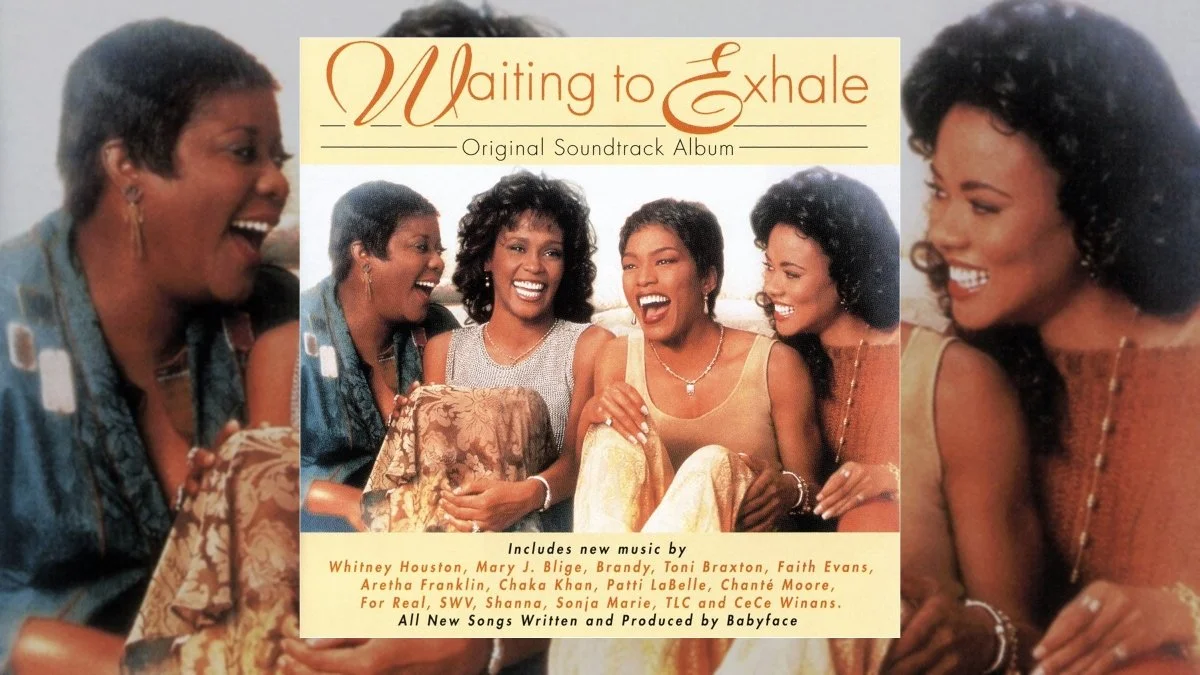
Happy 30th Anniversary to the Waiting To Exhale Soundtrack, originally released November 14, 1995.
Whitney Houston was always big business. With three smash albums and an unstoppable crossover appeal, she was poised for movie stardom. Her silver screen debut in The Bodyguard (1992) pulled in lucrative box office receipts and shattered sales records to the tune of over 50 million units internationally. With so much money at stake with her next move, she could have chosen some solipsistic business endeavor. And many would have.
Instead, she became a prism, breaking her intense light into a spectrum that illuminated community, culture, and most importantly, Black womanhood. Houston signed on to star in an ensemble film adaptation of Terry McMillan’s wildly popular 1992 novel Waiting To Exhale featuring an all-female cast, with a soundtrack to match.
This narrative follows four women pursuing their goals while obstructed by men of varying quality in their lives. Savannah (Whitney Houston) can’t seem to disentangle herself from unavailable men nor the push of her mother’s fearful advice to settle for one. Bernadine (Angela Bassett) works to restore her capsized life after being jilted from a lopsided, years-long marriage. Robin (Lela Rochon) struggles with the shell game of choosing better partners while so many focus only on her vampy exterior. Gloria (Loretta Devine) fights to keep motherhood from enveloping her full identity as her hope for love and mutuality wanes.
Originally, Houston intended to concentrate on acting and not record music for the companion album, until she heard the demo for “Exhale (Shoop Shoop).” Its lyric encapsulates Waiting To Exhale’s message of how important friendship is to resilience, to survival (“When you’ve got friends to wish you well / You’ll find the point when you will exhale”). Writer-producer Kenneth “Babyface” Edmonds admitted to Billboard that, having run out of lyrics, he simply substituted with some “shoo-be-doops.” The feel-good vibe won Houston over, plus another million or so people who pushed the lead single to #1 on Billboard’s pop and R&B charts.
Lena Horne once said, “It's not the load that breaks you down, it's the way you carry it.” If Houston distributed her weight just right, it could strengthen everyone. Accordingly, Waiting To Exhale united the most prominent and promising intergenerational women in soul music. These 16 tracks preserve a unique cross-section of contemporary R&B in amber, illustrating the culture of how women connect and the rhythms in which they do it.
Among the luminaries included were teen star Brandy, hip-hop soul vanguards Mary J. Blige, Faith Evans, SWV, and TLC, resident divas Aretha Franklin, Chaka Khan, and Patti LaBelle, divas-in-waiting Toni Braxton and Chanté Moore, and even gospel mainstay CeCe Winans. Now, it might seem counterintuitive to have a female-written bestseller turned into a female-centric film, only to have the all-female soundtrack guided by a man…unless that man is Babyface.
Listen to the Album & Watch the Official Videos:
With a proven track-record of penning radio-friendly, emotionally intelligent lyrics that capture the hearts of women, there was hardly a better songsmith for Waiting To Exhale. Each song of love, desire, betrayal, and friendship is bespoke to its artist, each artist curated by Houston to represent the diversity of Black women. Together, their cohesive musical threads braid all four heroines into something beautiful.
First is Robin who aspires toward sexy equanimity while still shedding woman-child uncertainty. Brandy channels her infatuation on “Sittin’ Up In My Room” with its spunky, plucked bassline and spacey chord textures. Beneath Robin’s sweetness, she grapples with whether sexuality empowers or entraps her. As she charts that arc, the disc’s most sensual moments trace her path. On the sitar-swirled boudoir ballad “Kissing You,” Evans trims her demure delivery in white lace. SWV nestles warmly into the subdued and confident “All Night Long.” On the more aggressive end, TLC’s slinky “This Is How It Works” keeps its overtures coy, while concealing a sly, Prince-like filth underneath.
At a very different point in development is Gloria, who feels torn between duties to her son and a burgeoning romance with her neighbor. Where she embodies the pleading and reticence of For Real’s “Love Will Be Waiting At Home,” her maturity correlates most to Khan, LaBelle, and Franklin, Exhale’s three upperclasswomen. Khan’s stately reading of the Rodgers and Hart standard “My Funny Valentine” mirrors Gloria’s backhanded body image. Meanwhile, LaBelle’s tender lullaby “My Love, Sweet Love” volleys between maternity and passionate surrender as Gloria’s unofficial theme song. As the queen mother, Franklin imparts the greatest gravitas of the three on “It Hurts Like Hell,” which represents the frustration of each character at one point or another.
Then there is Savannah, introduced in the opening sequence. Donning old Hollywood glamour while coasting down a desert paradise highway at dusk, she hopes a change of locale can ground her life. Moore’s elemental cool “Wey U” scores it so well, one hardly notices the scatted lyrics contain no actual words. As Savannah tries on suitors with fingers crossed, she hopes for the best, cueing poet Sonja Marie’s silky “And I Gave My Love to You” featuring jazz pianist Patrice Rushen. But ultimately, she finds herself drawn back to her future-faking old flame, echoing Houston’s “Why Does It Hurt So Bad.”
Bernadine, however, leaves the most lasting impression. After her husband announces he’s leaving her for his white female coworker, a storm of deferred indignance ignites. Houston protégé Shanna only begins to embody the protagonist’s pain on the youthful but powerful “How Could You Call Her Baby.” It is within the rasp and rawness of Blige’s modern blues tome “Not Gon’ Cry” that anger finally crystallizes (“I was your lover and your secretary / Working every day of the week / Was at the job when no one else was there / Helping you get on your feet / Eleven years I’ve sacrificed / And you can leave me at the drop of a dime”). In Exhale’s most iconic scene, Bernie, more clarified than crazed by her rage, sets her husband’s car and belongings ablaze in their driveway. For any woman done being downtrodden, the image of Bernie sauntering away with flames in her wake is forever linked to Blige’s smoldering anthem.
After each character faces the heat of their respective crucibles, several songs exemplify the ease of breath they seek. On the acoustic guitar-framed “Let It Flow,” another platinum pop and R&B #1, Braxton’s expressive contralto offers sage advice (“We deserve respect / But we can’t demand respect without change / There comes a time when we must go our own way”). This along with Houston’s “Exhale” and her inspirational Winans duet “Count on Me” evince that their solidarity is where solace and elevation are consistently found. And in that sense, art imitates life.
Houston’s instinct to share the limelight with her sisters allowed all invested parties to prosper. She became an influencer and power broker at a critical time in R&B when soundtracks and cinema synergized each other. If one faltered, the other could recover both—but with Waiting To Exhale, nothing failed.
Multiple Top 5 pop and R&B singles drove ticket and CD sales including “Sittin’ Up In My Room,” “Not Gon’ Cry,” “Let It Flow,” “Count on Me,” and “Exhale.” The feature opened to $14 million its first weekend, ultimately grossing over $80 million. Its septuple-platinum soundtrack stayed #1 for five weeks on Billboard’s Top R&B Albums and netted 11 GRAMMY nominations with a Best R&B Song win for “Exhale.” That’s big business. Houston hardly waited a year before readying her next movie The Preachers’ Wife (1996) and its accompanying Christmas-themed, gospel album.
Decades later, few have attempted replicating Waiting To Exhale‘s fusion without falling short. Perhaps another entity will one day assemble such an array of talent. Without Houston and her friends to wish them well though, it’s not something anyone should hold their breath waiting for.
Listen:
