
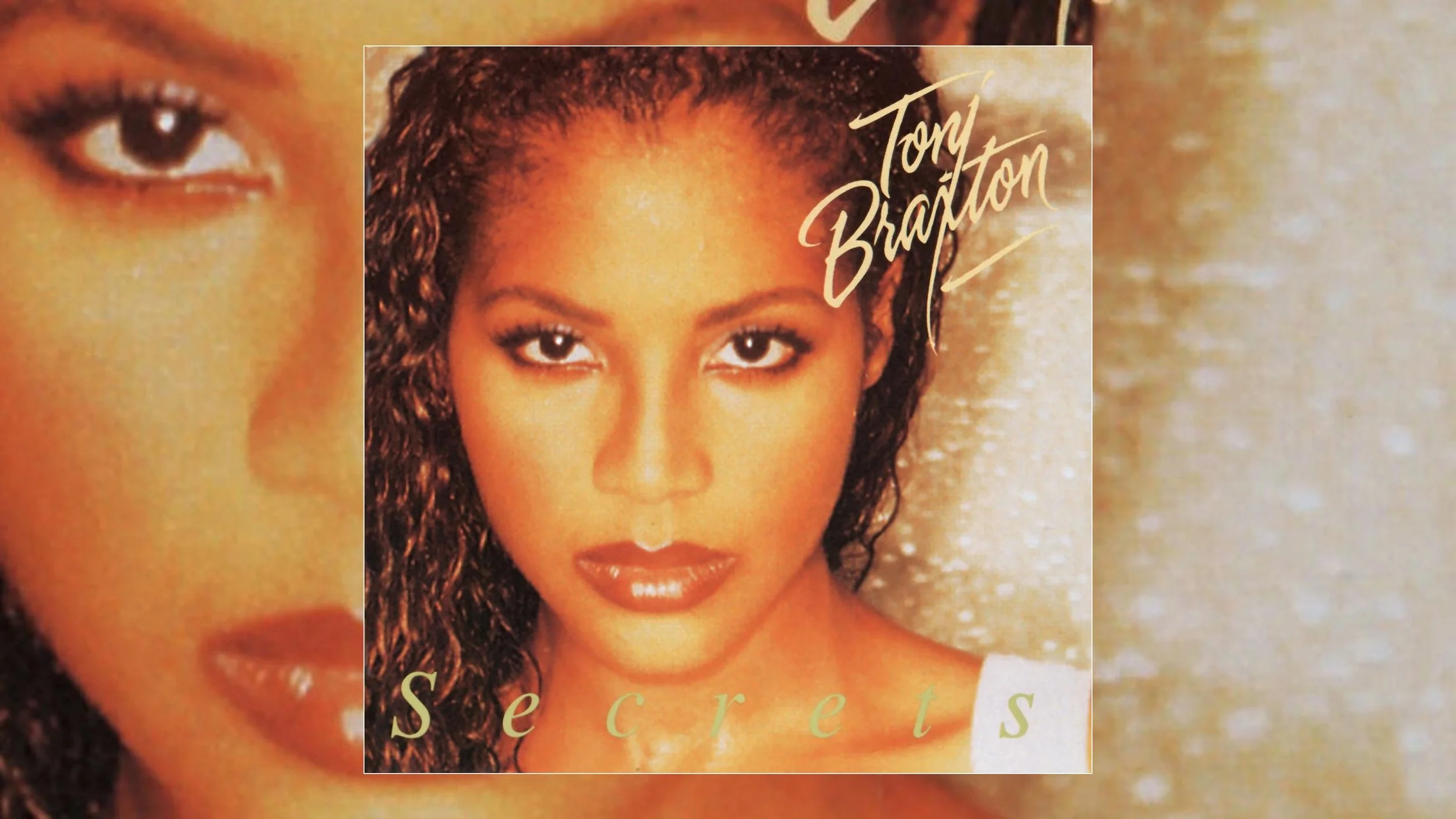
Happy 30th Anniversary to Toni Braxton’s second studio album Secrets, originally released June 18, 1996.
Some records announce themselves with spectacle. Others simply arrive, settle into the room, and quietly rearrange the furniture of popular music before anyone fully realizes what has happened.
Thirty years on, Secrets belongs firmly to the latter.
Toni Braxton's second studio album did not merely consolidate the extraordinary promise of her self-titled 1993 debut. It expanded her emotional vocabulary until heartbreak became emotional architecture; desire became atmosphere and silence itself became another instrument in the arrangement. Thirty years on, and that restraint feels almost radical.
An eight-times platinum certification from the RIAA and worldwide sales exceeding 15 million copies tell one story. GRAMMY Award nominations, chart domination and a string of defining singles tell another. Yet numbers struggle to explain why Secrets continues to resonate. The album occupies that rare space where commercial ambition and emotional precision become inseparable.
Braxton never chased vocal gymnastics. She possesses the technique to overwhelm any room she enters, but chooses instead to inhabit songs with remarkable patience. Her contralto does not demand attention. It invites confession.
This distinction matters.
The production team assembled around Secrets understood it too. Babyface's fingerprints cover much of the record, surrounding Braxton with arrangements that breathe rather than compete. David Foster contributes orchestral grandeur where necessary, Diane Warren provides one of popular music's most devastating narratives, while Tony Rich, Keith Crouch, Soulshock & Karlin and R. Kelly each bring distinct textures that somehow exist within the same emotional landscape.
The sequencing, for lack of a better word, feels almost cinematic.
"Come On Over Here" opens with understated confidence, allowing groove and melody to unfold naturally rather than exploding into obvious hooks. Tony Rich's production leaves enough empty space for Braxton's phrasing to become the song's defining feature. She sounds conversational, almost playful, yet there remains an emotional reserve that suggests every invitation carries the possibility of disappointment.
On "You're Makin' Me High," suddenly restraint transforms into sensuality.
Even now, the record feels remarkably modern. Groove Theory’s Bryce Wilson and Babyface constructed a rhythm that slid rather than marched, balancing hip hop influences against polished contemporary R&B without ever sounding trapped by either. Braxton delivered one of the great performances of the decade, her voice floating just behind the beat with a confidence that never tipped into excess. It became her first #1 single on both the Billboard Hot 100 and R&B chart because it understood something fundamental. Seduction rarely needs volume.
Listen to the Album:
"There Is No Me Without You" shifted the emotional center again. Babyface writes devotion with almost uncomfortable sincerity, while Braxton strips away any temptation to oversell sentimentality. The performance feels internal, as though listeners have stumbled into thoughts not intended for public consumption.
This intimacy becomes not only important here, but a defining characteristic of the album.
One of the album’s centerpieces, if not the centerpiece, is undoubtedly "Un-Break My Heart.”
Perhaps no power ballad of the modern era has been lauded with such widespread familiarity while remaining so emotionally intact. Diane Warren's composition could have easily collapsed beneath its own theatrical ambition, yet David Foster's elegant orchestration avoided melodrama by trusting the stillness between crescendos. Braxton resisted the temptation to perform grief. She instead chose to embody absence in all its totality.
It is a subtle distinction, but an extraordinary one.
For eleven consecutive weeks, the song occupied the summit of the Billboard Hot 100, becoming one of the defining recordings of the decade. Yet repeated exposure has done remarkably little to diminish its emotional impact. The final plea still lands with astonishing force because Braxton sounds less like someone asking for reconciliation than someone bargaining with memory itself.
The album's deeper cuts deserve just as much examination.
"Talking In His Sleep", written by Braxton and produced by Keith Crouch, introduces a darker psychological tension. The suspicion embedded within its lyrics unfolds through restrained production rather than obvious drama. Tiny instrumental details emerge and disappear like fragmented thoughts, creating an atmosphere of quiet paranoia.
"How Could An Angel Break My Heart", elevated by Kenny G's unmistakable saxophone, could have become overwrought in lesser hands. Instead, it achieves something surprisingly elegant. The instrumental passages act less as decoration than conversation, responding to Braxton's vocal lines with their own sense of melancholy.
Other tracks like "Find Me A Man" inject confidence without abandoning vulnerability, while "Let It Flow", first heard through the cultural phenomenon of Waiting To Exhale (1995), remains one of Babyface's finest compositions. Its message of emotional release unfolds with extraordinary patience, allowing healing to feel earned rather than inevitable. One of Secrets’ greatest secrets.
"Why Should I Care" explores resignation with understated sophistication, refusing easy catharsis.
Watch the Official Videos:
"I Don't Want To," produced and written by R. Kelly, remains musically compelling despite the unavoidable complexities surrounding its creator's legacy. Removed from its authorship, the song itself demonstrates Braxton's remarkable ability to communicate emotional contradiction. Love and exhaustion occupy the same sentence, refusing tidy resolution.
"I Love Me Some Him" shifts into contemporary soul territory through Soulshock & Karlin's polished production, yet Braxton's performance prevents the track from drifting into surface-level romanticism. There is obsession here, but also an acute self-awareness.
The album’s closing "In The Late of Night" settles into nocturnal reflection before quietly giving way to the hidden recording "Toni's Secrets," a spoken confession that strips away celebrity altogether. It is playful, vulnerable and unexpectedly human, ending an album built around emotional exposure with something resembling a private conversation.
Looking back after three decades, Secrets reveals itself as more than a collection of immaculate songs. It captured a moment when mainstream R&B trusted emotional intelligence as much as commercial instinct. The production remains luxurious without becoming cluttered, while Braxton's performances continue to demonstrate that power often resides in what remains unsaid.
Perhaps this is why the album has endured.
So much contemporary music mistakes confession for depth and volume for conviction. Secrets understood another truth entirely. Sometimes the quietest voice in the room leaves the deepest impression. Sometimes heartbreak does not arrive as an explosion. Sometimes it simply sits beside you, speaks softly and never quite leaves.
Thirty years later, Toni Braxton's masterpiece continues to do exactly that.
Listen:
