
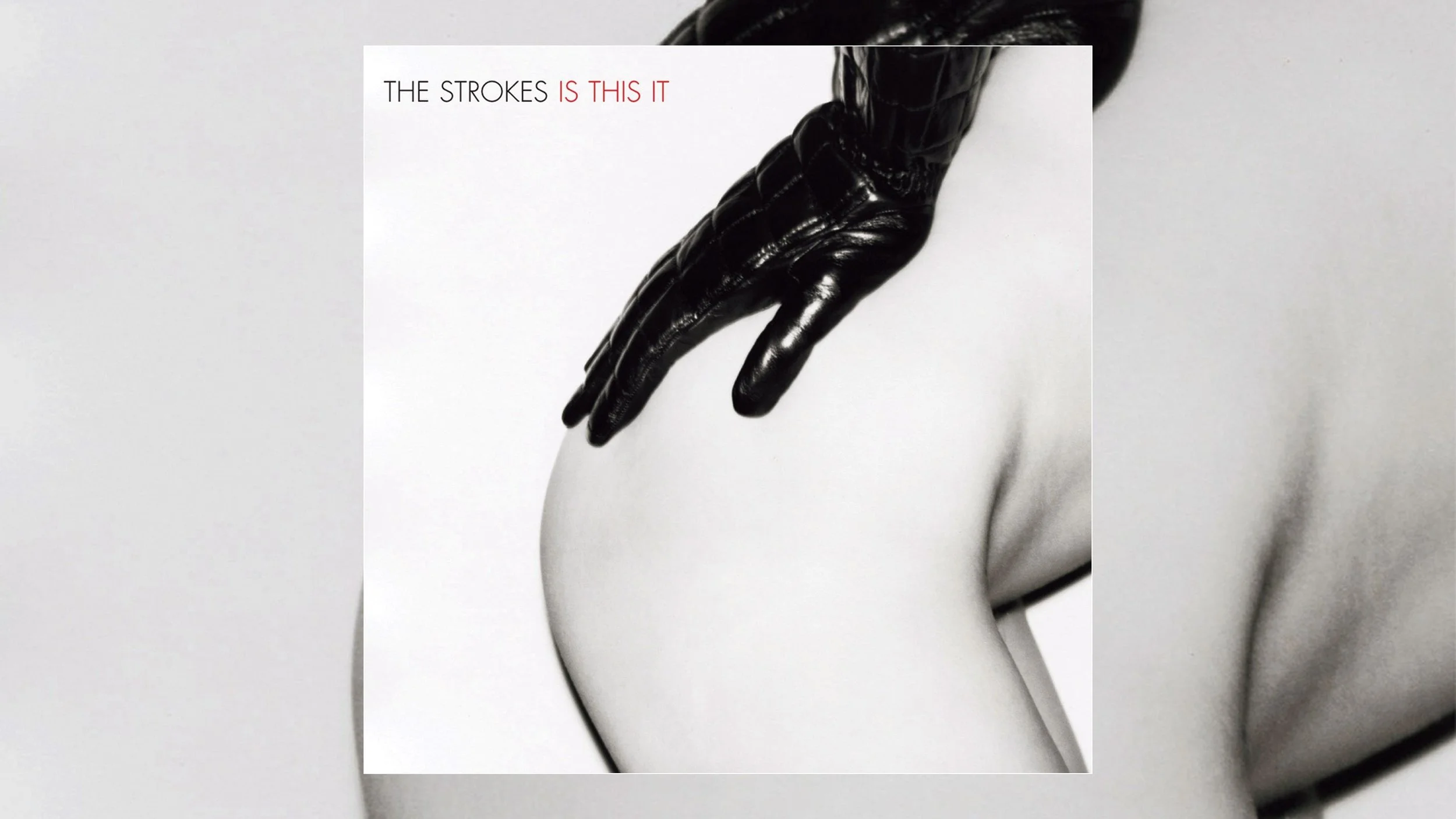
Happy 25th Anniversary to The Strokes’ debut album Is This It, originally released in Australia July 30, 2001, in the UK August 27, 2001 and in the US September 11, 2001.
Even though Jay McInerney was grumpy when he interviewed the Strokes in 2006 (“I’m too fucking old to be waiting around on some egomaniacal 27-year-old [Julian] who’s flexing his self-importance”), he’s probably one of the few people who actually saw them coming, long before anyone else did.
Call it “indie-sleaze,” call it the early-aughts New York scene—it seemed like it was never supposed to happen. In fact, at the turn of the millennium there was a prevailing attitude that rock ‘n’ roll was dead and every last remaining shred of cool had died along with it in 1996 when the alternative-music bubble burst.
That same year, President Bill Clinton had signed the Telecommunications Act of 1996, which gradually choked regional radio stations, and contributed to the prevalence of shitty corporate rock like Matchbox 20. Even Lollapalooza was on its last legs in 1996 due to Metallica’s headlining the festival, a disastrous decision that helped “kill” alternative music, according to Rolling Stone. Meaning, what Seattle ignited nationwide in 1991 had become by mid-decade tired, stale, and embarrassingly imitated and appropriated. Grunge was over, and Creed and Limp Bizkit were muscling in with swinging wallet chains to claim its place.
However, at the end of 1994 in a New Yorker profile titled “Chloe’s Scene,” Jay McInerney had interviewed a 19-year-old up-and-coming “it girl” named Chloe Sevigny, who he deemed “the coolest girl in the world.” Whether Chloe was indeed the coolest girl in the world is a matter of personal taste, but that was really neither here nor there. Chloe’s scene, which we’d soon get sharper glimpses of through indie film and glossy magazines over the rest of the decade, seemed truly intriguing.
What McInerney managed to capture in his article was a sense of growing excitement for New York that seemed to be brewing just beneath our consciousness as our collective obsession with Seattle was beginning to wane. The bold, ever-churning street fashion, nights out at Tunnel and Limelight, raves at The Shelter, watching the skateboarders in Washington Square Park—McInerney bottled, via Chloe, the magic of young New York.
The following year, Larry Clark’s KIDS, starring Sevigny, would depict New York as a gritty skateboarding-and-rave haven for feral Gen X teenagers at the tail end of the generation and on the cusp of coming of age. An overlapping fashion scene (which spawned the “heroin chic” aesthetic, for better or worse) was being helmed by a young New York photographer named Davide Sorrenti, who was known to skate, do graffiti with, and photograph the KIDS actors, while also hanging out with the likes of models Milla Jovovich and Jaime King.
Meanwhile, indie films like 1995’s Party Girl (starring Parker Posey) depicted New York City as an exhilarating place to be an angsty twentysomething. And, as everyone now knows thanks to Love Story, Carolyn Bessette and JFK Jr. were making the city look sexy in the tabloids. For anyone paying close attention in the second half of the ’90s, New York seemed like the “next place” to be.
“Everyone has a fantasy about New York,” observes The Rapture’s Luke Jenner; but for a cohort of late-Gen X musicians, including Jenner, New York’s mythic magnetism would find a particularly unforgettable expression at the turn of the millennium.
Listen to the Album:
And who better to recognize that than the guy who wrote the actual book (Bright Lights, Big City) on chasing New York cool? Much like his foresight in recognizing Chloe Sevigny’s hipness before anyone ever saw her in KIDS, Jay McInerney had seen the Strokes perform in 2000 at the Mercury Lounge, a small venue on the Lower East Side. At that point, he was in his mid-40s, but he still managed to find his way to that club. “It felt as if maybe we were experiencing a Lazarus moment in the history of rock ‘n’ roll, the way a lucky few hardcore fans in Seattle might have felt hearing ‘Smells Like Teen Spirit’ for the first time,” he recalled in 2006. “For many Strokes fans, though, ‘Last Nite’ really evokes the fall of the following year.”
He’s referring, of course, to September 11th, the calamitous event that would turn the world’s attention on New York, and make the Strokes and their scene seem like it had arrived ready-made and like kismet as a salve to soothe New York’s (and the nation’s) heartache and half-decade hunger for cool.
Out of the five Strokes, four were native New Yorkers, growing up on the tony Upper East Side. Albert Hammond Jr. grew up in Los Angeles (his father was a songwriter whose credits include the Julio Iglesias and Willie Nelson duet “To All The Girls I’ve Loved Before”), and he’d first met Julian Casablancas when they both attended the posh Swiss boarding school L’Institut Le Rosey. Julian’s father John Casablancas, the owner of Elite Model Management, had also attended Le Rosey in his youth. “I never lived with my dad,” Casablancas told SPIN in 2003. “Everything we got, we worked for.”
Julian met Nick Valensi and Fabrizio Moretti at Manhattan’s private Dwight School, and as they began to talk about starting a band, they soon added Nikolai Fraiture. “Julian was cool even before the band,” remembers Fraiture. “He was cool from first grade.” Fraiture and Casablancas had met while attending Friends School and Lycée Français de New York—meaning, there was no getting around the fact that these were definitely fancy private school kids, a fact many critics would use to dismiss the Strokes even though it wasn’t at all deserved.
As teenagers in the early ’90s, they were obsessed with grunge, particularly Pearl Jam and Nirvana, like everyone else their age (later, they’d get heavily into the Velvet Underground). Eventually, Casablancas dropped out of school to study music. He got his GED and went to a vocational music school called Five Towns College. Valensi had taken guitar lessons from a very young age (he once impressed them by playing Jimi Hendrix’s “The Star-Spangled Banner”), and Moretti had taken up the drums as a teen. Fraiture received a bass guitar as a 16th birthday present from his grandfather, but didn’t play it for another couple of years.
After high school, everyone started college or began working odd jobs around the city. But then in the fall of 1998, Albert moved to New York. “The way I met this band, too many things happened exactly right, that it seems so hard for it to just be luck,” Hammond recalls. “I ran into Julian on the street seven years after I’d met him in boarding school. Then I met everyone. I just felt it—the closeness. We were like brothers.”
In early 1999, they began practicing in earnest. They found a studio space on 38th Street in Hell’s Kitchen in what was known as “The Music Building,” where they locked themselves away for six months and began writing the songs for Is This It. Casablancas, the band’s principal songwriter, drove himself to perfection, remaining hours after everyone else went home. Their first gig was at a club called The Spiral, and only six people attended (Julian still threw up from nerves). They then rapidly started playing tons of shows at downtown venues like Brownies, Don Hill’s, Acme Underground, Luna Lounge, and Baby Jupiter.
But nothing really started to happen until they began playing the Mercury Lounge in the fall of 2000. It was there that they fortuitously met a fellow twentysomething named Ryan Gentles, the club’s booking agent. “The first time I saw the Strokes, I was watching a band that was just born a band,” he says. “I booked them immediately.” Gentles, who would soon become their manager, was so taken by the Strokes that he began sending out their demo to record companies. Geoff Travis at Rough Trade called the day he received it. “He said, “I want to sign them and fly the band to England for a tour. It was insane!” Gentles recalls.
Even though momentum was starting to build for the Strokes, for the other bands that would eventually form the early-aughts New York scene, there still didn’t seem like much of a “scene” at all. The Moldy Peaches knew the Strokes—they’d met Julian at a rooftop party and often attended the Strokes’ shows—but the much more folky Peaches didn’t really have a musical “home” yet of their own. “We just wanted to find a place to play music. It felt like all that wild, weird eclecticness had drained out of the city,” remembers Kimya Dawson. Her bandmate Adam Green agrees, and recalls being unimpressed when first moving to the city in the very late ’90s: “I remember thinking that maybe New York isn’t the kind of city anymore that produces iconic bands.”
Karen O, who Dawson and Green eventually met in the small anti-folk scene at the SideWalk Café in the East Village, had the same impression. “I was grateful playing at any venue in New York City, but it just wasn’t exciting me. I was skulking around the music scene, trying to sniff out some blood,” she says. “The last big wave of New York bands was a long time passed. I wanted something explosive to happen, without understanding what that was.”
Watch the Official Videos:
Although exciting things had been happening in New York in the mid-to-late ’90s in terms of the fashion and club scenes (as captured in “Chloe’s Scene”), not a lot was happening in terms of a rock scene—except for a band called Jonathan Fire*Eater. According to Lizzie Goodman’s oral history Meet Me In The Bathroom, Jonathan Fire*Eater was the blueprint, or progenitor, for the bands that would eventually form the early-aughts New York scene—they had the same swagger, style, sophistication, and garage-rock edge, as well as whatever it is that managed to scream “timeless New York rock ‘n’ roll.” Karen O remembers traveling to the city from New Jersey to see them when she was still in high school. “Those guys had so much fucking chutzpah sex appeal,” she recalls. “They’re these kind of scrappy, skinny, effeminate dudes, but just so fucking sexual. Just primal sex oozing out of their pores. It was so awesome.”
“A lot of my fashion sense was influenced by those guys,” says Interpol’s Paul Banks. “This girl I went to high school with in Spain was at NYU with me. Her boyfriend’s best friend was this guy Giles. Anyway, he was buddies with them, so I went to see Jonathan Fire*Eater at Tramps with Giles. Somehow, I was even in their dressing room beforehand. I never even spoke to Stewart [Lupton, the singer], but his presence was like: ‘Man, that’s what cool looks like.’”
The Strokes’ Nick Valensi never caught the band during their short heyday, but he remembers the comparisons. “It was always industry people who would mention, ‘Oh yeah, you guys are like what Jonathan Fire*Eater should have been five years ago,’ and we were like, ‘Who the fuck is that?’ I’d never heard of them.” Sadly, after recording two albums, Jonathan Fire*Eater broke up in 1998, largely due to Stewart Lupton’s heroin addiction, and the band came to be known as “possibly the most hyped young group that nobody has ever heard of.” (Band members Paul Maroon, Matt Barrick, and Walter Martin would eventually go on to form The Walkmen.)
But fast forward back to 2000. As Karen O was walking into Mars Bar where she’d meet Nick Zinner with whom she’d form Yeah Yeah Yeahs, and Interpol were honing their sound and self-releasing EPs, the Strokes began playing a residency at the Mercury Lounge, and a loud buzz began building around them in New York. In fact, Ryan Gentles began encouraging them to play other cities every so often so as to create a void, and more demand, in New York. Then, in January 2001, they embarked on the sold-out tour of the U.K. that Geoff Travis of Rough Trade had promised. They brought the Moldy Peaches along to open for them.
As had happened with the Pixies before them, the Strokes broke in the U.K. before anyone in the United States (outside of New York) remotely registered their appeal. The crowds were rabid, and the English music press fawning. The NME had offered a free CD on its cover that included “The Modern Age,” and the Strokes had unknowingly already built up a fanbase. “Were you guys aware of the craziness that you created before coming here,” one journalist asked. “Not before coming here, no,” said a stunned-looking Nikolai. “I don’t even know what’s going on right now,” Julian stuttered. “It’s all crazy and cool and bizarre.”
Even in New York, before they’d been signed to Rough Trade and charmed the pants off the Brits, the Strokes possessed an unmistakable glamour and magnetism even when simply strolling the streets. The first time they all met Albert Hammond Jr., he was wearing a suit, and they immediately strove to up their fashion game, choosing fitted leather jackets, tight jeans, and sleek boots. Beyond their shared aesthetic, the band’s unmistakable camaraderie lent them an aura of enviable exclusivity. “The thing with the Strokes is they were a real band. A band should be a gang, running down the street, chasing a bus, breaking windows, breaking hearts,” asserts fellow musician Jesse Malin. “Those guys had that.” “We felt like a gang,” confirms Valensi.
The band’s The Modern Age EP came out in the U.K. on Rough Trade right at the end of their mini tour of the U.K., further solidifying their fanbase there. Doves had asked the Strokes to open for them on their U.S. tour, and they promptly embarked on that upon returning to the United States. Then came another small tour with Guided By Voices.
Meanwhile, RCA Records began showing major interest, and talks had begun for a signing deal while Interscope and Epic also began sniffing around. Even though the deal with RCA wasn’t done yet, the Strokes began recording Is This It anyway, using money from a publishing deal with Warner/Chappell that they’d signed earlier in the year. They chose producer Gordon Raphael, and recorded it in the Spring of 2001 at Transporterraum in Alphabet City.
The Strokes then embarked on a second tour of the U.K. Is This It came out that July in Australia, and then a few months later in the U.K. “The Strokes’ arrival was a bomb in the middle of a plastic pool,” recalls Geoff Travis appreciatively. Meanwhile, the New York scene started to become an actual scene. Rough Trade came to New York to sign the Moldy Peaches, and the British press began turning their attention on other New York bands, with the NME even putting out an issue with a cover that read “We Heart New York.” “I was really excited because I would go on Avenue A to this magazine store and find copies of NME and be like, ‘Dude! This is all happening around me and eventually they’re gonna find me!” recalls Luke Jenner of The Rapture.
And then America went to work on September 11, 2001, and the morning abruptly erupted into total confusion, and then utter horror. Julian and Albert watched the Twin Towers fall from the window of their apartment on 19th Street and 2nd Avenue. That evening, not knowing what else to do, the Strokes went to their rehearsal space. They drank and played music and talked about what to do about the irreverent track “New York City Cops” on the album. “There was so much going on, all these cops and firefighters who had just died,” Valensi remembers. “We didn’t want to be insensitive.”
Suddenly, all eyes were on New York…and on the Strokes. Is This It was released in October (sans “New York City Cops”) and the Strokes performed a huge Halloween show at Hammerstein Ballroom. Meanwhile, the rest of the country gradually started catching on to this true New York band, and began regarding their Strokes fandom (and support of the growing New York music scene) as a way of celebrating the city. “The Strokes became ambassadors, the embodiment of that leather jacket, denim, sunglasses cool New York City in people’s minds. ‘That’s New York City music. They’re the new Velvet Underground,’” observes Kimya Dawson.
Is This It begins with the sound of a tape rewinding, a reminder that even though we’re already in the digital age, it’s a record that harkens back to an analog era. “Imagine you took a time machine into the future and found a classic album from way in the past and really liked it,” Casablancas told Gordon Raphael when discussing the sound he wanted to achieve. In fact, that’s the Strokes’ quintessence—they managed to sound uncannily like a band from the past (Television, The Velvet Underground, take your pick), but in a way that’s also startlingly fresh and modern. That is the heady magic of Is This It.
The album kicks off with the titular “Is This It,” Julian’s voice bored and listless but also unmistakably sad against the sunny backdrop of dual/dueling guitars and minimalistic drumming. “Can't you see I'm tryin'? I don't even like it / I just lied to get to your apartment / Now, I'm stayin' there just for a while / I can't think 'cause I'm just way too tired.” The majority of these songs will capture the clashing exuberance and ennui of youth, that twentysomething excitement of going home with someone only to realize when you get there that you really just want to fall sleep. As Jay McInerney observed, “It’s always 3 a.m. in Casablancas’s voice.”
The energy picks up with the stomping “The Modern Age,” a careening rocker where Julian even allows himself a growl. Letting yourself get lost in the song’s swagger, you can understand why Adam Green would say of the band’s early shows, “There was hysteria in the audience. These guys were, like, sex gods.” And also why, as a single, “The Modern Age” caused so much hysteria in the U.K. before the band even got there. Its strutting energy offset by Julian’s bedhead languor, and Nick Valensi’s sultry, wailing guitar solo, make it one of the most unforgettable tracks on the record.
“Soma” contains delightfully shifting rhythms, although it’s anchored in a simple guitar riff and steady, driving drums. “Barely Legal” is snaking and twisting, a tale of wasted youth and lost innocence—“I didn’t take no shortcuts / I spent the money that I saved up / Oh, mom, I’m runnin’ out of luck / But, like my sister, don’t give a fuck.” It’s one of the most classicly rock ‘n’ roll songs on the album, sounding like it could have come out any time from the ’50s to the present.
“Someday” is another track beaming with sunshine, and plenty of strut. You kind of want to tap dance with an umbrella to this song it’s so upbeat, and Julian suddenly regains some resolve—“I ain’t wasting no more time.” “Alone, Together,” another one of my favorites, is ticking and tension-filled—“Life seems unreal, can we go to your place?”—and captures the weird loneliness you think you’re not supposed to feel in your 20s, when you’re surrounded by friends and non-stop activity.
It segues perfectly into “Last Nite,” definitely the flagship song of Is This It—“Oh, baby, I feel so down / Oh, it turn me off / When I feel left out.” I first moved to New York in 1997 at age 20, and then again in 2002 at age 25, and I can still remember the exhilaration of a night of partying, followed by the tired letdown of morning, skulking home on empty gray streets or hurtling home in a barren subway car; “Last Nite” manages to capture both feelings simultaneously.
“Hard To Explain” opens with a pulsing drum-machine beat, and dissolves into something euphoric and gloriously poppy, featuring an abrupt stop mid-song that’s repeated again at the end. “When It Started,” which replaced “New York City Cops,” is strangely both marching and head-bopping, and seems to capture the life of a young professional in the city.
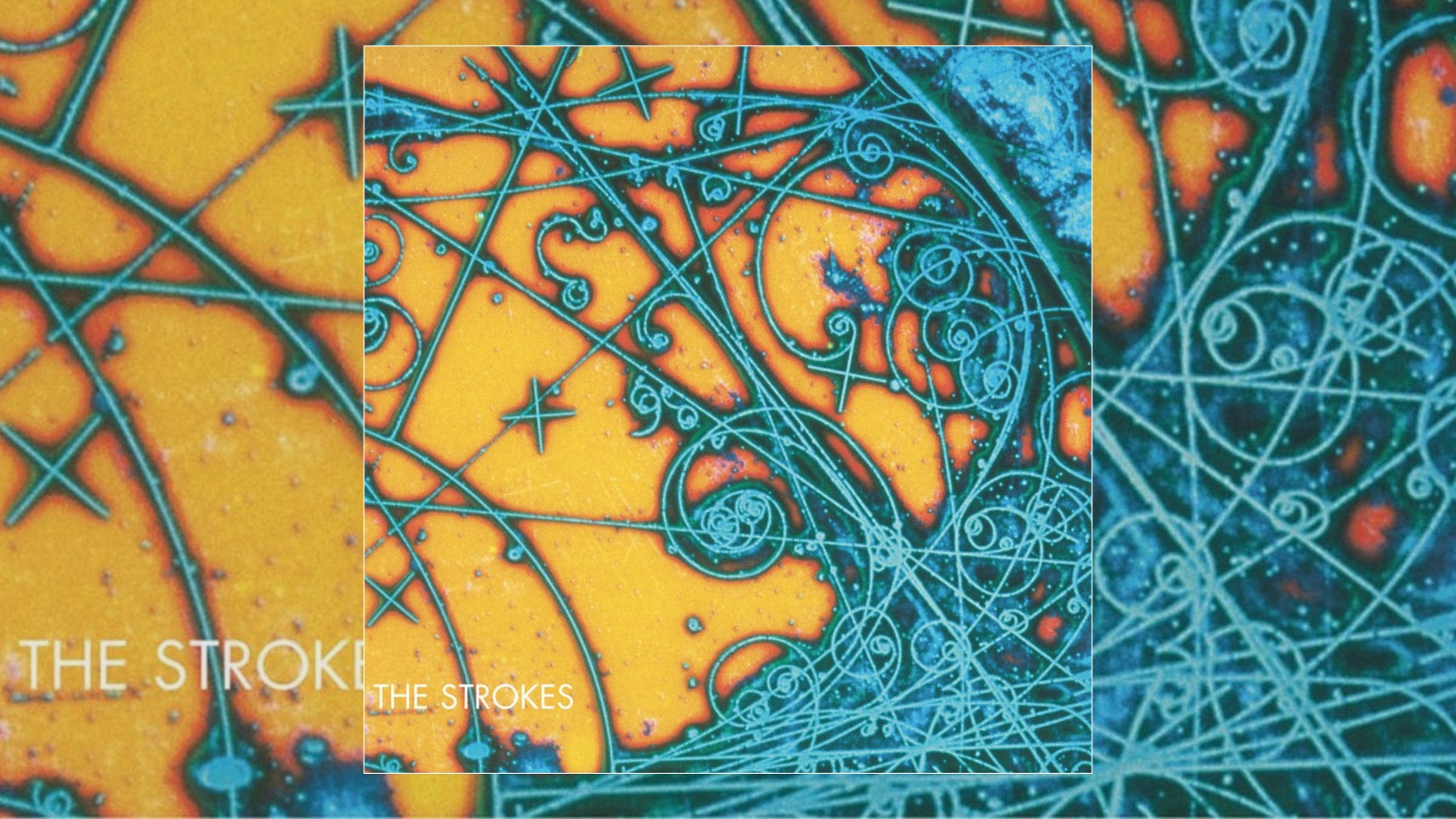
Alternative cover artwork for the US release of Is This It
“Trying Your Luck” offers a moment of heartfelt commitment, and is about being willing to lay it all on the line for a romantic prospect—“I know this is so rare, but / I’ll try my luck with you.” The album ends with “Take It Or Leave It,” which oozes with frustration over male-female relationship dynamics—“And girls act too much / And boys act too tough.” Here, Julian drops all pretense of boredom and embraces a full-on punk growl as the song chugs to an abrupt end.
During the recording of the album, the Strokes’ U.S. label dropped by the studio to hear the album. The record execs didn’t like its lo-fi quality, the sound Julian had purposely hoped to cultivate. “They said it was crappy-sounding and unprofessional, and I was ruining Julian’s voice and killing any chance the band had of a career,” Gordon Raphael remembers. “It was very satisfying when the album became a modern classic.”
Listen:
