
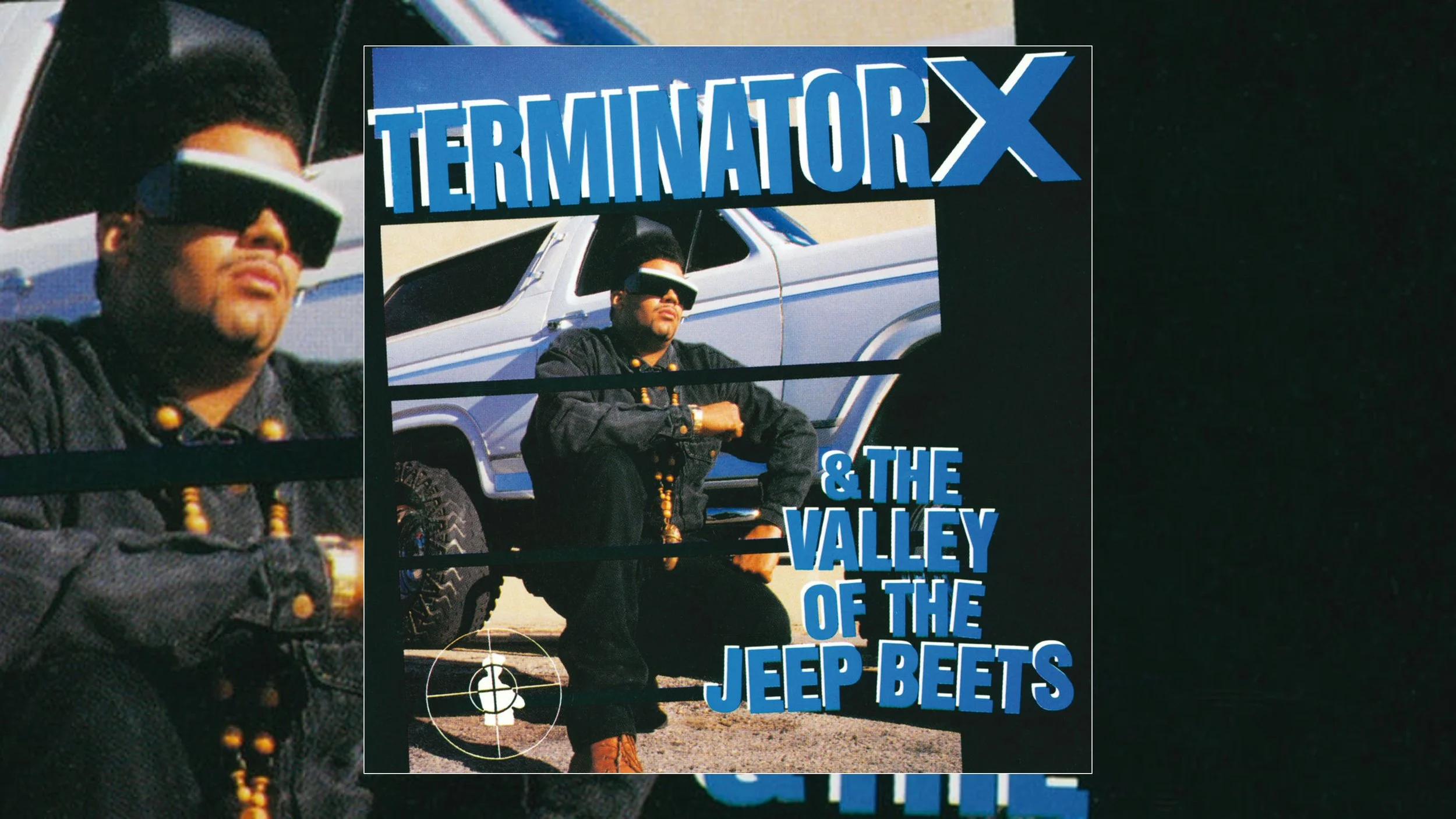
Happy 35th Anniversary to Terminator X’s debut solo album Terminator X & the Valley of the Jeep Beets, originally released May 7, 1991.
“’Is he a musician or a technician?’ He’s a little bit of both. He’s an Assault Technician, which means he attacks the music in his own way.”
This is how Chuck D describes Norman “Terminator X” Rogers in the liner notes of Terminator X & the Valley of the Jeep Beets, the debut project from the Public Enemy DJ, released 35 years ago. “He doesn’t talk much,” Chuck continues. “X represents a mystery—he is a mystery—and it represents a last name, a family name, that was taken away from Black people.”
It is true during Terminator X’s initial decade-plus run with Public Enemy that he was always presented as a cypher. He famously never spoke on record, or in interviews, because, as Chuck and Flavor Flav would frequently remind us, he “speaks with his hands.” He cut an imposing figure when he appeared in the group’s videos or promotional photos, frequently dressed in all black and wearing futuristic-styled sunglasses. He’d often loom in the background or behind a pair of turntables, in motion only when he scratched or cut records.
It makes sense that Terminator X would release his own “solo” album before Chuck D or Flavor Flav. Public Enemy was rooted in old school tradition, where the DJ was championed as either an equal partner in the group or the frontman. So, the idea that Terminator would put together his own album, while still representing the core group, was very much in keeping with Public Enemy’s ethos.
The early 1990s were a great time creatively for hip-hop artists on a major label. It was probably the last era when artists could try something different and still get backing. I believe I’ve written here before how 1990-91 was a great period for Def Jam Records, as they put out more underground and experimental releases than any other period of their existence. It was also before sample clearing costs were a major concern, so there was ample artistic freedom.
Valley of the Jeep Beets was a Terminator X-fronted compilation, featuring various up-and-coming artists doing their thing to the DJ’s production. “I think of this thing as a Quincy Jones of hip-hop type music project,” Chuck wrote in the liner notes, “…not straight hip-hop all the way through but hip-hop flavored music.” Indeed the 13-track album is a collection of songs from across numerous musical genres. Many of these artists hadn’t appeared on an album before, and few would afterwards, but Terminator X found the best way to accentuate their strengths.
The album is structured to emulate an underground radio broadcast that would emanate out of the speakers of jeeps traversing the roads after the sun had set, channeling “50,000 Watts of funking hip-hop power.” Songs flow into hectic transmissions and again into dense musical collages. The blasts are “hosted” by Jeff “Air” Foss, an infamous DJ at WRHU, Hofstra University’s radio station, as well as occasionally Wildman Steve, who worked with Chuck D while at WBAU, Adelphi’s college station.
Though Valley of the Jeep Beets is a Terminator X album, released on the DJ’s Def Jam-backed P.R.O. Division imprint, the Bomb Squad’s guidance is apparent. The production squad, best known as the architects of Public Enemy’s sound, “supervised and reduced” the album, and Carl Ryder (Chuck D’s production alias) is listed as one of its executive producers. Valley of the Jeep Beets was released during a time when the production collective was working to spread its wings through its SOUL Records imprint. This album can be seen as one of three more experimental Bomb Squad-related projects released in the first half of 1991.
That said, it’s still primarily Terminator X’s show, and he makes his presence felt on every track. Valley of the Jeep Beets is a thumping aural experience, with Terminator providing the glue that holds the album together.
Listen to the Album:
Valley of the Jeep Beets explodes with atomic bomb-like force from the beginning with “Buck Whylin’.” Featuring raps by Chuck D, it’s very much a Public Enemy song, and is one of the top 5 tracks the group recorded during the 1990s. Chuck is at his fiery best, delivering four verses with thunderous authority. The track, which Terminator later revealed was “Chuck D’s creation,” samples the gritty guitars of Black Flag’s “Rise Above” over the “Funky Drummer” break. Terminator X makes his presence felt on the turntables, furiously scratching the intro vocals to En Vogue’s “Hold On.” The song also featured the first on-record appearance by rapper/activist/author Sister Souljah, who provides the memorable introduction and soliloquies between each verse.
Terminator X does an excellent job overall on all of the album’s singles. “Homey Don’t Play That,” featuring raps from the duo Bonnie & Clyde, is a solid early 1990s offering. Both women contribute competent verses to a sample of James Brown’s “The Payback.” It’s also a throwback to a time when rappers would name songs after pop-culture catchphrases.
“Juvenile Deliquentz”” by the group of the same name, is also entertaining. The collection of young rappers might not have been the sharpest on the mic, but they effectively convey the frustration of being young Black men trapped in an education system that doesn’t seem concerned with offering them anything of lasting value. Terminator X again shines on production, manipulating a piece of Jimmy McGriff’s “It Feels So Nice To Do It Again.”
“Back to the Scene of the Bass” by The Interrogators is another of the album’s most chaotic songs. Terminator X crafts the track from seemingly dozens of sample sources, creating a churning whirlwind of sound. The group, fronted by rapper B-Wyze (who’d go on to collaborate with Public Enemy for years), describes taking things to the streets in old school-styled sound systems battles, while one member of the crew even describes his struggles with drug addiction. Veteran emcee True Mathematics appears on the song to reprise his role as crooked police officer Sgt. Hakes. The rapper, who released a Bomb Squad produced album in the late 1980s, introduced the character on another Public Enemy B-side “Get the F… Outta Dodge.”
Terminator X’s production does a lot of heavy lifting on other entries. Though Andreas 13 delivers well-intentioned raps about the everyday hardship of living as a Black man in the United States on “The Blues,” as an emcee, he probably wasn’t ready for prime time. The production also carries “Wanna Be Dancing,” the album’s first single and attempt at a radio friendly dance track, featuring a sample of Parliament’s “Body Language.” Celo of the Casino Brothers does a serviceable job attempting to engage the audience, but it was not the club banger that they envisioned.
Valley of the Jeep Beats does feature some innovative non-hip-hop offerings. “DJ the Selector” is a dancehall track featuring The Dub Master. Terminator X’s approach was ahead of the curve, as the use of the busy, wall of sound production for a dancehall song would pre-date the hip-hop remixes for future legends like Supercat and Louie Rankin by a couple of years.
“Run That Go Power Thing” by The Spacey B. Experience was very “ahead” of its time. The track is a high energy throwback mid-1970s style psychedelic soul/rock song, powered by a full horn-section, a few blistering guitar solos, and scratches by Terminator. Though the track seemed a little out of place on the album in 1991, there is very much a market for this type of song during the last two decades. The Spacey B. Experience could release a 45 RPM of this song on Now-Again Records tomorrow and no one would assume that it was recorded more than 30 years ago.
“No Further,” an R&B track by Section 8, is one of the album’s clear misses. Terminator opts for a sparse production approach, with the group crooning to the drum track from Biz Markie’s “Make the Music With Your Mouth” and occasional sprinkles of piano and synthesizer. That said, the vocalists are pretty subpar and don’t add much musical value.
Chief Groovy Loo, who ends the album with “Ain’t Got Nothing,” sounds like the most seasoned “new” emcee on the album. He powers his way across the track at a brisk pace, delivering three verses to portions of Kool & the Gang’s “Funky Stuff” and various other guitar and keyboard stabs. Loo would end up being the only rapper on the album to put out a post-Valley of the Jeep Beets album. Chief Groovy Loo and the Chosen Tribe’s dropped Got ’Em Running Scared (1993), executive produced by Chuck D, through Ichiban/WRAP Records.
Valley of the Jeep Beets might not have launched many new careers, but it was still extremely entertaining. I might not have ever owned a jeep, but I can attest that it sounded good in a Walkman. Terminator X might not have ever spoken on record, but his debut was a primal, and triumphant, roar.
Listen:
