
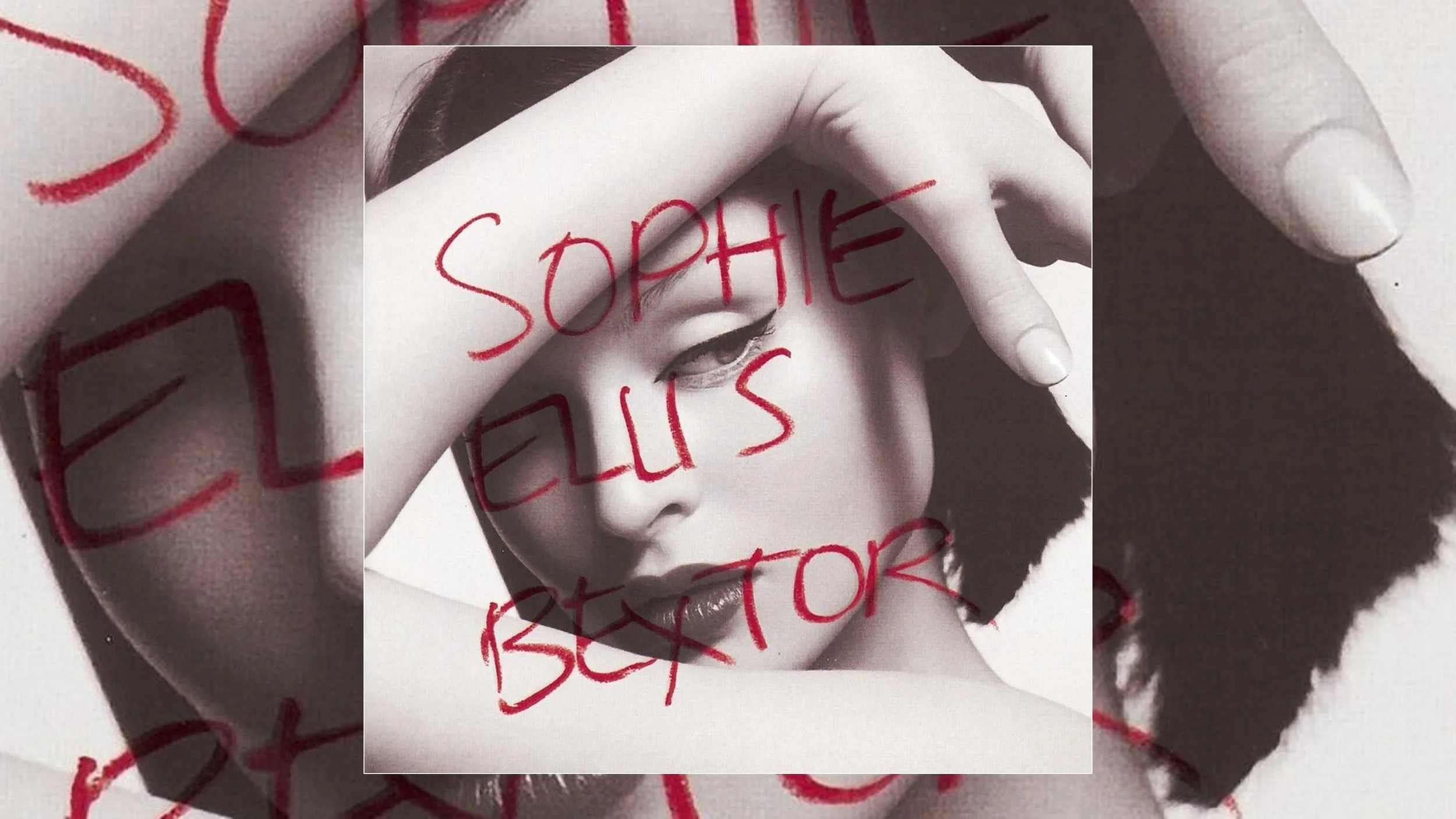
Happy 25th Anniversary to Sophie Ellis-Bextor’s debut solo album Read My Lips, originally released in the UK August 27, 2001 and worldwide September 3, 2001.
Twenty-five years ago, Sophie Ellis-Bextor stared directly down a camera lens, crimson lips immaculately painted, and introduced herself as though pop music were an invitation she might accept, provided the room was interesting enough. Read My Lips remains one of the more peculiar British pop debuts of its period: sophisticated without becoming remote, knowingly theatrical without collapsing into novelty, and utterly committed to the proposition that dancing could be glamorous, strange and faintly dangerous.
For those of us who were there when it arrived, separating the album from the life surrounding it is almost impossible. I remember the phenomenon of “Murder on the Dancefloor” happening in real time. More personally, I remember the nights. So many nights. Clubs, crowded floors, that opening instrumental appearing through the noise and Ellis-Bextor’s unmistakable voice following it. Certain records become attached to memory because we deliberately place them there. Others simply infiltrate. Read My Lips did the latter.
Its origins, however, were hardly inevitable. Ellis-Bextor had emerged as vocalist of Britpop band theaudience before its dissolution left her searching for another musical language. The answer came partly through Spiller’s “Groovejet (If This Ain’t Love),” the 2000 disco-house colossus that transformed her into an international pop presence. Its success created an awkward problem for Read My Lips: how do you follow something that already sounds like the definitive version of you?
Critics noticed. Some reviews judged the album against “Groovejet,” occasionally finding it wanting, but twenty-five years later that comparison feels unnecessarily restrictive. Read My Lips was doing something more complicated than manufacturing another “Groovejet.” It was constructing Ellis-Bextor as a pop character, and what a character she became.
“Take Me Home” opens the album by reworking Cher’s 1979 disco recording with a distinctly early-millennium sheen. The production is polished almost to the point of reflection, yet Ellis-Bextor never disappears inside it. Her voice has always possessed a fascinating emotional temperature: cool, clipped and unmistakably English, she rarely attacks a song when she can arch an eyebrow at it instead. Where other singers might have pushed these arrangements towards vocal excess, Ellis-Bextor understood restraint as seduction.
“Lover” continues that delicious aloofness, while “Move This Mountain,” written with Ben Hillier and Blur bassist Alex James, exposes something darker underneath the immaculate surface. Its heavier atmosphere is important to the album’s architecture because Read My Lips is remembered as a dance record, but it is not relentlessly euphoric. Desire here frequently comes with unease attached.
Listen to the Album & Watch the Official Videos:
At the album’s center sits “Murder on the Dancefloor,” written by Ellis-Bextor and Gregg Alexander, and close to immaculate: that guitar figure, the elastic bass, the gleaming strings, the conversational precision of her vocal. Even its central threat is delivered with impeccable manners. “Murder on the Dancefloor” never begs for attention. It behaves as though your attention was already guaranteed.
Pop history has been unexpectedly generous to the song. Its resurrection more than two decades later through Emerald Fennell’s Saltburn was extraordinary to witness. Suddenly, a track that belonged so vividly to one generation’s nights out was moving through TikTok, streaming charts and the bedrooms of listeners who had not been born when Read My Lips was released. There was something wonderfully vindicating about it. The song had not been rescued from obscurity; it had survived perfectly well. A new generation had simply discovered what the rest of us already knew.
Elsewhere, Read My Lips reveals considerably more range than its reputation sometimes allows. “I Believe” is sleek and melodic, while “Leave the Others Alone” and “By Chance” move into more introspective territory, revealing the melancholy that often sits just beneath Ellis-Bextor’s composure. “The Universe Is You,” from whose opening verse the album takes its title, is quintessentially Ellis-Bextor: romantic, stylish and slightly peculiar.
“Is It Any Wonder,” written with Moby, introduces another tonal shift, its electronic textures placing Ellis-Bextor within the broader experimental possibilities of turn-of-the-century pop, while “Everything Falls into Place” closes the original release with an almost appropriate sense of resolution. On the expanded UK edition, “Sparkle” and “Final Move” further complicate the record’s emotional palette. Neither feels like padding, with “Final Move” particularly allowing vulnerability to creep through the lacquer.
The production across Read My Lips is fascinating precisely because it refuses complete uniformity. Damian LeGassick, Jeremy Wheatley, Marco Rakascan, Ben Hillier, Alex James, Matt Rowe, Gregg Alexander and others contributed to a record assembled through multiple creative relationships, yet Ellis-Bextor herself provides the cohesion. Seventies disco architecture rubs against eighties electronica and the immaculate surfaces of early-2000s European dance-pop. Somehow, her voice makes these different rooms part of the same house.
Visually, Read My Lips was just as considered. Photographed by Mert Alaş and Marcus Piggott, Ellis-Bextor’s face became integral to the album’s identity: the lipstick, the porcelain complexion, the enormous eyes, the slightly aristocratic detachment. Even the title Read My Lips feels like both instruction and provocation. At a time when pop femininity was frequently marketed through accessibility, Ellis-Bextor offered something more eccentric. She could be glamorous without appearing desperate to be desired and camp without winking furiously at the joke.
That distinction matters to her cultural legacy. Ellis-Bextor helped preserve a particular strain of intelligent British dance-pop in which style was not considered the enemy of substance. Her later career would expand that universe considerably, but Read My Lips established its grammar. She made the dancefloor feel elegant and faintly surreal, a place where heartbreak could wear lipstick and emotional catastrophe could arrive with a four-on-the-floor beat.
Its commercial success, peaking at #2 in the UK and eventually earning double-platinum certification, confirmed that audiences understood the proposition even when some critics hesitated. Four singles carried its life well beyond 2001: “Take Me Home,” “Murder on the Dancefloor,” the double A-side “Get Over You” / “Move This Mountain,” and “Music Gets the Best of Me,” added to subsequent editions and another essential piece of Ellis-Bextor pop.
Twenty-five years later, perhaps the most remarkable thing about Read My Lips is how little embarrassment attaches itself to returning there. The clubs have changed. We have changed. Some of us may now encounter these songs in kitchens, cars and living rooms rather than beneath a mirrorball at one in the morning. Then again, perhaps some of us are still in the club.
Either way, the physical response remains. That beat arrives and memory starts moving before thought has caught up. Somewhere between who we were in 2001 and who we have become in 2026, Sophie Ellis-Bextor is still standing there, lipstick perfect, asking us to dance. Twenty-five years on, the answer remains yes.
Listen:
