
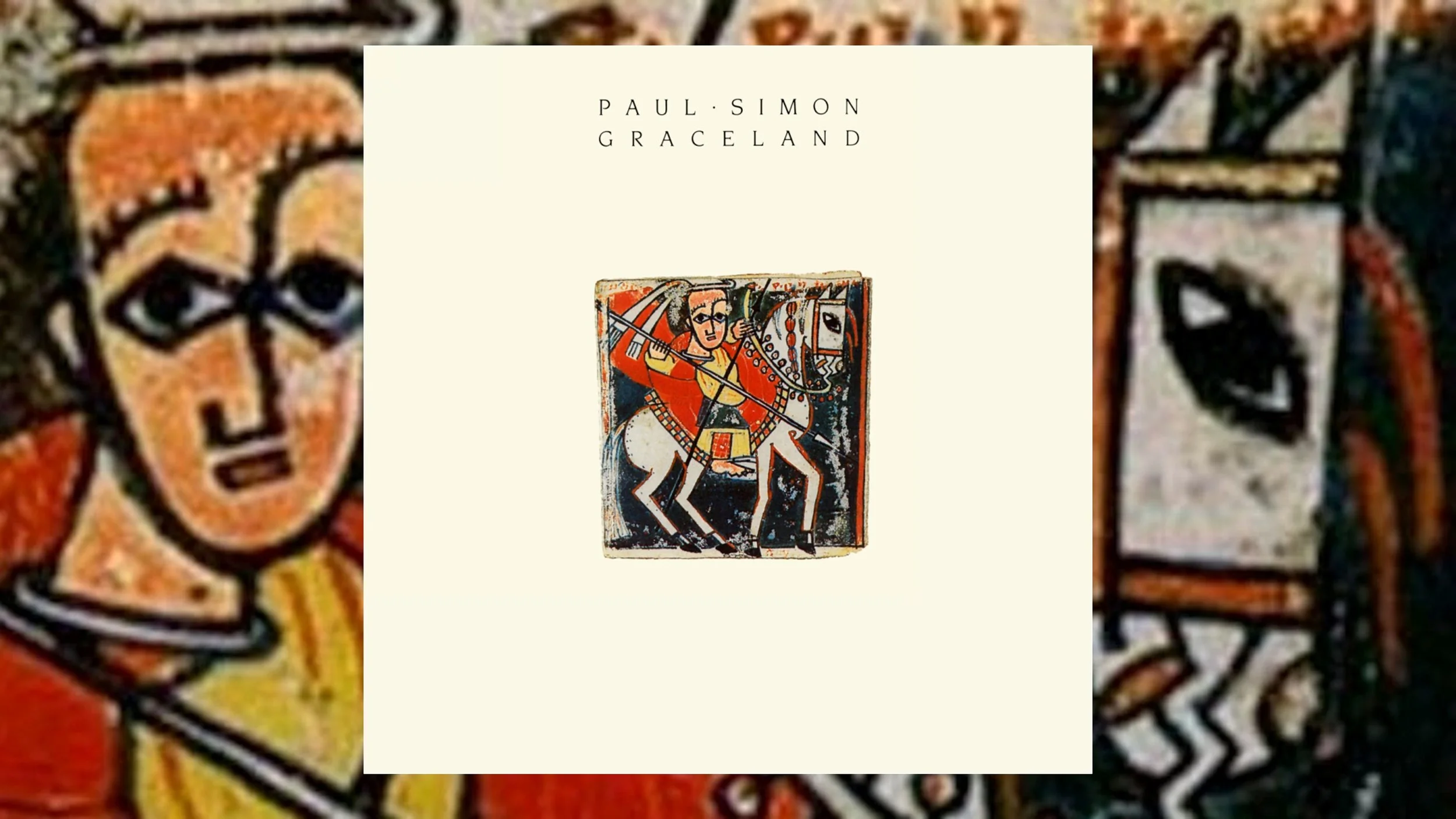
Happy 40th Anniversary to Paul Simon’s seventh studio album Graceland, originally released August 25, 1986.
Back in 1984, Paul Simon found himself in a rough spot—a messy divorce, and Hearts and Bones (1983) receiving a lukewarm reception. That album was meant to reunite him with Art Garfunkel, but ended up as a diary of his marriage with Carrie Fisher. Garfunkel’s vocals were wiped from the recordings. Simon summed it up best: “I had a personal blow (his divorce), a career setback, and the combination of the two put me into a tailspin.”
Then his friend, guitarist Heidi Berg handed him a cassette—no label, no explanation—of South African street music. Simon played it on repeat during a drive out to Montauk, totally hooked. Initially he was convinced it must have been some obscure strain of doo-wop, the music of his own Queens childhood, that had somehow escaped him. The cassette turned out to be Gumboots: Accordion Jive Hits, Volume II.
In a Rolling Stone interview from 1986, Simon talked about what pulled him in: “I was listening to it for fun for at least a month before I started to make up melodies over it. Even then I wasn’t making them up for the purpose of writing. I was just singing along with the tape, the way people do. It was very good summer music, happy music. It sounded like very early rock & roll to me, black, urban, mid-Fifties rock & roll, like the great Atlantic tracks from that period. The rhythm was a fairly uptempo, 2/4 feel with a strange accordion in there.”
Encouraged by Hilton Rosenthal, Simon decided he had to go to Johannesburg—not just to grab samples or fly folks to New York, but to actually travel there. Quincy Jones and Harry Belafonte quietly backed him during the We Are the World sessions, telling him to run it past the African National Congress. The South African black musicians’ union got together and voted to let him visit, saying the exposure would help their music reach the world.
But even with the union’s approval, not everyone was thrilled. Billy Bragg, Jerry Dammers, and Artists United Against Apartheid slammed Simon for breaking the UN’s cultural boycott. Didn’t matter why—he was still crossing a line.
So, February 1985 rolls around. Apartheid is at its peak, the boycott is in full force, and Simon, along with his engineer Roy Halee, lands in Johannesburg. No lyrics, no set songs, just a plan to play and see what happens. Groups like the Boyoyo Boys and General M.D. Shirinda and the Gaza Sisters jammed with Simon for two weeks. They laid down loose, sprawling grooves that later got chopped and reassembled into the bones of songs like "Gumboots" and "You Can Call Me Al."
The politics of the moment was a constant presence. The sessions had to wrap by early evening so the Black South African musicians could get home before curfew, since they risked being stopped and required to produce papers. Simon made sure his collaborators felt like equals, paying them $200 an hour—three times the New York rate—when the standard in Johannesburg was barely $15 a day. He split songwriting credits for any musical contributions as well.
Listen to the Album & Watch the Official Videos:
From Johannesburg, recording scattered across cities and continents. Musicians flew to studios in New York, Louisiana, London, and LA, adding Cajun accordion, Chicano rock guitar (with Los Lobos), and Louisiana zydeco to the stew. The South African core stayed front and center. One turning point: Lorne Michaels invited Simon to preview songs on Saturday Night Live in May 1986, with his South African band and Ladysmith Black Mambazo — a performance later described as nothing short of a revolution in American taste. The album finally dropped that August.
It starts bold with “The Boy in the Bubble,” where accordion crashes into drum machines, making it clear this isn’t typical 1986 radio fare. The title track follows, a father-son road trip to Elvis’s mansion that doubles as meditation on loss and reinvention. “I Know What I Know” throws South African folk melody against cocktail party small talk. “Gumboots” channels the tape that started it all into a breezy horn-driven shuffle.
"Diamonds on the Soles of Her Shoes," built around Ladysmith Black Mambazo's vocal arrangements, is the album's clearest statement of cross-cultural harmony—American melody riding on Zulu counterpoint. “You Can Call Me Al” storms through with Bakithi Kumalo’s bass solo (played backward!) and Simon’s quirky lyrics about an identity crisis.
The album’s second half softens and stretches out—“Under African Skies” (with Linda Ronstadt), “Homeless” (a cappella with Ladysmith, blending Zulu and American gospel), “Crazy Love, Vol. II,” “That Was Your Mother” (recorded with Good Rockin’ Dopsie), and “All Around the World or the Myth of Fingerprints” (featuring Los Lobos), tying up the album’s restless travels.
What holds it together isn't a lyrical concept so much as a temperament: joy and sorrow sitting in the same bar, often the same line, a pattern that mirrors the tension of its own creation. What binds everything isn’t some grand concept—it’s the mood. Joy and sadness mixed together, sometimes in the same lyric, echoing the contradictions of its creation.
Graceland snagged the GRAMMY Award for Album of the Year, went multi-platinum, and shook up what Americans knew about African music. Ladysmith Black Mambazo became international stars, and the record is credited for kicking off the “world music” wave. The Library of Congress added it to its National Recording Registry in 2006.
But its legacy? Never simple. That’s why it still matters. Simon made it by defying a boycott designed to isolate a regime he openly opposed. People—especially Black artists and anti-apartheid activists—argued whether Simon’s collaboration was solidarity or exploitation, even with fair pay and shared credit. Simon’s take? The boycott targeted the government, not musicians, and making music together was itself a stand against apartheid’s division.
Four decades later, Graceland remains true to what it was from the start—a beautiful, tangled, genuinely collaborative album that changed what pop music could sound like.
Listen:
