
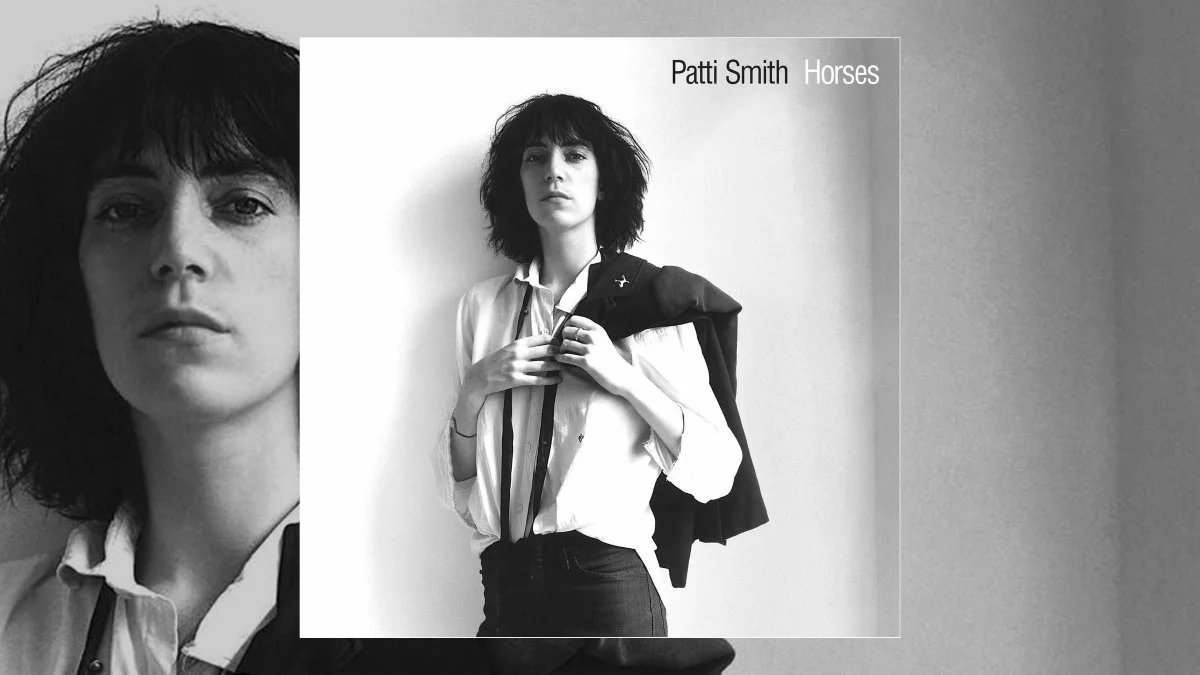
Happy 50th Anniversary to Patti Smith’s debut album Horses, originally released December 13, 1975. (Note: Select sources cite November 10, 1975 as the album’s original release date.)
On Valentine’s Day one year, Patti Smith and her husband Fred “Sonic” Smith went horseback riding on the beach. She had a white horse and his was speckled gray. Suddenly, his horse broke into a run and she decided to follow it. They tore across the beach in reckless, salty, windblown abandon. “Had it been a scene in a movie, I could have happily made it never ending,” she recalls. In another memory, Smith, who was always sickly as a child, stole a skating pin from another sick child, rifling through the little girl’s jewelry box while she was sleeping. The child died not long after, and the stolen pin haunted Smith from its hiding spot under her bedroom floorboards in the way that Smith’s later song “Free Money” would capture the desire for a quick, easy fix that’s never actually quick or easy.
Smith grew up poor in rural South Jersey, near a square-dance hall. As a young teen, she fell in love with a boy named Johnny, who lived down the hill to the first right. He hunted squirrels and rabbits for sustenance, and she doesn’t remember him having a mother. He shyly gave Patti his brown boot lace for her skate key, and he had dark blond hair that fell in his eyes in a way that reminded her of James Dean.
One Saturday, he asked her to go skating with him, and she can still picture him bending down to tie her laces in a quiet act of chivalry. They held hands and skated the rink in endless circles, time freezing that moment of innocence. A few days later, because she hadn’t heard from him, Patti got on her bike and rode down the hill to the first right, only to see Johnny’s father motioning to him and his sister to hurry. The family’s station wagon was packed with all their worldly belongings. As they drove away, Johnny pressed his palm to the window, his young face reading a bleak goodbye.
For a long time prior to that, Smith had felt like she was suffocating. She loved poetry—by age 15 she would develop an obsession with the transgressive French poet Arthur Rimbaud—and her desire to one day be an artist of some ilk made her dreams big and technicolor and bursting at the edges, far too big for South Jersey to contain. Only her devotion to her siblings had kept her from running away.
One autumn evening, lightning struck an old black barn, which burst into flames. As her siblings ran outside to get a closer look, Patti stayed behind bouncing her youngest sister Kimberly on her hip. The conflagration—and her resentment that she couldn’t get closer to the action, offset by her deep love for her baby sister—would stick with Patti, and the scene would form the basis of the song “Kimberly.”
These are merely a few of the narrative threads and nubby knots and frayed scraps of life that formed Smith’s seminal debut album Horses, and the big, expansive, colorful life that stretched out after it. In her new memoir Bread of Angels, released last month, Smith reflects on her 78 years with a calm, but hard-earned wisdom, often framing things in generational terms. During George W. Bush’s presidency, Smith protested the war in Iraq as well as several of the president’s controversial policies, and she seems to see Bush, born in 1946 like herself, as a symptom of a moral failing, or a selling out, of the Baby Boomer generation. (She doesn’t mention Donald Trump, also born in 1946, but I’m tempted to interpret her fiery, uncensored feelings for Bush as a stand-in and a precursor.)
At one point, in Patti Smith: Dream of a Life, a documentary filmed over the course of a decade that included the Bush era, Smith feverishly works up the crowd during a performance of “My Generation.” “My generation, we had dreams. We had dreams, man. And we fucking created George W. Bush! New generations, rise up! Rise up! Take the streets—the world is yours.”
Listen to the Album:
Out of all the disparate urges and dreams and odd moments of happenstance that came together to make Patti Smith a new kind of rock star, a deep sense of generational responsibility glows at the core of Horses, the album that ignited punk and changed the way we regard rock ‘n’ roll and gender and what is orthodox when it comes to artistry.
“I believe it’s Patti’s journey of defining herself within the lineage and tapestry of rock ’n’ roll,” muses Lenny Kaye, Smith’s founding partner in the Patti Smith Group. “Both of us grew up with the music as the soundtrack of our liberation. What are you going to do to further the music’s progression? We felt, for whatever reasons, the initial spark and instinct of what attracted us to rock ’n’ roll in the first place was in danger of being lost by a new generation.”
In other words, innovation and risk were about to be buried by slick, overproduced, status-quo ’70s rock. “We wanted to evolve it [rock ‘n’ roll] in a certain way so that there would be a next generation. That it could continue and not be a rehash of what went before,” Kaye asserts. “That, to me, is what punk is about.”
There’s another scene in Dream of a Life where Smith (who, in addition to being a musician, is also a visual artist, a photographer, and a writer) sits in her art studio, painting murky drips in brown, chartreuse, and eggshell white on a huge canvas propped against the wall. “I like the story of Jackson Pollock,” she murmurs casually. “Jackson Pollock was looking at a book of Picassos and he said, ‘Damn him!’ and he, like, throws the book and he says, ‘Damn him, he’s done it all!’ And of course, Picasso did do it all, except for what Jackson Pollock did.”
Smith points out that in Guernica, there’s a horse with tiny drips of saliva at its teeth. “It might be—you know, Picasso isn’t one for drips. They’re the only drips that I’m really familiar with in Picasso’s work.” She continues painting unhurried. “It’s like Jackson took the drips from the mouth of the horse and then took that small aspect and created a new vocabulary.”
And that’s precisely what Smith did with Horses, from the embers of the music of the ’60s. “As T.S. Eliot said, every generation translates for itself and it’s up to us to both embrace history and break it apart. Blow it up even,” she asserts, dripping a snaky streak of chartreuse through a muddle of brown.
Smith eventually left South Jersey, where she’d been toiling in a non-unionized factory, for New York City in 1967. She soon struck up a friendship with the photographer Robert Mapplethorpe that was so beautiful, formative, and intense that it eventually become fodder for her memoir Just Kids. “Write our story,” he said as he was dying of complications from AIDS in the late ’80s, and so she did, the memoir eventually winning the National Book Award for nonfiction.
Energized by the city, Smith wrote prolific poetry, and began developing a strong, memorable stage presence at readings throughout the early ’70s. She strove to never be boring, and so she recruited guitarist and music critic Lenny Kaye as accompaniment, asking him if he could make his guitar sound like a car crash. Kaye was already interested in new musical expressions, having curated the 1972 album Nuggets, whereby he collected dissonant garage-rock songs he called “punk rock.”
The duo soon morphed into a band, adding pianist Richard Sohl, who had an improvisational jazz background, and guitarist Ivan Kral. They played residencies at Max’s Kansas City in 1974, and at the Bowery’s sublimely filthy CBGB, which owner Hilly Kristal had recently opened in response to bands like Television and Smith’s own forming an as-yet-undefined scene. After seeing them perform at CBGB, drummer Jay Dee Daugherty joined the band in the summer of 1975. A contract with Clive Davis’ Arista Records soon followed, and they recorded Horses that autumn at the late Jimi Hendrix’s Electric Lady Studios. It would be the first album from CBGB’s renegade scene to break through to the mainstream.
They chose John Cale, former member of the Velvet Underground, as their producer. There would, famously, be friction between Cale and the band, but at this point in history it’s mostly been forgotten. “The collaboration between John and our band was very fruitful,” says Kaye. “ It forced us to make decisions about who we wanted to be. And that to me is what a debut album is. And the fact is that 50 years later, for whatever the strengths and flaws of the record, it’s still speaking to people.”
Robert Mapplethorpe took Horses’ iconic cover photo in the sun-drenched Greenwich Village apartment of his partner Sam Wagstaff. Smith wears an androgynous white button-down shirt, her black blazer thrown casually over one shoulder, a horse pin studding its lapel. Smith hoped to conjure the image of the French poet Charles Baudelaire. Upon seeing the photo, the record label wanted to airbrush the slight shadow of fuzz on Smith’s top lip, but she refused.
“She doesn’t look like any other female singer of that period. She hasn’t been prettified,” observes Philip Shaw, author of 33 ⅓: Patti Smith’s Horses. “The sort of hangover of the ‘hippie woman’ was predominant, I think, in the record industry’s view of what women should be. But here Patti is, looking androgynous, strange and challenging. That in itself was new and different.”
For Caryn Rose, author of Why Patti Smith Matters, the photo was a beacon to feminists, and maybe even to women who didn’t know they were feminists quite yet. “She didn’t have a full face of makeup. It was the secret ‘Bat signal,’” she says. “It was brave, but she didn’t know it was, that’s how she presented herself. There wasn’t really the concept of ‘nonbinary’ when I was growing up. I liked makeup and dressing up, but I didn’t want any part of it. Patti also liked it, but she wanted to control it. The cover was out there for everyone who needed to see it.”
In the process of refusing Arista’s desire to present her in a certain way, Smith also rewrote the album’s ad copy to better represent the band’s sound: “Three chords merged with the power of the word.” A formidable artist’s statement if there ever was one, and a distillation of what would soon become punk rock’s ethos.
The album rips open with perhaps the most memorable first line of any album ever: “Jesus died for somebody’s sins, but not mine.” Despite its seeming sacrilege, Horses will be a record that feels at many points like a revival, like a deep—if not religious—experience, then a spiritual awakening full of soul-scraping improvisation, sweat-soaked fervor, and, ultimately, transcendence. When Smith first wrote the words “Jesus died for somebody’s sins…,” initially as part of a poem called “Oath,” she saw them not so much as a provocation (she had been raised as a Jehovah’s Witness) but as a declaration of responsibility, “signaling accountability for my choices in life and art.”
“Oath” was repurposed in service of reimagining the 1964 song “Gloria” by Van Morrison’s band Them. Retitled “Gloria: In Excelsis Deo,” the song sees Smith bending gender yet again, when she leaves a boring party only to leer at a “sweet young thing” in a pretty red dress. The song is macho and peacocking, and yet Smith refuses to be anything other than the kind of rock god she’s always admired, unabashedly adopting the sexual confidence and swagger of Jim Morrison or Iggy Pop before her.
The laid-back, reggae-infused “Redondo Beach” was inspired by an argument Smith had with her sister Linda, who took off for Coney Island in a black cloud of anger. Patti suddenly, inexplicably had a panicky feeling that something had happened to her. She wrote the lyrics in the lobby of the Chelsea Hotel, where she was living at the time, and even though it was inspired by fierce sisterly love, the song itself is about one half of a lesbian couple who dies by suicide, the woman’s body washing up on the beach. Kaye had long been inspired by reggae, often traveling to the West Indian neighborhoods in Brooklyn and asking the clerks at the record stores to play him every single. In performances, Smith used the introductory line, “Redondo Beach is a beach where women love other women.”
On the sprawling, incandescent “Birdland,” Smith’s inspiration is a book by Peter Reich, son of the psychoanalyst William Reich, in which Peter dreams his deceased father comes to rescue him in a UFO. Smith’s improvisational storytelling demonstrates her deeply imaginative way with words: “It was if someone had spread butter on all the fine points of the stars cause when he looked up they started to slip.” Smith’s awe and reverence eventually dissolves into a gorgeous cacophony of piano and wah-wah-infused guitar that mimics further descent into a beautiful but impossible dream.
“Every night before I rest my head / See those dollar bills go swirling ‘round my bed / I know they’re stolen, but I don’t feel bad / I take that money, buy you things you never had,” Smith croons on the tinkling, piano-studded “Free Money,” the first song she ever wrote with Kaye. The song turns into a chugging locomotive of a rocker, and you can almost see little Patti lying in her childhood bed, wrestling with the guilt of that stolen skate pin under the loose floorboard. The song, really, though was spurred by wanting to provide financially for her hardworking yet poor family. “The lyric, Scoop the pearls from the sea, cash them in and buy you all the things you need, was written for my mother,” Smith divulges. “We all wish for things beyond our grasp; she dreamed of having a big house for the family with many bedrooms on a cliff overlooking the Mystic River.”
Another song about family, “Kimberly” pulsates and shimmers like a half-forgotten dream, but Smith’s memory is sharp-edged and vivid: “The wall is high, the black barn / The babe in my arms in her swaddling clothes / And I know soon that the sky will split.” It’s a song that any oldest sister can relate to, or anyone who’s had to take on too much responsibility for her siblings, no matter how purely and ferociously she loves them: “And I feel like just some misplaced Joan Of Arc /And the cause is you lookin’ up at me.”
Pinpointing unacknowledged emotional and physical labor is often deeply liberating for women, who are too often made default caregivers. “That’s not just a love song between two sisters or from one sister to another sister, but it’s also like you can hear the weight of her saying, I’m caring for another living being right now,” observes the musician Blondshell. “When I heard her say, ‘I feel like just some misplaced Joan of Arc,’ and then later, ‘Your soul was like a network of spittle,’ I was just like, wait a second. We’re allowed to say things like that?”
For the song “Break It Up,” Television’s Tom Verlaine encouraged Smith to cull her writing notebooks in a new way. Smith opened up to a page about a dream where she was in a graveyard with a statue that reminded her of Jim Morrison, imagining that she needed to “break it up” in order to free Morrison’s life force inside. It’s a song that reminds me of the winter when, as teenagers, my friend Koryn and I took a USO bus from our American army base in Heidelberg to Paris all in the name of visiting Jim Morrison’s grave in the Père Lachaise. I’m sure we did other things on that trip—probably visited some museums—but I mostly remember smoking Gauloises and wandering around that frosty cemetery for hours in a taste of chilly, but exhilarating freedom. The song itself is a dirty rock anthem with husky vocals and an infectious, fist-pumping chorus—and plenty of sexy, spidery guitar-playing provided by Verlaine.
The nine-minute triptych “Land” deals with the hero’s journey of Johnny, a character inspired in part by Smith’s friend William S. Burroughs’s novel The Wild Boys—and also possibly Smith’s first love who inexplicably had to leave South Jersey. For me, the song is about the deep, soul-cleansing salvation we are afforded every day through rock ‘n’ roll—raucous music as a transformative religious experience. In the opening scene of “Land” —written with slight remove like a scene in a film—Johnny is brutally assaulted and humiliated by a gang of boys in a high-school hallway and left for dead.
Suddenly, a stampede of white and silver horses rush in like the cavalry—Horses, horses, horses, horses—and the hallway is now a dusty and wild Western plain. Then, just as suddenly, Johnny (and we) are transported to a dance hall where the power of rock n’ roll—in its purest, rawest, most original form—mercifully pipes in to save Johnny (and, really, the whole fucking world) from depression, despair, and total ruin. “Do you know how to pony, like Boney Maronie?” Smith wails, “Do you know how to twist? Well it goes like this, it goes like this.” The song eventually ends with nine vocal tracks Smith mixed together herself, creating a trippy montage that she later confessed frightened her.
The music for “Elegie” was written by Blue Öyster Cult’s Allen Lanier, who gifted Smith the horse pin that adorns her jacket on the album’s cover. It’s a sober and somber song in which Smith pays further tribute to the musicians who came before her, but particularly Jimi Hendrix, who built the studio where her band was recording. In fact, the track was purposely recorded on the fifth anniversary of Hendrix’s death. “But I think it’s sad, it’s much too bad / That our friends can’t be with us today” is Smith’s final line of poetry on Horses.
Though the album initially enjoyed modest commercial success, critics immediately honed in on Horses as a landmark album. Smith, however, had created it not in hopes of critical or mainstream acclaim, but for all the world’s misfits who felt like they never quite belonged, just as she had.
“As long as I can remember, I sought to be free,” Smith says in Dream of a Life. “I fled the confines of a rural existence, said farewell to the factory, the square-dance hall, the withering orchards. I had a mind to become an artist, a poet. And through that pursuit, I found my beat and the root of my voice.”
Listen:
