
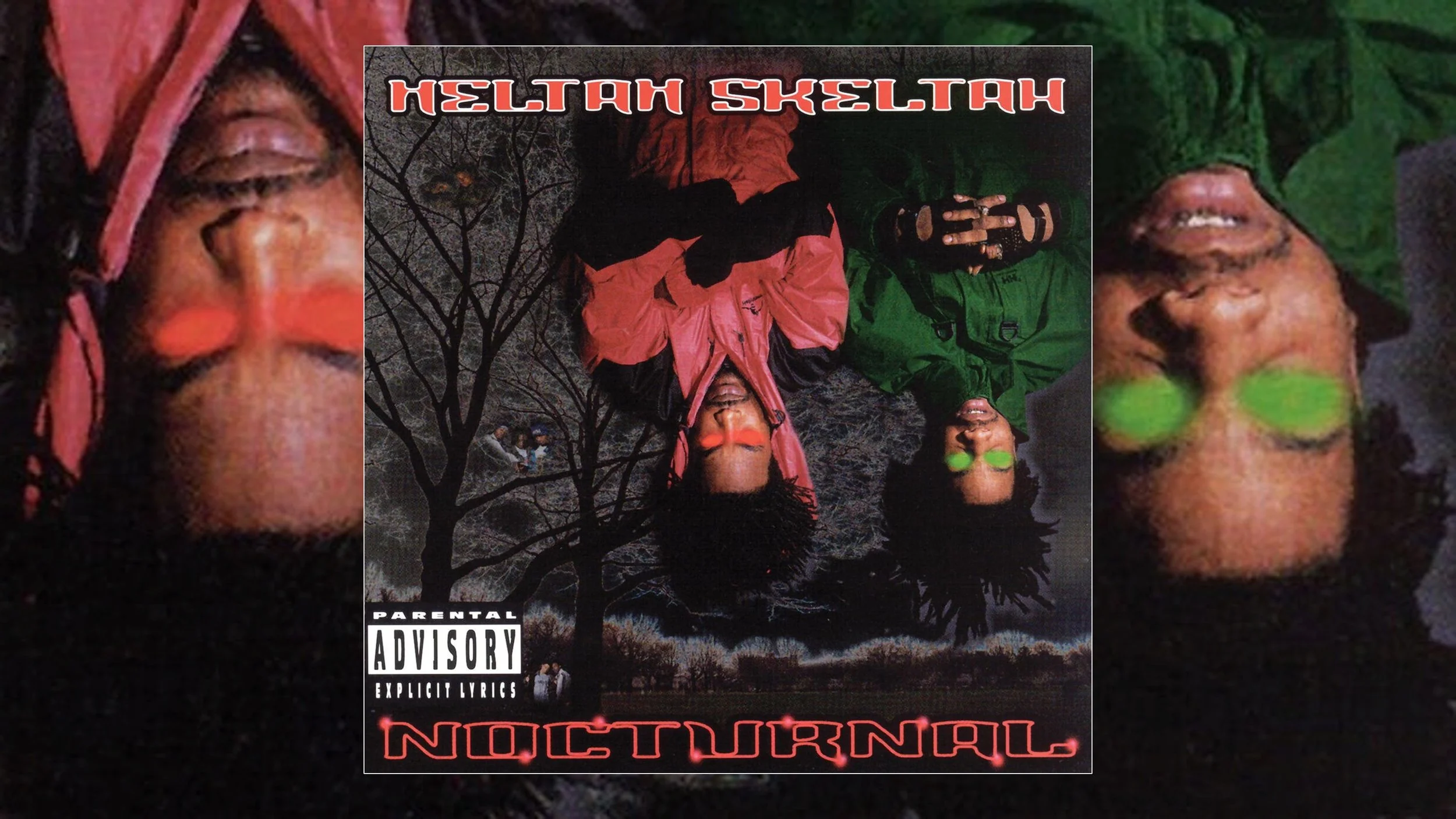
Happy 30th Anniversary to Heltah Skeltah’s debut album Nocturnal, originally released June 18, 1996.
When you think of collectives that symbolize the gritty East Coast aesthetic, the Boot Camp Clik is right at the top. Along with Wu-Tang Clan, the collective captured the sound throughout the 1990s and into the 21st century, generating multiple all-time great albums.
In the Brooklyn-based crew, Black Moon were the pioneers. Fronted by emcee Buckshot and producer/DJ Evil Dee, they set the tone with their debut Enta Da Stage (1993). It can be argued that their first single, “Who Got Da Props,” was as important as any track when it came to reasserting the traditional boom-bap hold in the market in a post-Chronic (1992) hip-hop landscape.
The success of Black Moon led to the formal introduction of Smif-N-Wessun. The duo was somehow even grimier, and their debut, Dah Shinin’ (1995) might even be an even better album than Enta Da Stage.
As important as both Black Moon and Smif-N-Wessun were to my love of mid 1990s hip-hop, I’ve always held a special place for Heltah Skeltah. The duo, and their debut album, Nocturnal, released 30 years ago, showed that the BCC had staying power and a deep bench of talent, and introduced audiences to two of the most interesting emcees in the camp. Comprised of Sean “Ruck” Price a.k.a. “Tall Sean” (R.I.P.) and Jahmal “Rock” Bush a.k.a. “Da Rockness Monstah,” Heltah Skeltah rank high among the best groups of the era.
I first became aware of the crew from their appearances on the aforementioned Dah Shinin,’ particularly when they provided the hook to the single “Wontime,” and their deft verses on the “Cession At Da Dog Hillee” posse cut. They later graced “Headz Ain’t Ready,” an extended BCC collective track on the New Jersey Drive soundtrack (1995) while Rock delivered a standout verse on the extended version of “The Points” song from the Panther soundtrack (1995). By the time Nocturnal was released, they’d built sufficient anticipation for the project.
Nocturnal was different in a number of ways from other BCC releases to that point. For one, it was the crew’s first full-length not released through Nervous Records. The imprint had begun as the home for the collective, but as the years passed, tensions over the usual issues (such as money) began to arise. Buckshot and partner Dru Ha (a former intern at Nervous) got together and launched the Duck Down imprint, signing a distribution deal with Priority Records.
Nocturnal was also the first BCC release not to be produced by Da Beatminerz production team in its entirety. The team (made up of Evil Dee, Mr. Walt, Baby Paul, and Rich Black) had been the sole architects of the BCC’s sound, manipulating jazz and soul samples to create dark, hard-hitting backdrops.
Listen to the Album:
Though Da Beatminerz did produce the majority of Nocturnal, Heltah Skeltah enlisted beat-makers outside the production team to provide solid to excellent tracks. Some of the producers are less well known: both Shameek and Supreme the Eloheem seem affiliated with the group, and have few, if any, production credits outside of the BCC camp. Others, like Lord Jamar, Shawn J. Period, and E-Swift, were well-respected in their fields, and supply Heltah Skeltah with high-grade hip-hop.
As lyricists, both Ruck and Rock acquit themselves well throughout Nocturnal. Though Ruck may have grown into the underground icon later in his career, at the time of this album’s release, Rock was the one who received the most attention. Both emcees cut imposing figures (Ruck and Rock measured 6’4” and 6’5” in height, respectively), Rock’s deep, gravelly croak of a voice helped him stand out. Ruck is, in contrast, almost understated on the mic. But what he lacks in flashiness he makes up for in pure technical skill. Throughout Nocturnal, his ability to bend words and syllables is impressive to behold.
E-Swift, best known for his role as DJ/producer/emcee for Tha Alkaholiks, worked behind the boards for the album’s first single (and last song), “Operation: Lockdown.” Thickly coated in blunt haze, it features a surreal musical sensibility and stylistically complex verses, as the duo trade raps to a harp sample and what sounds like chirps from a pager. The blend helps make it one of the best singles, and songs, released during the era.
“Operation: Lockdown” showcases what would be Heltah Skeltah’s strength throughout Nocturnal: contrasting hostile lyrical content to smooth, jazzy grooves. They use this approach on “Letha Brainz Blo,” the album’s first full-length track, as Baby Paul loops up the opening portion of Johnny Pate’s version of Look Of Love.” The pair attack the track with ferocity, as Rock raps, “You punk bastard, you could get the gat quick, or your ass kicked / That dry shit your lips spit? Get the Chapstick.”
Heltah Skeltah deliver similar balance on the airy “Undastand” and the laid-back “Place to Be” (produced by Shawn J. Period). “Therapy,” the album’s second proper single, also maintains its mellow feel. Here Ruck assumes the role of Dr. Killpatient (apparently Price was a big fan of Looney Tunes), counseling a troubled Rock about his pervasive violent thoughts. Vocalists crooning hooks on rap tracks during the 1990s have a spotty track record, but I must admit that Vinia Mojica’s sweet tones fit in well over Baby Paul’s grooves.
“Leflaur Leflah Eshkoshka” is another of the best songs of the mid-1990s. It was originally released as part of a “Double A Side” single by the “Fab 5” supergroup, made up of Heltah Skeltah and the OGC (the Originoo Gunn Clappaz) trio, another component of the BCC. According to Price in an interview with Complex, the song was conceived as “just an introduction to new artists on the [Duck Down] label.” In regard to the song’s title, he confessed, “I just said that shit, I don’t even know what it means. … It means absolutely nothing. We were just bugging the fuck out.”
All five emcees fittingly bug the fuck out throughout the song, weaving short verses together, each displaying a wide array of deliveries and techniques. Rock delivers some of his most memorable lines, rapping, “Rockness Monsta, is he for real? It can’t be / See him in action as he transform, that man’s me!” Meanwhile, Ruck gives another subtly complex performance, rapping, “I’m drastic, when it comes to verbs I be flipping / ’Cause herbs just be shitting off the words I be kicking.” Baby Paul again proves to be Nocturnal’s production MVP, sampling a portion of Catalyst’s “Ujiri.”
Heltah Skeltah get sufficiently bugged out again with “Da Wiggy.” The track is a sort of grimy tribute to early 1980s Electro-Hop group Newcleus, as the duo deliver rugged verses to a thumping basslines and guitar licks taken from Love Unlimited Orchestra’s “Strange Games and Things.” The hook features the pair channeling the mid-1990s Brooklyn version of “Jam On It,” through heavy vocal effects. without taking themselves seriously in the slightest.
Heltah Skeltah do get into a few hard-hitting lyrical brawls. Rock and Ruck deliver uncut ruthless aggression On “Clan’s, Posse’s, Crew’s, and Clik’s,” Ruck and Rock confront “six bitch-ass n****s on the corner” trying to cypher on the own, hitting them with heavy dosages of pure ruthless aggression. “Word to moth’, I’ll murder ducks who never heard of Ruck,” Price raps, “plus, my mind ills off rhyme skills with the 9mm that I buck.”
Watch the Official Videos:
The album takes an even darker turn in town throughout its back-half. The pair, joined by Louisville Sluggah, explain their mindset for getting into foul shit on “Prowl.” The aforementioned Supreme the Eloheem hooks up a pounding piano sample and wailing flutes for “Triple R,” where Heltah Skeltah are joined by Tha Representativez, and group of BCC soldiers in training.
The pair journey “through the dungeon of darkness” on “Soldiers Gone Psycho.” Baby Paul expertly chops a portion of Wade Marcus’ “Lost in a Pool of Red,” making the song the grimmest entry on Nocturnal. Ruck’s first verse on the track is one of his best on the album, as he raps, “What? You don’t wanna battle me, battle me, that’ll be the day my whole posse rushes your monkey ass like cattle, G.”
Both members of the group do get some opportunities to shine on their own, each wrecking a different track produced by Shaleek. Though it would take another four or five years for Ruck to really display the charisma that carried his solo career as the “brokest rapper you know,” you can discern some of the inklings of the stylings on “Sean Price,” a sort of solo song (it also features a verse from BCC affiliate Illa Noyz). Ruck displays his verbal dexterity over the groaning track, rapping, “Go to Hell with angel dust, plus, I bust the Devil’s lungs / With lyrics that come from tip of the tongues, now you strung.”
Rock shines on the haunting “Grate Unknown,” the only full-fledged solo track on the album. Rock glides across the dense and busy track, dispersing three verses to sprinkles of piano, strings, and bell-like percussion. As a comic book fan, I thoroughly enjoyed the Cyberforce reference, as Rock raps, “I strap on bombs on blow your face up like Stryker.”
Three decades later, the rough and tumble hip-hop that Heltah Skeltah and the BCC provided audiences sounds as potent as ever. Raw raps over obscure jazz samples will always sound fly, and few did it as well as Heltah Skeltah when they were in their zone. Though Price would go on to achieve greater notoriety as a solo artist before his death, his chemistry with Rock still sounds as impressive as ever, and both of their talents were clear from their first effort.
Listen:
