
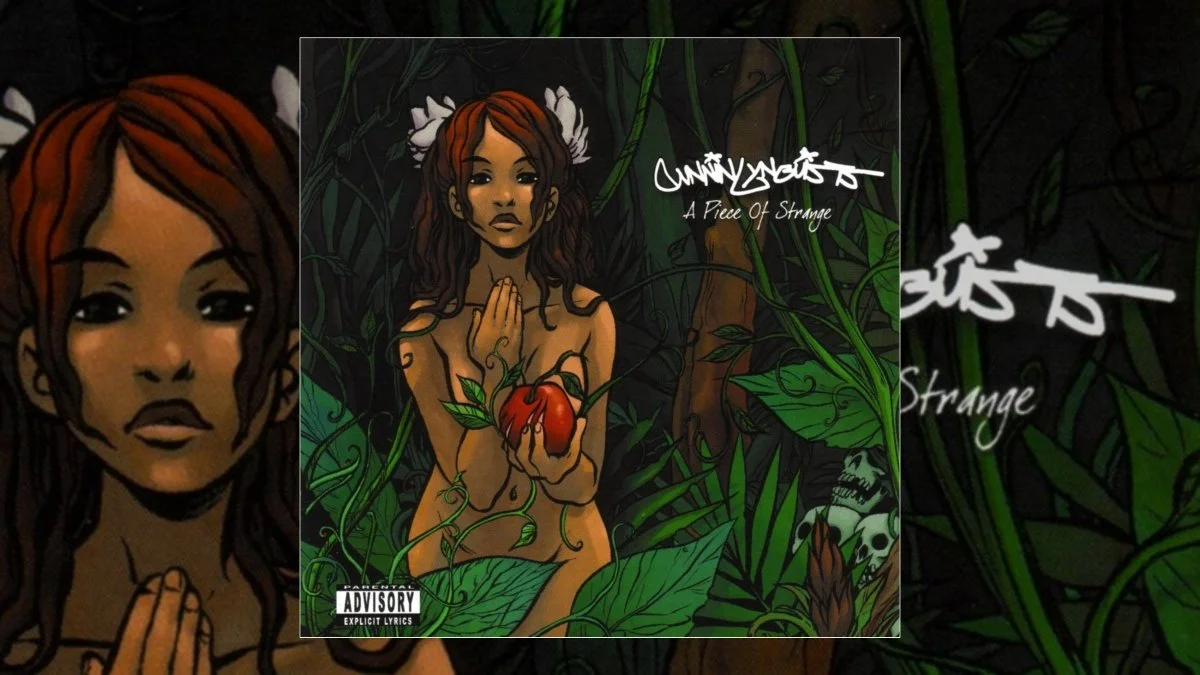
Happy 20th Anniversary to CunninLynguists’ third studio album A Piece of Strange, originally released January 24, 2006.
When considering the pantheon of all-time great Southern hip-hop groups, we often think of standard bearers like OutKast and Goodie Mob, while also acknowledging pioneers like Geto Boys, UGK, and Eightball & MJG. All of these are justifiably great, but heads who know their shit would also include CunninLynguists.
The Kentucky-based group has had numerous configurations over the years, but its current/best lineup includes emcees Willis “Deacon the Villain” Polk and Garrett “Natti” Bush, and producer/emcee Ryan “Kno” Wisler. The group has been consistently dope since its inception in the early 2000s, but its masterpiece is A Piece of Strange, released 20 years ago.
A Piece of Strange represented a thematic shift in approach by CunninLynguists. Previously, the group had released Will Rap for Food (2001) and SouthernUnderground (2003). Both were dope in their own right, but focused on straight emceeing, with the occasional diversion into conceptual territory. That changed with the conception of A Piece of Strange.
“We were learning from SouthernUnderground that we couldn’t make records talking about nothing anymore,” Kno said in an extensive interview with XXL about the creation of A Piece of Strange. “Our fan base and the listenership had grown so much that we decided we needed to make something that reflected our persons and abilities.”
This shift changed Kno’s production style. Previously, he had relied heavily on sampling material. However, during the process of recording A Piece of Strange, he began to incorporate live instrumentation. “[A Piece of Strange] was the first record where I was like, ‘I don’t have to completely rely on samples to accomplish all the things I have in my brain,’” he explained in the XXL interview. The sound that he created is evocative of the music generated by Organized Noize/Dungeon Family and Suave House Records, which the members of the crew had grown up on.
The recording of the project also resulted in a shift in the group’s lineup. Mr. SOS, who had joined the group in 2003, left during the planning process for A Piece of Strange, mostly due to creative differences in the crew’s direction with the album. The remaining two brought in Natti to replace SOS. Natti had already appeared on the group’s Sloppy Seconds 2 (2005) mixtape and was a member of Deacon’s side project, Kynfolk.
A lot of talk about A Piece of Strange centers on how it’s a concept album built around a narrative. Specifically, members of the group have explained that the album tells a story about people walking both to and away from sin. It might be because I’m kind of dense, but I’ve never fully delved into all of the intricacies of how all of the tracks interlock (aside from one notable four-song sequence).
That said, following the album’s “story” isn’t a requirement for enjoying A Piece of Strange. The individual components all are dope on their own merits. Deacon, Natti, and Kno all work in tandem to create a unified mood, with lyrics and music that are thought-provoking and evocative. Regardless as to whether I’ve picked up on all of the themes and symbolism that appear throughout A Piece of Strange, I consider it one of the better albums of the 21st century.
Listen to the Album:
Deacon and Natti make a good team throughout A Piece of Strange, providing cerebral lyrical content. They contemplate their roles in the world and their efforts to live as righteous as they can, all while acknowledging the constant temptation to commit wrong. While Kno produces the album in its entirety, he has a noticeably reduced role on the mic, contributing only one verse. However, he often “speaks” through the numerous and often extended instrumental interludes that appear throughout the project.
A Piece of Strange starts off strong with “Since When?”, which plays like an extended version of André 3000’s “The South got something to say!” declaration during the 1995 Source Awards. During the mid ’00s, there was still a considerable amount of tension about the South’s dominance of mainstream hip-hop, between album sales and chart placements (back when both of those were still a thing). Many “real” hip-hop artists and fans openly mocked what they viewed as gimmick-based/subpar music dominating the public conversation at the time (see: 4DL’s “Laffy Taffy”).
“Since When?” features Natti and Deacon schooling listeners about the South’s deep and often un-acknowledged “true” hip-hop history, championing its extensive lineage of lyricists who helped create great albums. They also herald their own skills, as they rap, “Standin’ on southern dirt that helped America get rich / You ain’t gotta struggle with a shovel to dig this / Cold as no power, after hours in the winter months / Hot though crock-pot flow, so here dinner comes.”
“Caved In” definitely evokes the Organized Noize/Dungeon Family sound, and not just because Cee-Lo croons the song’s hook. The track is as soulful as much of what appeared on albums like Goodie Mob’s Soul Food (1995) and Still Standing (1998), with Deacon describing the desperation he’s observed on the streets of the Southern neighborhoods that he’s lived in and travelled through. “Nothing to Give” is one of the album’s bleakest entries, as Natti and Deacon depict the compulsion of some to commit often unspeakable crimes under the cover of darkness, believing that operating at night will allow them to act with impunity.
Deacon speaks on his efforts to seek peace from the stresses of life on “Hourglass,” whether in the form of true love from a woman, or from enjoying the good times with his friends. The track’s second verse is particularly poignant, as he recalls the bliss he felt during the partying of his youth, while remaining aware that he can’t get caught up in “Peter Pan scenes.”
The album then segues into “Beautiful Girl,” the group’s dedication to their love of marijuana. CunninLynguists are hardly the first artists to compare their love of weed to their love of women, but “Beautiful Girl” is still a fun track all the same. The track’s blaring horns and rolling drums seem designed to conjure auditory visions of Rick James’ “Mary Jane,” the definitive “weed as a woman” song. Natti asserts that this herbal remedy “can make a blind man see and forget his doctor's appointment / For her sheer enjoyment I'll even risk unemployment.”
The hallucinatory “Brain Cell” is a clear highlight of the album. Besides delivering a solid verse, Kno does some of his best production work here, hooking a mournful horn sample and pairing it with some obscure late 1970s pop cheese, transforming it all into a jazzy and pensive track. Deacon and Natti join Kno, each examining how we construct mental prisons for ourselves at many points of our lives, risking the loss of our freedom and lives.
The song “What’ll You Do?” is considerably less grim, but it also effectively conveys the album’s theme. Deacon contemplates the hustle of working as a blue-collar underground rapper, living off the tour grind, trying to seek sources of revenue in a landscape where even 20 years ago consumers weren’t purchasing music. Though he works to remain optimistic, Deacon acknowledges that making music long-term “for the love” may not be tenable.
There’s no denying the power of the extended four-song passage that takes much of the album’s back half. The story begins with “Never Know Why,” where the group narrates the end of life of a former fire-fighter, now riddled with Alzheimer’s, glaucoma, arthritis, and many of the other indignities associated with old age. The song examines his misdeeds, in particular his rejection of his daughter, who he cut off after having an interracial baby. Guest emcee Immortal Technique speaks from the perspective of the bigot, now on his deathbed, accepting his mortality, but ultimately unrepentant of the choices that he’s made.
This segues to “The Gates,” which features the most moody and ethereal track on the album. Here Tonedeff, a dynamo of an emcee, assumes the role of the deeply flawed narrator, now in the afterlife and greeted by Deacon as St. Peter at Heaven’s Gate. Even with all of his sins and deepest misdeeds laid bare, the man remains defiant and angry, and is cast down below, “sentenced to fight fire for eternity.”
After the “Damnation” instrumental interlude, the run ends with “Hellfire,” a frenzied double lyrical assault by Deacon and Natti. Kno does an expert job at chopping and repurposing a sample of Arthur Brown’s “Fire!” as the two emcees drop explosive verses. While Natti boasts that “they gone need dental records to retrieve them names,” Deacon proclaims “Murder, death, kill with the grill / You've heard the best; don't sit still as you feel this.”
While the previous sequence is A Piece of Strange’s most arresting passage, “America Love Gangstas” is its center of gravity. The track is just as—if not tragically even more—resonant today as it was when it was released two decades ago. The group explores this nation’s continued obsession with the gangster in popular culture and its spillover into reality. Natti and Deacon reference the fascination with both celebrity criminals and fictional ones, but their rhymes could just as easily apply to the True Crime Industrial Complex that drives the streaming and podcast world.
Their words regarding gangsters in the political realm are even more relevant. Natti may have been writing about the George W. Bush administration when he admonished those who “gave plenty of orders for slaughters ain't swatted a fly; modern day cowboys with shiny alloys for side arms,” but he sure as hell could be referring to our current regime’s violent and lawless ways. The song closes with an extended spoken word piece by Tim Means. You can’t help but think about ICE’s operations in cities like Minneapolis, Chicago, and Los Angeles and the current president’s threats to annex Canada and Greenland when he proclaims that “this ain't Democracy: it's a Survival of the Fittest / A country built behind closed doors with gods as their witness.”
A Piece of Strange shifted how CunninLynguists made music. Which isn’t to say that they attempted to replicate it many times over during the subsequent two decades. But moving forward, they continued to create brooding and occasionally abstract entries into an exceptional body of work. Without A Piece of Strange, CunninLynguists likely would have been remembered as a dope little group that put out a few thoroughly entertaining albums. But after releasing A Piece of Strange, they set the stage to become legendary and followed through on that promise.
Listen:
