
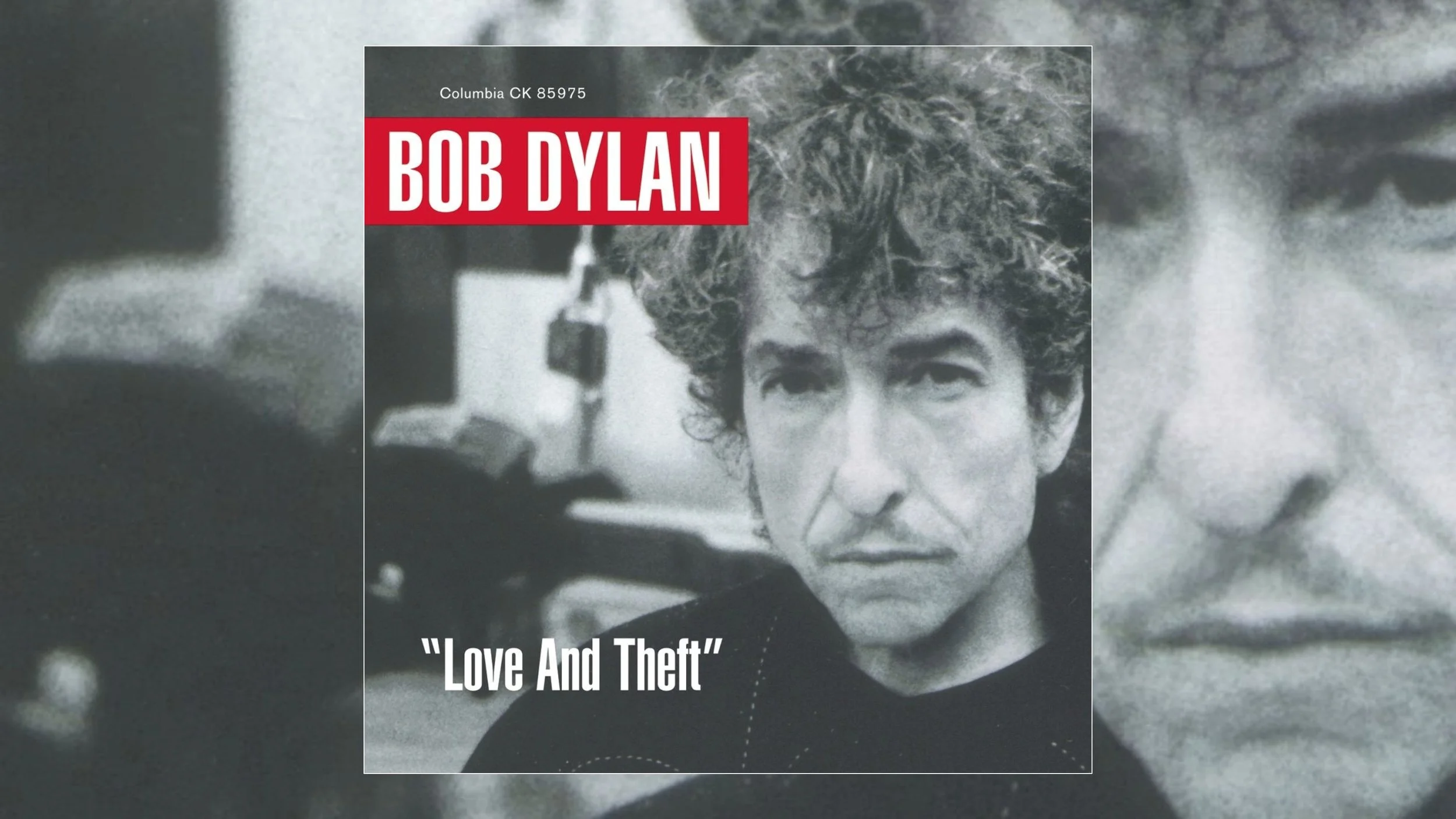
Happy 25th Anniversary to Bob Dylan’s thirty-first studio album “Love And Theft”, originally released September 11, 2001.
September 11, 2001 is a day none of us will ever forget, especially New Yorkers like myself. I remember walking the streets of the city and seeing the looks on everyone’s faces. We were still in shock, wondering when things would start to feel normal again. Music was the one thing I always used to pull me out of whatever funk I was in the midst of, so a trip to a record store was what the moment needed.
Bob Dylan’s thirty-first studio album “Love And Theft” dropped on September 11th. The release date rendered it almost incidental by the horror unfolding that morning. The record itself would become recognized as one of the defining artistic statements of his late career. The quotation marks in the title adorned on the album cover were deliberate, lifted from historian Eric Lott's study of blackface minstrelsy, Love And Theft: Blackface Minstrelsy And The American Working Class.
“Love And Theft” arrived four years after Time Out Of Mind (1997), the album most critics believe pulled Dylan out of a long commercial and critical wilderness. That record won him three GRAMMY Awards including Album of the Year. After decades of uneven records, Dylan proved he was an artist still capable of urgent, essential work.
Where Time Out Of Mind was drenched in Daniel Lanois' murky, reverb-heavy production, “Love And Theft” was something else entirely: dry, warm, well-written and self-produced under the pseudonym Jack Frost. Dylan assembled his touring band—Larry Campbell, Charlie Sexton, Tony Garnier, David Kemper—and recorded the album mostly live in the studio.
“Love And Theft” sounds more like a tribute to pre-1950s American music: Tin Pan Alley, Delta blues, rockabilly, Western swing, with a dash of vaudeville. In a 2016 interview with Rolling Stone’s David Browne, Dylan said, “All my songs, the styles I work in, were all developed before I was born. When I came into the world, that spirit of things was still very strong. Billie Holiday was still alive. Duke Ellington. All those old blues singers were still alive. And that was the music that was dear to me. I was never really interested in pop music.”
“Tweedle Dee & Tweedle Dum” kicks the record off with a rollicking, Bo Diddley type blues shuffle, Dylan's gravelly growl delivery is surreal, playful, and ominous (“Well, a childish dream is a deathless need / And a noble truth is a sacred dream / My pretty baby, she’s lookin’ around / She’s wearin’ a multi-thousand dollar gown / “Tweedle-dee Dee is a lowdown, sorry old man / Tweedle-dee Dum, he’ll stab you where you stand / ‘I’ve had too much of your company,’/ Says Tweedle-dee Dum to Tweedle-dee Dee”).
Listen to the Album:
“Mississippi” is a song famously left off Time Out Of Mind (Dylan couldn't get a version he liked with Lanois). During a press conference in July 2001, Dylan said, “We had that (‘Mississippi’) on the Time Out Of Mind album. It wasn’t recorded very well but thank God, it never got out, so we recorded it again. But something like that would never have happened ten years ago. You’d have probably all heard the lousy version of it and I’d have never re-recorded it. I’m glad for once to have had the opportunity to do so.” This version is an elegant meditation on time running out (“Sky full of fire, pain pourin' down... Only one thing I did wrong / stayed in Mississippi a day too long”).
“Summer Days” flips the mood entirely. It’s manic rockabilly meets big-band swing and Dylan sounds like he’s enjoying every minute of it.
“Bye and Bye,” “Moonlight,” and “Floater (Too Much to Ask)” has Dylan doing his best road movie Bing Crosby impression.
“High Water (For Charley Patton)” is the album's most explicit nod to its blues forebears, a banjo-driven, apocalyptic vision that name-checks the Delta bluesman directly while referencing African-Americans displaced by the Great Mississippi Flood of 1927.
“Honest with Me” is pure electric snarl, a hard-charging blues-rock number that could have come off Highway 61 Revisited (1965).
The album ends with “Po’ Boy,” “Cry a While” and “Sugar Baby,” the latter a soft, sorrowful song that serves as a perfect breath of calm following Dylan’s intense sonic adventure.
In an interview two months after the album’s release, Dylan told Rolling Stone’s Mikal Gilmore, “Every one of the records I’ve made has emanated from the entire panorama of what America is to me.”
“Love And Theft” is on my personal list of top twenty albums of all time. It got me through a rough period and it has lost none of its punch over the past twenty-five years. It was inducted into the GRAMMY Hall of Fame and is now ranked among Dylan's very best work.
Listen:
