
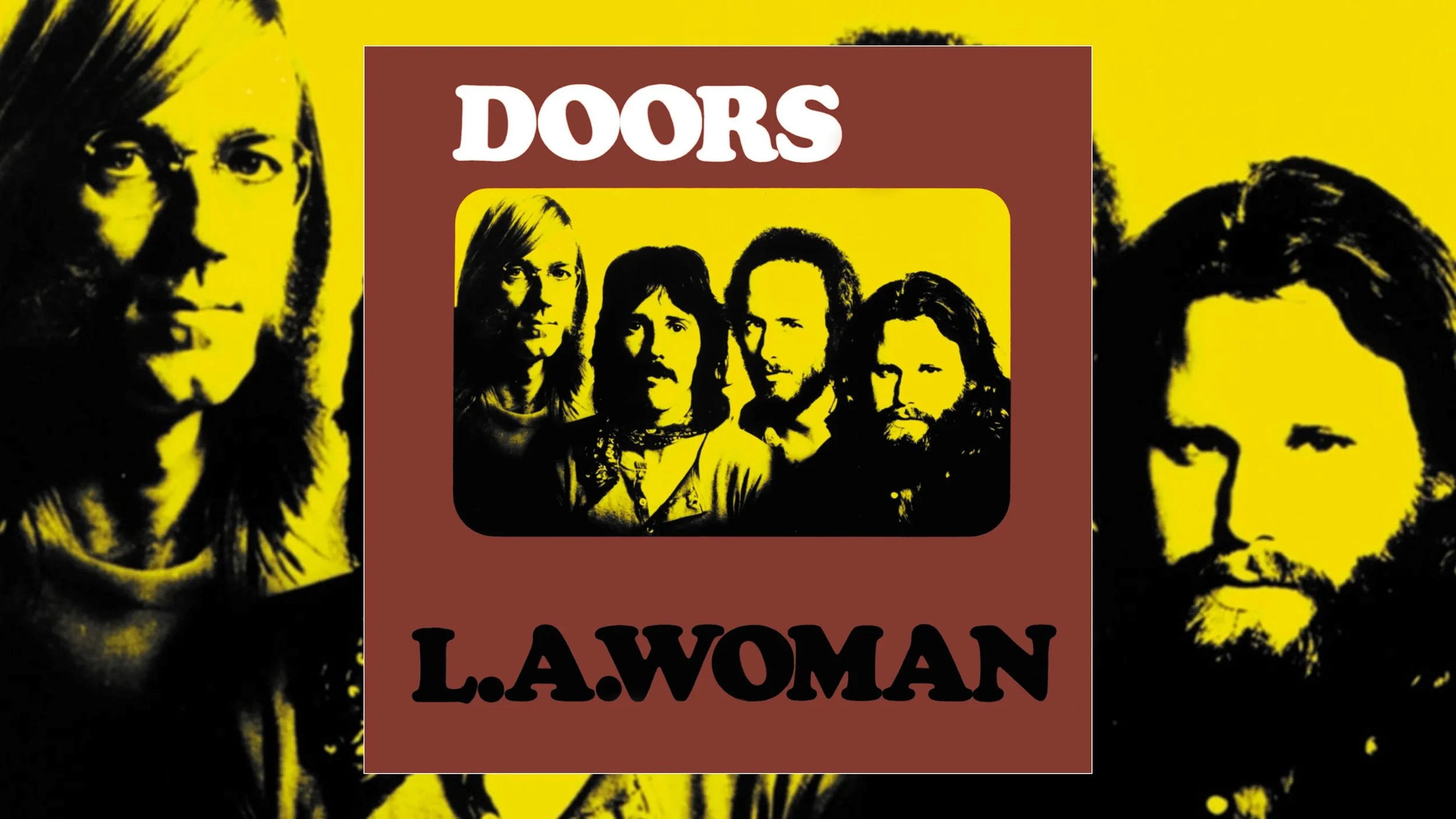
Happy 55th Anniversary to The Doors’ sixth studio album L.A. Woman, originally released April 19, 1971.
In December of 1970, Jim Morrison performed his final concert with the Doors in New Orleans. That night, Ray Manzarek witnessed Morrison’s soul leave his body. The singer went noticeably limp like a wrung-out dishrag. “Everyone who was there saw it, man,” Manzarek recalled. “He lost all his energy about midway through the set. He hung on the microphone and it just slipped away. You could actually see it leave him. He was drained.”
In The Doors, Oliver Stone’s 1991 biopic of the band, that moment is dramatized instead as part of the Doors’ infamous 1969 concert in Miami, where Morrison allegedly exposed himself and simulated fellatio on Robby Krieger’s guitar. The incident brought ongoing legal problems, while contributing to a worsening of Morrison’s alcoholism, which had already been destroying his life. Stone depicts the concert as a Dionysian bacchanal, with the roiling crowd shedding clothes and inhibitions and even all touch with reality, while bonfires rage and a Native American pow wow ensues, stretching as far as the eye can see. As Morrison hangs on the microphone, his head falling back, the sound fades and the spirit of the Native American medicine man who’s served as Jim’s symbolic spirit guide throughout the film looks upon the singer with grave concern and sadness. And then, suddenly, the sound roars back and the drunken, drugged-out bohemian chaos resumes.
In the summer of 1991, I watch The Doors with my friend Jessica in a dingy motel room while nibbling antipasti—olives, tomatoes, soft pillows of mozzarella—that her Italian mother has spread out on the little table before us. Every summer, my family has made a ritual of traveling from our army base in Heidelberg, Germany, to another American army base in Livorno, Italy, for our annual beach vacation. This year, Jessica and her family end up in Livorno at the same time, staying at the little motel on base while my family camps at the sprawling campground nearby. On the day we watch The Doors, it’s stormy and the ocean is too treacherous for swimming, and so we head over to the little video store on base to find something to watch on the motel-room VCR.
Jessica is probably my first friend in a long string of friends who I’d describe as “witchy.” She wears Victorian poison rings on her fingers, ankle bracelets studded with tinkly little bells, and she has long, lank dishwater-blond hair while everyone else is still stuck in the ’80s with their crunchy perms. Jessica and her parents live in downtown Heidelberg in an apartment with high ceilings, tasteful art, and antiques and lush plants everywhere. She’s the first person to take me to the dusty, medieval Head Shop tucked away in a little alley in the Altstadt to buy silver jewelry and heady incense. She’s also the first person to take me to the Café Journal for frothy cappuccinos and a sophisticated atmosphere of University of Heidelberg students and blue clouds of cigarette smoke. (Keep in mind that at this point we’re, like, 12 or 13.) So is it any wonder that when given a choice of videos in the summer of ’91, Jessica resolutely chooses The Doors?
I’m 14 that summer, and in only a month after school starts, my generation will experience the inception point of its own tragic rock-n-roll trajectory with the release of Nirvana’s Nevermind (1991). But right now, we still have to borrow our parents’ generation’s excitement and debauchery and darkness and tragedy, and we’re absolutely riveted. For the rest of the summer, Jessica and I take particular amusement in quoting Meg Ryan’s character in The Doors: “Jim, you actually put your dick in that woman?!” While the other one of us tries to sound sheepish and answers, “Sometimes.” (This is the scene where Jim’s fiery redhead of a girlfriend Pamela Courson throws a charred duck carcass at him when his mistress shows up at one of their parties.)
Really, though, we were hooked on all of it: The leather pants, the velvet bellbottoms, the go-go dancers, the saggy ’60s boobs, the LSD trips in the desert, the shamanism, the blood drinking, the wedding ceremony with the witch with the sword, the cameo by Andy Warhol, the drunken arguments while hanging halfway out of hotel-room windows—but, really, above all, the music. Holy shit, the music. Why couldn’t I have been my mother’s age in 1967, going off to college and listening to Doors records while ironing my hair in real time?
At the end of 1970, though, when Jim Morrison was hanging limply on his microphone and Ray Manzarek saw his soul leave his body, the party was mostly over. Almost everything that had made the Doors magical and technicolor and provocative and psychedelic had taken a dark, grimy, depressing turn.
Listen to the Album:
The 1969 Miami concert had led to a felony charge of lewd and lascivious behavior, and three misdemeanor charges: indecent exposure, open profanity, and public drunkenness. “You’re all a bunch of fuckin’ idiots!” Morrison had sneered at the crowd. “You’re all a bunch of slaves! What are you gonna do about it, what are you gonna do, what are you gonna do?” At one point he unbuckled his belt and unzipped his pants, seemingly to pull out his junk. Actually, though, he was wearing boxer shorts underneath, even though he typically went commando. He’d planned to fake exposure like the actors in The Living Theatre, an experimental performance-art troupe he’d recently become obsessed with. The Living Theatre was known to aggressively confront its audience in an attempt to guide them to new realizations about their own conformity, vanity, misconceptions, and responsibilities in the world.
After Morrison was slapped with the Miami charges, word began to spread among concert promoters that the Doors were too risky of an act to book and most of the shows they’d lined up were cancelled, leading to a significant loss of revenue. Morrison would spend the remainder of his short life traveling back and forth to the Miami courthouse to defend against the charges. Already an alcoholic, he began drinking even more heavily, and, despite being only in his mid-20s, he developed a paunch he’d attempt to conceal with loose, flowing shirts. He grew a mountain-man beard, rarely changed his clothes, and his voice became so hoarse that some of the people around him began to fear he was done as a vocalist. He fell into a deep depression upon learning that Jimi Hendrix and Janis Joplin had died. Meanwhile, paternity suits began rolling in from semi-girlfriends and one-night stands, while Patricia Kennealy, the journalist he’d married on a whim in a Wiccan ceremony, decided to abort her pregnancy after deciding Morrison was too unreliable to be a father. Jim promised he’d be at her side during the procedure, and then never showed up.
At one point during all of this, Morrison was interviewed by Salli Stevenson for Circus magazine, where he reflected on the Miami concert. “I think I was just fed up with the image that had been created around me, which I sometimes consciously, most of the time unconsciously, cooperated with,” he mused. “It was just too much for me to really stomach and so I just put an end to it in one glorious evening. I guess what it boiled down to was that I told the audience that they were a bunch of fucking idiots to be members of an audience. What were they doing there anyway? The basic message was realize that you’re not really here to listen to a bunch of songs by some good musicians. You’re here for something else. Why not admit it and do something about it?”
Morrison had long thought deeply about performance, about pop culture, about crowd psychology, about philosophy. The son of a high-ranking naval officer, young James Douglas Morrison grew up, like most army brats, moving around a lot. He had a highly inquisitive mind and, by the age of 16, he was already reading Rimbaud, Nietzsche, and William Blake, while also being completely enthralled by Elvis Presley. He’d attend three colleges before enrolling at the film school at UCLA, where he befriended Ray Manzarek, who played the keyboards in a surf-rock band called Rick and the Ravens. Jim and Ray bonded over the blues, experimental film, and experimenting with LSD.
During his time at UCLA, Morrison created one film, which earned him a D, and despite being regarded as brilliant by numerous professors and fellow students, he decided to drop out and move to New York. He never made it to the Big Apple—he just ended up hanging around Venice Beach, where Manzarek ran into him one day not long after his exit from film school. Jim had been loafing around the beach, chasing chicks, and writing poetry and song lyrics, and on that fateful day Manzarek asked him to sing him one of his songs. Morrison sang him the sultry and croon-y “Moonlight Drive,” and it totally blew him away.
Manzarek asked him if he’d like to start a band. Fortunately, Morrison had already chosen a name based on a poem by William Blake: “If the doors of perception were cleansed, everything would appear to man as it is: infinite.” Morrison then moved into the apartment Manzarek shared with his girlfriend, and they began working on songs in earnest. Manzarek soon found their drummer John Densmore through a Transcendental Meditation class he was taking, and then Densmore invited another friend from the same mediation class named Robby Krieger, a guitarist trained in Spanish flamenco, to join the band.
In the summer of 1965, Manzarek rented a house where the Doors could rehearse around the clock. They began writing songs as a unit, when one day Krieger brought in a catchy song he’d been working on called “Light My Fire.” It felt like a hit.
The band soon landed their first gig at a nightclub on the Sunset Strip called the London Fog. Prior to the Doors, Morrison had never sung before, and so he turned his back to the audience out of shyness. As Morrison grew in confidence, one night the Doors attracted the attention of a talent booker for the more prestigious Sunset Strip nightclub Whisky a Go Go, and she ended up convincing the owner—who really didn’t like the Doors—to hire them as the house band. By the end of 1966, they were opening for Buffalo Springfield, Van Morrison, and The Turtles.
Lines began forming outside the Whisky, with throngs of women clamoring to get a look at the singer in the tight leather pants. Eventually, Jack Holzman, founder of Elektra Records, caught a show and became so convinced of the Doors’ talent that he offered them a three-album contract. Not long after, the band’s residency at the Whisky screeched to a halt when Morrison decided to turn their song “The End” into an Oedipal epic, screaming, “Mother, I want to…fuck you!” during a moment of high drama and hanging suspense. The Whisky’s owner called Jim a “sick bastard” and fired them on the spot.
Only weeks later, the Doors recorded their first album in the span of five days with producer Paul Rothchild. “Light My Fire” climbed quickly to the top of the charts, hitting No. 1 in the summer of 1967. Then came their infamous live performance on The Ed Sullivan Show, where Morrison was asked to refrain from singing the line “Girl, we couldn’t get much higher” and did it anyway. The Doors were now bona fide rock stars, and four more albums followed in quick succession, solidifying the Doors as part of the vanguard of the sexual revolution and consciousness-changing counterculture of the late ’60s. For the band, it became an electrifying whirlwind.
But by the end of 1970, as Morrison was mired in problems both legal and personal, he was smoking up to three packs of Marlboros per day, had a rattling cough, and had once, as he confessed to Robby Krieger, even coughed up blood. As the Doors began recording what would be their final album L.A. Woman, he was showing up to the recording studio late, drunk, and coked up out of his mind. Longtime producer Paul Rothchild couldn’t take it anymore, and so he left, telling the band they should record the album on their own. They decided to co-produce the album with their sound engineer Bruce Botnick. The band created a makeshift recording studio in their office and rehearsal room, which they nicknamed “The Doors’ Workshop.” They invited Elvis’s bassist Jerry Scheff and a second guitarist, Marc Benno, to record with them. “At last, I’m doing a blues album,” Morrison told everyone.
Meanwhile, Morrison and his longtime girlfriend Pamela Courson decided that when the album was finished, they were going to move to Paris for six months and live as exiles. In the summer of 1971, after several idyllic months in Paris, Courson would find Jim dead of a heart attack in the bathtub, finally at peace with a slight smile on his face. He was buried in the Père Lachaise cemetery, where he had enjoyed visiting the resting places of many of his own heroes and idols upon first arriving in Paris. In the mid-1990s, at the tail end of my teen years, my friend Koryn and I would take a USO bus to Paris for the sole purpose of paying our respects to the Lizard King. It was a cold, blustery, but sunny day, and the grave was free of the usual crowds. It was peaceful and beautiful.
As much as L.A. Woman was a love letter to Morrison’s adopted home of Los Angeles, it was perhaps, too, a subconscious farewell. He’d come to believe that the people and places he’d become so comfortable with were now a negative influence or a force holding him back, despite how much he loved them.
The album kicks off with the strutting, deeply bluesy “The Changeling,” a song that captures Morrison’s own metamorphosis from sex symbol to bloated, bearded mountain man, as well as his disillusionment with the entertainment industry—“I’ve lived uptown / I’ve lived downtown / but I’ve never been so broke that I couldn’t leave town.” Morrison’s voice is gravelly and weather-worn, the tone of a much older man. “He'd lived on the beach and in the hills. He'd had money and been broke,” Ray Manzarek told LA Weekly in 2012. “He'd had his L.A. adventure, and he was out.”
“Love Her Madly” is a song Robby Krieger wrote for his girlfriend Lynn, who later became his wife. “She had a bad temper, and when she'd get mad, she'd slam the door, and the house would shake,” Krieger recalls. He came up with the tune when he was futzing around with a new guitar, a Gibson 12-string acoustic. Manzarek then added some harpsicord-style keyboards. The Doors always did volatile romance incredibly well, and this track is no exception—Morrison gets some of his ’50s-style croon back, and the song twists and turns and rollercoaster careens, capturing the danger and razor’s edge of never knowing if this is the last time your love walks out the door.
“Been Down So Long” takes its title from a Richard Farina novel Morrison had read called Been Down So Long It Looks Like Up to Me. Morrison’s voice takes on the ragged, frayed edges of a 100-year-old man, and the title pretty much speaks for itself—the singer was worn out, exhausted, spent, and desperately needed a rest. The quintessential blues. Meanwhile, “Cars Hiss By My Window” is languid and liquid, but there’s something unsettling at the bottom. “It's a dark Venice Beach song. Four a.m. You can't sleep. Your girl's passed out, and who knows what arguments you've been through. She's cold and she'll kill. You. Take it out of Venice and stick it in Hollywood and it's The Day of the Locust,” Manzarek observed.
“L.A. Woman” continues the album’s glinting night theme, taking us on a raucous trip through the underbelly of “The city of night, the city of lights.” It begins on a Sunday afternoon in the Hollywood bungalows, but then night falls and the hills are burning and we roam the alleyways, witnessing cop cars, topless bars, motels, money, and murder madness. As a refrain, Morrison uses an anagram of his name: Mr. Mojo Risin’. He seems to be rousing himself for another round of living, conjuring the lifeblood, or Eros, the life force: “Mr. Mojo Risin’, Mojo risin’, got to keep on risin’.”
“After we recorded the song, he wrote ‘Mr. Mojo Risin’ on a board and said, ‘Look at this.’ He moves the letters around and it was an anagram for his name,” recalled John Densmore. “I knew that mojo was a sexual term from the blues, and that gave me the idea to go slow and dark with the tempo. It also gave me the idea to slowly speed it up like an orgasm.”
Originally written for inclusion in the arthouse film Zabriskie Point, “L’America” is suspenseful and moody, and then turns into a swaggering, odd, asymmetrical rocker. The director Michelangelo Antonioni chose a Pink Floyd song instead, and the Doors shrugged and included it on L.A. Woman.
“Hyacinth House” is a stark departure from the album’s blues theme, and is named after Krieger’s old house in Benedict Canyon. The song is about needing a brand-new friend who won’t bother you, an introvert’s declaration if there ever was one. “Crawling King Snake” is a John Lee Hooker cover that the Doors had played numerous times while performing on the Sunset Strip. Meanwhile, “The WASP (Texas Radio and the Big Beat)” was one of Morrison’s poems that the band had included in the Doors’ first concert souvenir book published in 1968.
The song is, ultimately, about the power and beauty of rock ‘n’ roll. “‘The WASP’ was about the new music Jim heard when his family were moving around the Southwest states in the '60s,” Krieger told Ultimate Classic Rock. “He got this vision of a huge radio tower spewing out noise. This was when Wolfman Jack was on XERB, out of Rosarito Beach in Mexico, blasting out 250,000 watts of soul power. He saturated the airwaves – you could hear him from Tijuana to Tallahassee up to Chicago where Ray lived. There were no laws about how powerful a radio station could be. That started rock ’n’ roll for my generation.”
L.A. Woman ends with the haunting, cinematic “Riders on the Storm,” a sound-layered, seven-minute jazz-infused epic about a killer hitchhiker on the road, which would be prophetic for the serial-killer ’70s. However, it’s also something else entirely: “The last verse: ‘Your world on him depends /Our life will never end /You gotta love your man.’ It becomes a very spiritual song; you won’t still occupy this body, but the essential life will never end, and love is the answer to all things,” mused Manzarek to Uncut. “It gives the song a different perspective.”
“It was the last song recorded by The Doors and the whisper voice is the last singing that Jim ever did in the studio, in the background on the ride out,” he continued. “How prophetic is that? A whisper fading away into eternity, where he is now.”
Listen:
