
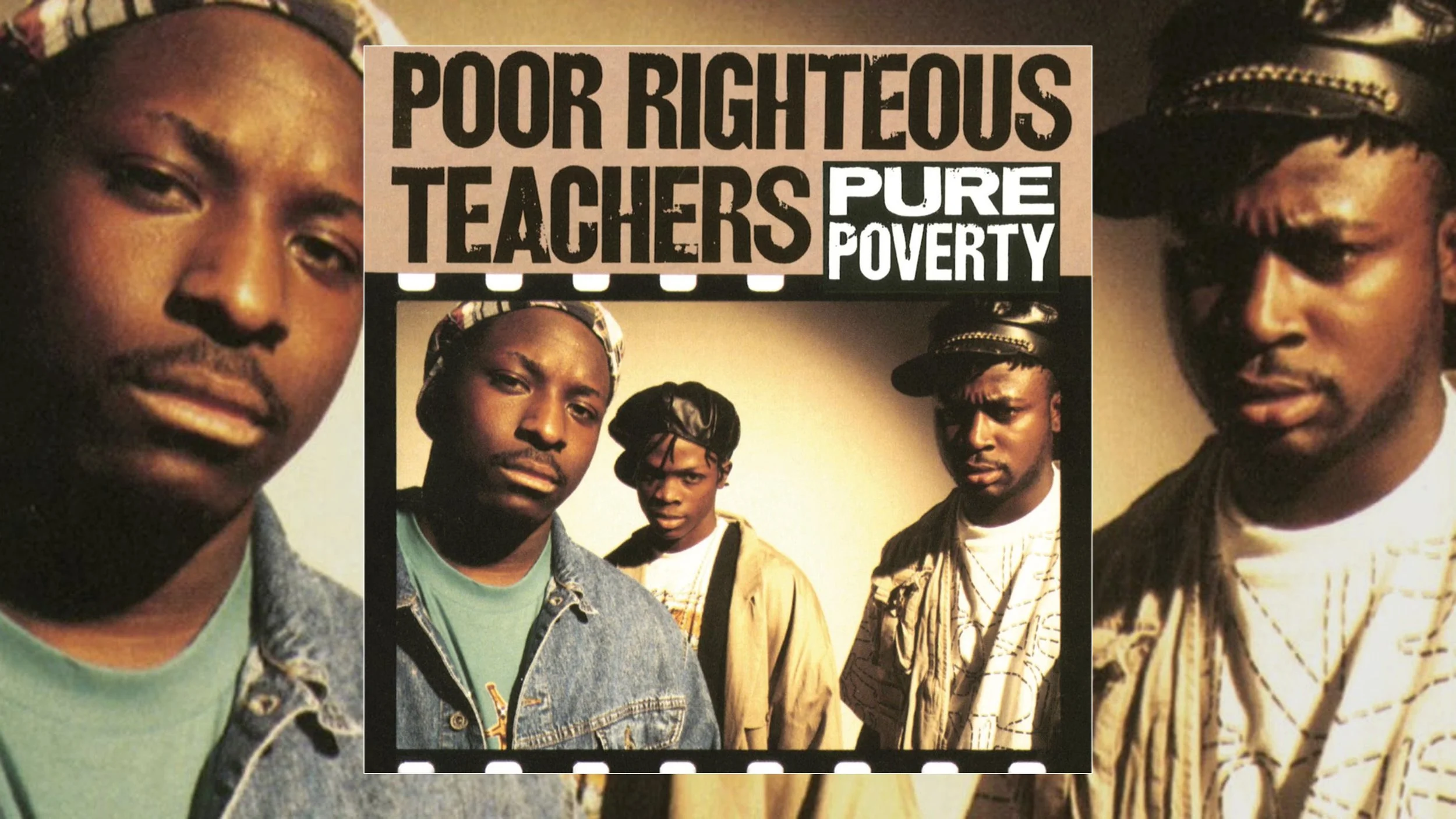
Happy 35th Anniversary to Poor Righteous Teachers’ second studio album Pure Poverty, originally released September 3, 1991.
There haven’t been many “conscious” hip-hop groups with lengthy careers. Public Enemy set the standard, as they’ve delivered music at a regular clip for four decades. There are precious few others. Boogie Down Productions, Goodie Mob, X Clan, and Black Star (a.k.a. Yasiin Bey & Talib Kweli) have all released multiple quality “conscious” albums, but precious few have sustained runs.
That said, even today, Poor Righteous Teachers still aren’t really recognized for their brilliance. From the early to mid-1990s, they had an excellent four-album run. Across these releases, they promoted positivity in the Black community, decrying the “devils” who sought to eliminate the Black population, and espousing the philosophy of the Islamic faith-based Nation of Gods and Earths.
Hailing from Trenton, New Jersey, PRT was made up of emcees Timothy “Wise Intelligent” Grimes and Kerry “Culture Freedom” Williams as well as their DJ Scott “Father Shaheed” Phillips. Wise was lead emcee, while Culture Freedom most often assumed hype-man duties. Father Shaheed (R.I.P.) served as the group’s DJ. While they are best known for their debut LP Holy Intellect (1990), their follow-up album Pure Poverty is one of their strongest.
Released 35 years ago, Pure Poverty demonstrated the group’s resolve had not waned. If anything, it had become stronger and played an even more central role in their music. Wise is even more confrontational on their sophomore release, exhibiting little patience for “snakes.” The group maintained their approach that they’d utilized on their first album, while improving lyrically and musically.
Producer Anthony “Tony D” DePaula was an indispensable component of PRT’s success. He produced much of Holy Intellect and provided the beats for nearly all of Pure Poverty. The project showcases his strength as a producer, as he blends well-known breakbeats with dusty soulful and jazzy samples that he unearthed.
PRT begins Pure Poverty with the first single “Shakiyla (JRH).” The song is a direct call-back/remix of Holy Intellect’s “Shakiyla,” and a superior reinterpretation at that. Whereas the first version of the song is a treacly ballad, what appears here has a much more rugged edge. The track is the group’s celebratory love declaration to Black women, with Wise Intelligent delivering his rhymes with a heavy Jamaican patois. I also must admit, to this day, I have no idea what “JRH” stands for.
Listen to the Album & Watch the Official Videos:
The marriage of hip-hop and reggae/dancehall is a frequent musical theme throughout Pure Poverty, and this pairing is front and center on “Easy Star,” the album’s second single. It’s a joyful, musically crowded romp, with the group dumping buckets of ideas into a proverbial pot, yielding hearty results.
The group’s alchemy on the track is stunning. Tony D blends riddims with pieces of multiple versions of “In-Gadda-Da-Vida,” as Wise delivers his rhymes in a sing-songy flow. Culture Freedom is at his best providing ad-libs for the track, while Father Shaheed contributes a furious scratching solo at around the song’s mid-point. The group also drafts dancehall artists Long Man and Lego to chat during the song’s hook.
In terms of Pure Poverty’s subject matter, Wise Intelligent is committed to the upliftment of the Black community and dispensing the teachings of the NGE. Songs like “Each One Teach One” and “Rappin’ Black” center on these lessons, with Wise emphasizing the power of positivity and the importance of resistance. ”Just Serving Justice,” which hosts another appearance by the Long Man/Lego Man pair, features some of Tony D’s best production work, as he merges elements of disco, old school hip-hop, and reggae.
Occasionally tracks on Pure Poverty seem designed to directly invoke their Holy Intellect material. “Self-Styled Wisdom” goes as far as to have Wise Intelligent delivering his rhymes to a sample of War’s “Slippin’ Into Darkness,” which Tony D used as the backbone for “Rock Dis Funky Joint,” the crew’s signature song. “Self-Styled Wisdom” first appeared as a B-side to Holy Intellect’s title track a year earlier, but fits into the flow of Pure Poverty.
“Strictly Mash’ion” also shares some sonic similarities to “Rock Dis Funky Joint” as well. Tony D speeds up a sample of the opening guitar licks from Bob Marley’s “Them Belly Full (But We Hungry)” in a way that suggests the aforementioned War sample. Wise exudes cool over the track’s four verses, effortlessly executing winding verses and delivering lines like, “Just to grab a hold, I'll reach the crescent of your soul / Draw you out then distill you as in rain drops.”
PRT also directly invokes their influences on “The Nation’s Anthem,” inspired by the World Famous Supreme Team’s “Peace Allah and Justice,” a promo that the pioneering NGE crew used on their WHBI radio show during the early 1980s. PRT expands on their fellow New Jersey residents’ premise, with Wise delivering a short verse decrying injustices against the Black community. The group gets even more confrontational on “Freedom or Death,” a driving, funk-filled jam, where Wise Intelligent promises militant actions against oppressors of the Black population.
Pure Poverty shines when the crew slows the tempo. Wise Intelligent gives a great verbal exhibition over creeping guitar grooves and sampled vocal moans on “Hot Damn I’m Great.” Tony D later mixes strings, percussion, and stabs of the Soul Searchers’ “Ashley’s Roachclip” on “Method’s Dropping Mental.”
The album’s title track draws things to a close on a sorrowful note. Over pieces of the Fatback Band’s “Put Your Love (in My Tender Care),” Wise laments how poverty has been used as a weapon to shape the lives and mental outlook of the Black community, weakening their spirits and draining their resources, pushing some towards criminal activity. He also elucidates how poverty has helped the advancement and sustainability of hip-hop music. “Pure poverty pushing me closer to the point of no return,” Wise raps, “and as long as there’s pure poverty there will be rap, you gots to learn.”
Poor Righteous Teachers continued their run as a group into the mid-1990s, recording and releasing two more excellent albums. Truthfully, I enjoy Pure Poverty the most among the four, as it most effectively blends the energy of each of its members, while maintaining a raw sound. It solidified their dedication to their purpose and demonstrated their superior skills as hip-hop artists. I wish there had been more groups like them.
Listen:
