
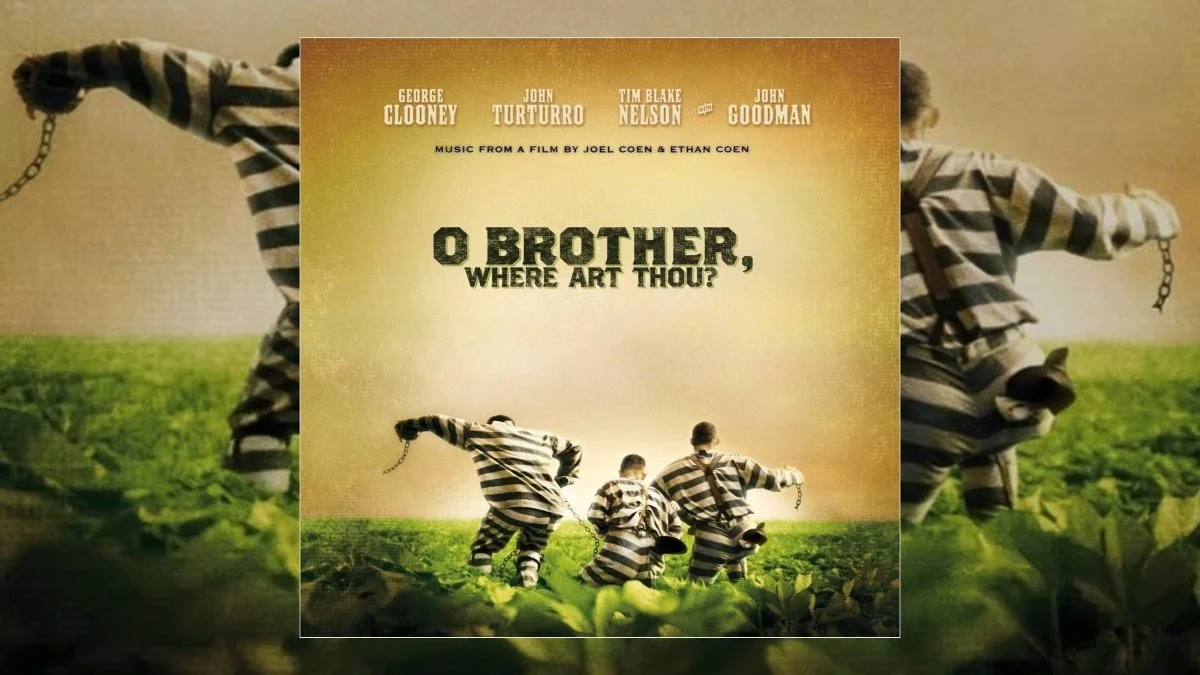
Happy 25th Anniversary to the O Brother, Where Art Thou? Soundtrack, originally released December 5, 2000.
O Brother, Where Art Thou? is one of the best movies in the Coen Brothers’ masterful filmography. Taking place in the Deep South during the Great Depression, it is loosely based on Homer’s The Odyssey. Emphasis on “loosely,” since the Coen Brothers eventually sheepishly admitted that they never read the massive epic poem, instead borrowing its well-known themes, concepts, and names to inform the plot.
Beyond the film’s relatively ridiculous plot (in a good way) is the vast patchwork that made up the building blocks of music in the United States. This music populates the film’s soundtrack released 25 years ago. It is a transcendent soundtrack that is both an essential component to the film and has achieved a life of its own outside of the film.
Instrumental to the film’s soundtrack was Joseph Henry “T-Bone” Burnett. Burnett began working as a musician and producer in the 1960s, then touring with Bob Dylan’s Rolling Thunder Revue in the mid-1970s. He continued to produce through the 1980s, working with artists like Elvis Costello and Roy Orbison.
Burnett started working in film during the late 1980s, getting his first big break by helping the Coen Brothers curate the soundtrack for The Big Lebowski (1998). In an interview with NPR, Burnett said that shortly after completing The Big Lebowski, Ethan Coen contacted him and asked, “How’d you like to make a film about the history of American music?”
In what was a bit of an unusual move, the soundtrack was conceived, and “new” songs were all recorded, before the film was shot. This decision by the Coen Brothers made sense, as the soundtrack often drives the film’s narrative, becoming its cinematic centerpieces. Burnett has said that “a lot of the material was written in the script,” and the brothers were present at all of the soundtrack’s recording sessions. Burnett has said they tried to record as much of the material as possible in the style of the time-period in which the film was set, with most of the time the musicians/bands recording around one microphone.
The album begins with vintage recordings of folk and gospel standards. These include a 1959 recording of the African-American “bad man ballad”/prison work song “Po’ Lazarus” by James Carter and the Prisoners, as well as the original 1928 recording of “Big Rock Candy Mountain” by railroader/minstrel Harry McClintock. Most of the rest of material on the soundtrack were new recordings of traditional folk songs, old time Mountain Music, hymns, dirges, novelty songs, and fiddle tunes. These were recorded by contemporary artists in traditional styles, in a way that would fit into the film’s setting in 1937 rural Mississippi. These include beautiful takes of songs like “You Are My Sunshine,” “Keep On the Sunny Side,” and “I Am Weary (Let Me Rest),” which are all foundational American standards.
Listen to the Album:
The lynchpin of the soundtrack itself is “I Am a Man of Constant Sorrow,” which appears in four different iterations throughout the album. The most well-known is the “Radio Station Version” performed by “The Soggy Bottom Boys” a.k.a. esteemed Bluegrass performers Dan Tyminski (then a member of Alison Krauss’ Union Station Band), Pat Enright, and Harley Allen.
The song’s origin dates back to the 1910s (or even the early 1800s) but was first published by Richard Burnett in 1928. The Stanely Brothers recorded what is considered by many to the definitive version of the song in 1950. The “Soggy Bottom Boys” version is a reinterpretation of the Stanley Brothers’ incarnation and lends the film and its soundtrack its upbeat and irreverent character.
Two instrumental versions of “Constant Sorrow” also appear on the soundtrack. One is a slower, straightforward folky interpretation by Norman Blake, who also recorded the version of “You Are My Sunshine” for the soundtrack. The other is a mournful version by John Hartford, known for his expertise on the fiddle. Hartford’s version serves as a sort of swan song for the bluegrass legend, who died from non-Hodgkin lymphoma six months after the soundtrack’s release.
The Soggy Bottom Boys make another non-“Constant Sorrow” appearance on the album, playing their version of the Vaudeville blues song “In the Jailhouse Now.” It’s another song that dates back to the 1910s but found popularity with country music interpretations around the late 1920s, with its frequently yodeled chorus. Here actor Tim Blake Nelson sings lead, capturing the song’s folksy and non-descript charm. And contrary to what the film suggested, it was Pat Enright who did the yodeling, not John Turturro.
Chris Thomas King, who plays “Tommy Johnson” in the film, contributes “Hard Time Killing Floor Blues” for another of the soundtrack’s highlights. The Baton Rouge-born King recorded rap/blues fusion during the 1990s, but here more than establishes his chops as a consummate Bluesman. “Hard Time…” was first written and recorded by Delta Blues singer Skip James in the late 1920s. King’s interpretation is similar to James’, as he plays it as a low-key, straight-ahead Blues song, but with his own soulful baritone instead of King’s distinctive falsetto.
Some of the album’s best contributions came from some combination of Emmylou Harris, Alison Krauss, and Gillian Welch. Krauss and Welch collaborate on a stunningly exquisite version of “I’ll Fly Away.” Though the Kossoy Sisters’ version of the song appears in the film itself, Krauss and Welch’s interpretation is a beam of pure joy. Harris joins Krauss and Welch to record an evocative version of the lullaby “Didn’t Leave Nobody But the Baby,” their eerie vocals carrying the track over the most minimalist of instrumentation.
Some of the album’s most evocative moments come from the a cappella compositions. “Down To the River To Pray,” sung by Krauss, scores the film’s baptism scenes and is haunting in its beauty. Ralph Stanley’s take on “O Death” is stark and blunt in its execution. He initially recorded a few versions while playing the banjo, before eventually unspooling the chilling ballad without instrumentation.
The Fairfield Four contribute an a cappella version of “Lonesome Valley.” The gospel group has existed in some configuration since the early 1920s, going throughout countless iterations in the subsequent 100+ years. They had begun to earn recognition in the late 1990s before appearing on the soundtrack. The quartet’s deep and resonant vocals on the song are both chilling and inspirational.
The soundtrack closes with a final vintage entry: the Stanely Brothers’ 1955 recording of the gospel standard “Angel Band,” which roots go back to the 1860s. When juxtaposed with Stanley’s version of “O Death,” it’s even more powerful. Whereas “O Death” was born out of dread and fear, “Angel Band” finds the narrator welcoming of the Angel’s presence, ready to transition beyond the mortal coil to whatever awaits them.
The O Brother soundtrack was a massive commercial and critical hit. Over the years, its gone eight times platinum. It also earned multiple GRAMMY Awards in 2002, including wins for Album of the Year, Best Country Collaboration with Vocals (for “I Am A Man of Constant Sorrow”) and Best Male Country Vocal Performance (for “O, Death”).
The album also had an impact beyond sales and awards, helping bring about the resurgence of Bluegrass and traditional Americana that persisted for well over a decade, and is still present today. I don’t think it’s a coincidence that the Hardly Strictly Bluegrass music festival, based in San Francisco, launched in 2001; it still occurs, as strong as ever, almost 25 years later.
The soundtrack’s release also coincided with the release of the Down In the Mountain documentary, which featured a May 2000 performance of many of the songs on the soundtrack by contributors to the project. In 2011, the soundtrack was reissued to celebrate the 10th anniversary of its release, including a 14-song bonus CD of material. These included the aforementioned songs that appeared in the film, but not the album, as well as more vintage recordings that were intended to appear in the film, but didn’t quite make it.
It’s an amazing thing that both the film and the soundtrack for O Brother, Where Art Thou? still have vibrant lives a quarter century after they were released. The soundtrack enhances the film and can stand apart from it independently as a unique and sublime piece of work. That’s a rarefied air where few albums can ever exist.
Listen:
