
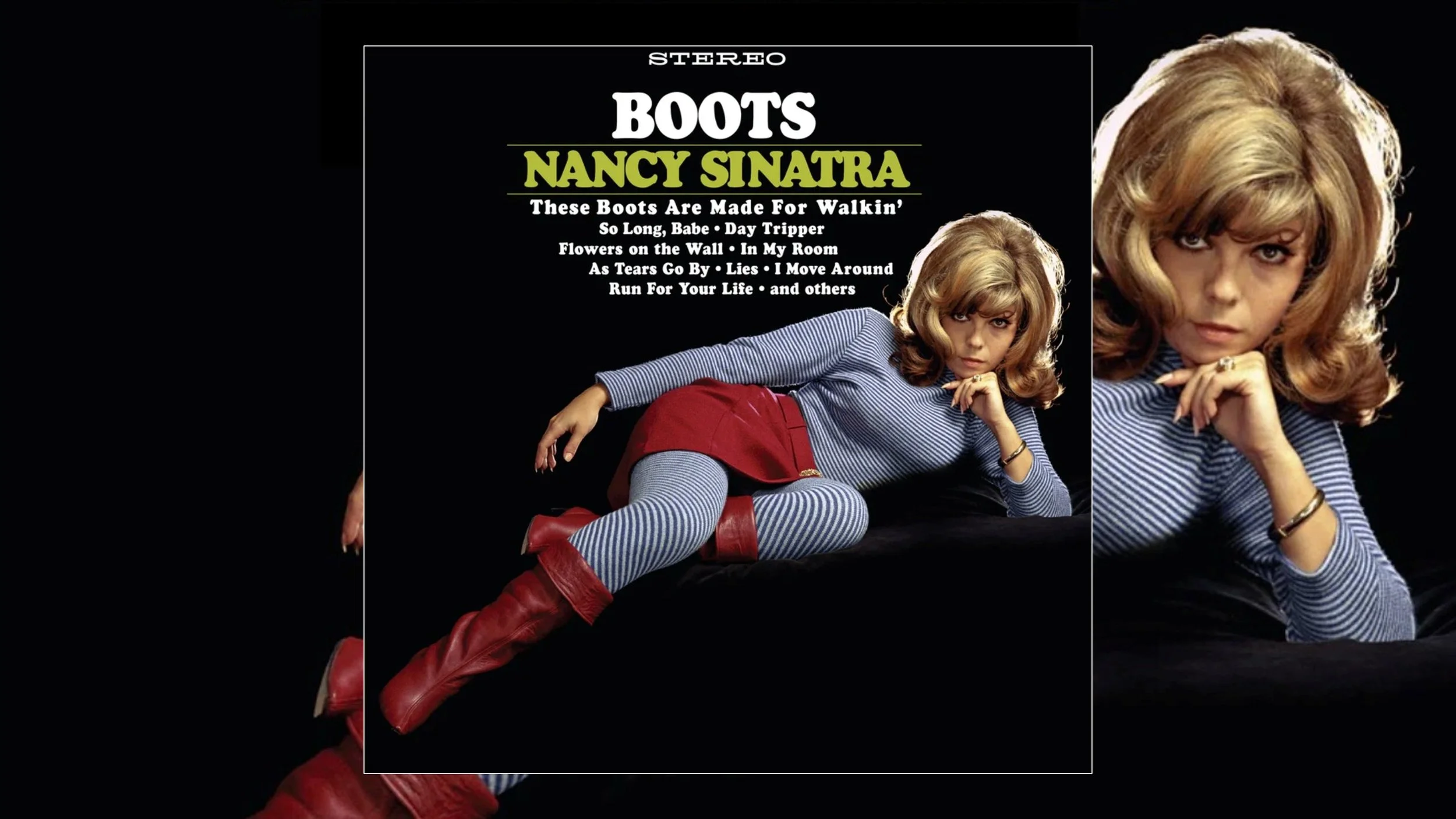
Happy 60th Anniversary to Nancy Sinatra’s debut album Boots, originally released March 15, 1966.
In March 1966, a voice stepped out of the shadows of lineage and into authorship. Nancy Sinatra had already lived with a name that carried its own architecture. To be the daughter of Frank Sinatra was to inherit not just privilege, but to live in an atmosphere that was not only clearly dense with expectation, but one could assume that it also demanded it. Yet Sinatra’s debut album Boots did not behave like an heirloom. It behaved like a provocation.
Produced by Lee Hazlewood and arranged by Billy Strange, this record builds on contradiction. It is unabashedly both austere and theatrical, restrained and quietly confrontational. Hazlewood, who understood the dramatic potential of understatement, stripped away the ornamental habits of mid-sixties pop femininity. In their place, he installed something cooler, more deliberate. Sinatra does not oversell emotion here; she positions it. Her voice is neither overpowering nor submissive. It is observant. It watches.
The album opens with “As Tears Go By,” written by Mick Jagger, Keith Richards, and Andrew Loog Oldham, which, under Sinatra’s care, became something subtly different. Where the original version carried youthful melancholy, through Sinatra’s lens, the song feels prematurely wise. She sounds less like someone mourning lost innocence and more like someone cataloguing it with a clinical clarity that belied her years. Strange’s arrangement ensures that he leaves space around her phrasing, allowing each line to settle before the next arrives.
Her reading of “Day Tripper,” by John Lennon and Paul McCartney, shifts the song’s center of gravity. The original thrived on kinetic urgency; Sinatra slows the song's pulse right down and, without hesitation, exposes its ambiguity. She gently removes the swagger and replaces it with scrutiny, as if she is less interested in the thrill of the encounter than in its emotional weight. This interpretive instinct becomes one of the album’s defining traits. Sinatra is not merely covering songs. She is deliciously interrogating them.
“I Move Around,” written by Hazlewood, establishes mobility as both fact and metaphor. The rhythm carries the faint suggestion of Western expansiveness, but Sinatra’s delivery remains urban, controlled. Movement here is not freedom. It is a necessity. Similarly, her version of “It Ain’t Me Babe,” by Bob Dylan, removes the defensive posture of the original and replaces it with calm refusal. She does not sound wounded. She sounds resolved.
At the center of the album sits “These Boots Are Made for Walkin’,” a recording that altered the framework of female representation in popular music. Built on that legendary bassline that moves with unhurried certainty, the track does not plead or negotiate. It announces. Sinatra’s voice is measured to the point of intimidation. She never raises her voice because she does not need to. Authority and restraint collide and become acutely Sinatra’s own.
Listen to the Album:
When the song snared the #1 spot on both the Billboard Hot 100 and the UK Singles Chart, and helped propel the album to #5 on the Billboard 200, it confirmed a shift already underway. The cultural imagination had found space for a new kind of female protagonist—one that most definitely did not collapse under emotional weight but redirected it.
“In My Room,” written by Lee Pockriss and Paul Vance, presents solitude not as loneliness but as self-possession. Sinatra’s phrasing is intimate without inviting intrusion. “Lies,” by Beau Charles and Buddy Randell, carries a faint undercurrent of accusation, but Sinatra resists theatrical anger. She understands that disappointment expressed quietly can feel more absolute.
“So Long, Babe,” another Hazlewood composition, operates like a companion piece to “Boots.” Where the earlier track radiates confrontation, this one suggests aftermath. Sinatra sounds neither triumphant nor regretful. She sounds finished. That emotional finality becomes one of the album’s most radical gestures. In a musical era saturated with longing, Sinatra offers closure.
Her interpretation of “Flowers on the Wall,” written by Lew DeWitt, introduces ambiguity. The song’s portrait of isolation becomes, in her hands, less a confession than an observation. “If He’d Love Me,” by Miriam Eddy, examines emotional dependency without endorsing it. Sinatra presents vulnerability as a condition, not an identity.
The album closes with “Run for Your Life,” another Lennon-McCartney composition, delivered without the aggression that defined its original form. Sinatra drains the threat from the lyric and replaces it with something more unsettling: detachment. It is as though she has stepped outside the emotional logic of the song entirely.
Throughout Boots, Hazlewood and Strange construct an environment that allows silence to function as architecture. The instrumentation, performed by members of The Wrecking Crew (not officially credited), avoids unnecessary density. Guitars flicker at the periphery, and basslines move with quiet authority. Drums arrive precisely when needed, but never overstay their welcome. This economy and understanding of sound creates a framework in which Sinatra’s voice becomes the primary narrative instrument.
What makes Boots endure is not simply its historical importance, but its psychological precision. Sinatra does not perform femininity as fragility. She performs it as awareness. She understands where she stands within each song, and she refuses to apologize for occupying that space.
In the decades following its release, the album’s influence has managed to travel far beyond its original context. Boots’ aesthetic may be minimal, but it is beautifully composed as well as faintly confrontational, and can be traced through generations of artists who discovered power in emotional control rather than excess. And yet Sinatra’s contribution is still too often filtered through that famous surname, as though her work exists in conversation with her father’s legacy rather than alongside it.
What Boots did do, is it managed to resolve that question sixty years ago. It announced Nancy Sinatra as much more than an extension of history, and ensured that she was the author of her own cultural moment. She did not escape her inheritance. She redefined its terms.
Listen:
