
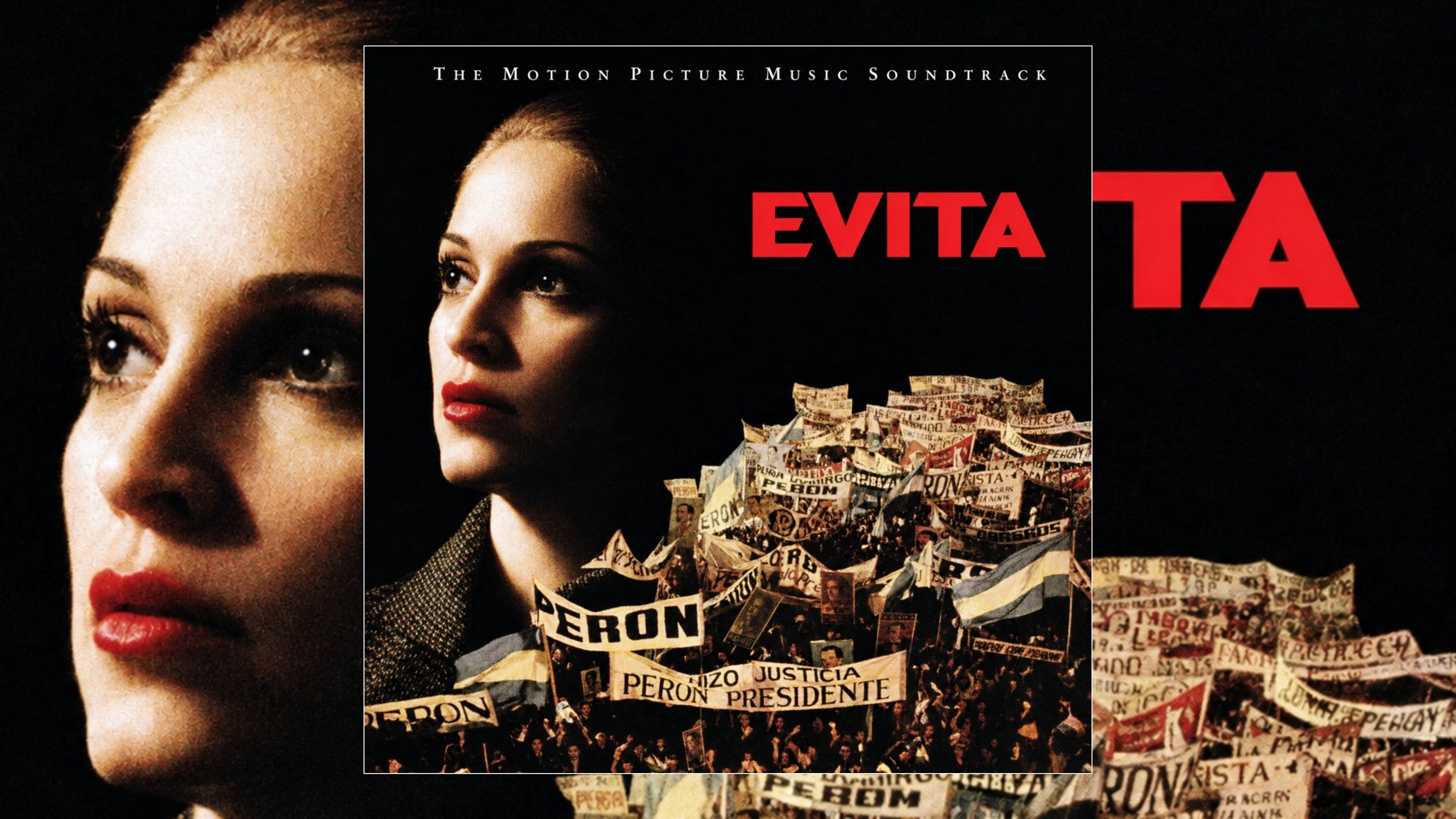
Happy 30th Anniversary to Madonna’s Evita Soundtrack, originally released in the UK October 28, 1996 and in the US November 12, 1996.
There are moments in an artist’s career when the greatest act of defiance is to abandon everything that has made them recognizable. No easy feat. For Madonna, whose extraordinary command of popular culture had already transformed the possibilities of female artistry, 1996 presented an opportunity unlike anything she had previously attempted.
With Evita, she surrendered the familiar provocations, the calculated sexuality and much of the visual vocabulary that had made her the most scrutinized woman in music. In their place came something far more demanding: the responsibility of portraying Eva Perón, a woman whose extraordinary ascent from poverty to political immortality had inspired devotion, resentment and decades of historical argument.
This became arguably the most intensely revealing artistic undertaking of Madonna’s career, one that demanded she be taken seriously beyond the phenomenal achievements of her pop stardom.
Released on October 28, 1996, in the United Kingdom and November 12 in the United States, Evita brought Andrew Lloyd Webber and Tim Rice’s celebrated musical to cinema under the direction of Alan Parker. For Madonna, securing the title role was the culmination of something deeply personal. Her determination to portray Argentina’s former First Lady was evident long before filming commenced, and the intensity with which she approached the production suggested an artist acutely aware of what was at stake. Madonna had spent more than a decade challenging the entertainment industry’s expectations of women, yet the legitimacy afforded to her male contemporaries remained frustratingly elusive.
But the greatest revelation was in her voice.
Having undertaken extensive vocal training in preparation, Madonna emerged with a richness, control and emotional articulation that many listeners had never previously heard. The familiar, occasionally nasal inflections of her earlier recordings gave way to a more expansive instrument, capable of expressing a newfound vulnerability without sacrificing the individuality that made her immediately identifiable. Her commitment to interpreting Lloyd Webber’s demanding compositions demonstrated not simply technical improvement, but an understanding of how musical phrasing could illuminate character.
The soundtrack, recorded over approximately four months, was not without its difficulties. Madonna initially struggled with the unfamiliar demands of recording alongside an orchestra, eventually completing her vocals separately. Yet these challenges became almost irrelevant when confronted with the finished work. Supported by magnificent orchestration, the music possesses a dramatic sophistication that remains incredible and profoundly beautiful three decades later.
Listen to the Album:
“Buenos Aires” introduces Eva as a young woman intoxicated by possibility, and Madonna attacks the composition with an exhilarating combination of ambition and youthful arrogance. There is an almost physical urgency to her delivery, capturing someone determined to escape the circumstances of her birth. Conversely, “Another Suitcase in Another Hall” gave way to a gentler, more introspective Madonna, whose interpretation finds extraordinary sadness in the uncertainty of a woman repeatedly forced to reconsider where she belongs. Something Madonna herself was living.
Alongside Antonio Banderas, whose portrayal of Che provides the narrative with its essential skepticism, Madonna navigates the political and emotional contradictions of Eva’s ascent. Their exchanges throughout “Peron’s Latest Flame” and “Waltz for Eva and Che” are particularly compelling, the latter highlighting the uneasy relationship between public adoration and private ambition. Jonathan Pryce brings considerable authority to Juan Perón, while Jimmy Nail contributes to the musical’s earlier chapters with an appropriately theatrical confidence.
“Rainbow High” captures Eva’s transformation into a meticulously constructed national symbol, with Madonna’s performance possessing an almost delicious awareness of the parallels between celebrity and political influence. Few performers could have understood the mechanics of public image quite so intimately. Madonna had spent her career demonstrating that appearance could be an instrument of power, and here she portrays a woman who recognized precisely the same thing decades earlier.
Yet it is “Don’t Cry for Me Argentina” that remains the soundtrack’s defining achievement. Madonna resists the temptation to overwhelm the composition with theatrical excess, instead approaching its emotional grandeur with remarkable restraint. The result is a performance of considerable dignity, where every carefully measured phrase suggests the complicated relationship between Eva and the people who worshipped her.
The newly composed “You Must Love Me,” awarded both the Golden Globe and Academy Award for Best Original Song in 1997, is perhaps the album’s centerpiece. Stripped of political ceremony, Eva confronts her mortality and the frightening possibility that love may have been conditional upon her usefulness. Madonna’s voice is exquisitely fragile, revealing an emotional depth and honesty that would have been difficult to imagine during the confrontational excesses of some of her previous periods.
By the time “Eva’s Final Broadcast” and “Lament” arrive, the transformation is complete. The woman who once demanded attention now struggles simply to remain present. Madonna allows the character’s physical and emotional exhaustion to inform her delivery, giving the soundtrack a conclusion that is almost unbearable in its tenderness.
Watch the Official Videos:
Visually, Evita was equally extraordinary. Madonna looked resplendent on the cinema screen, inhabiting an exquisite succession of costumes that traced Eva’s transformation from provincial outsider to Argentina’s impeccably dressed First Lady. The gowns, jewelry and immaculate styling were never merely decorative. They communicated status, aspiration and the increasingly suffocating expectations attached to Eva’s public identity. Madonna understood this instinctively, bringing both a physical and intellectual intelligence to the performance that extended far beyond her remarkable wardrobe.
Her acting deserved an Academy Award nomination. That she was overlooked remains one of the more disappointing omissions of that awards season, particularly considering the emotional and physical commitment required to sustain such a demanding performance. Her Golden Globe victory for Best Actress in a Motion Picture Musical or Comedy was thoroughly deserved, but the absence of Oscar recognition still feels like an injustice.
Commercially, Evita was an international success, reaching #2 on the American Billboard 200, topping the British album chart and selling more than seven million copies worldwide. Its significance, however, cannot be only measured through sales figures. The soundtrack fundamentally altered perceptions of Madonna’s musical abilities, demonstrating that the woman frequently dismissed as a provocateur possessed a profound and interpretive intelligence, as well as an impressive capacity for artistic discipline.
It also anticipated the extraordinary vocal assurance of 1998’s Ray of Light, an album that would further redefine her musical identity. The Madonna who emerged from Evita was not a different artist so much as one whose abilities had finally been given room to expand, and more importantly, to be seen exactly as they were.
Three decades on and the emotional significance of Evita extends far beyond its beautiful compositions and cinematic achievements. There is something profoundly wonderful about watching a woman who had spent her professional life being underestimated assume the identity of another woman whose ambition, influence and public image had provoked similarly complicated reactions.
Madonna did not merely play Eva Perón. She understood the cost of becoming a symbol, the loneliness that can accompany extraordinary visibility and the exhausting necessity of continually defending one’s right to occupy space.
And that is exactly why Evita remains among her most important achievements. Beneath its orchestral grandeur, historical spectacle and magnificent costumes exists a deeply human examination of ambition, love, mortality and the peculiar cruelty of public judgement. Madonna gave Eva Perón an extraordinary voice, but in doing so allowed audiences to hear something in her own that they had too often refused to acknowledge.
And thirty years later, the beauty of that achievement has diminished not one iota.
Listen:
