
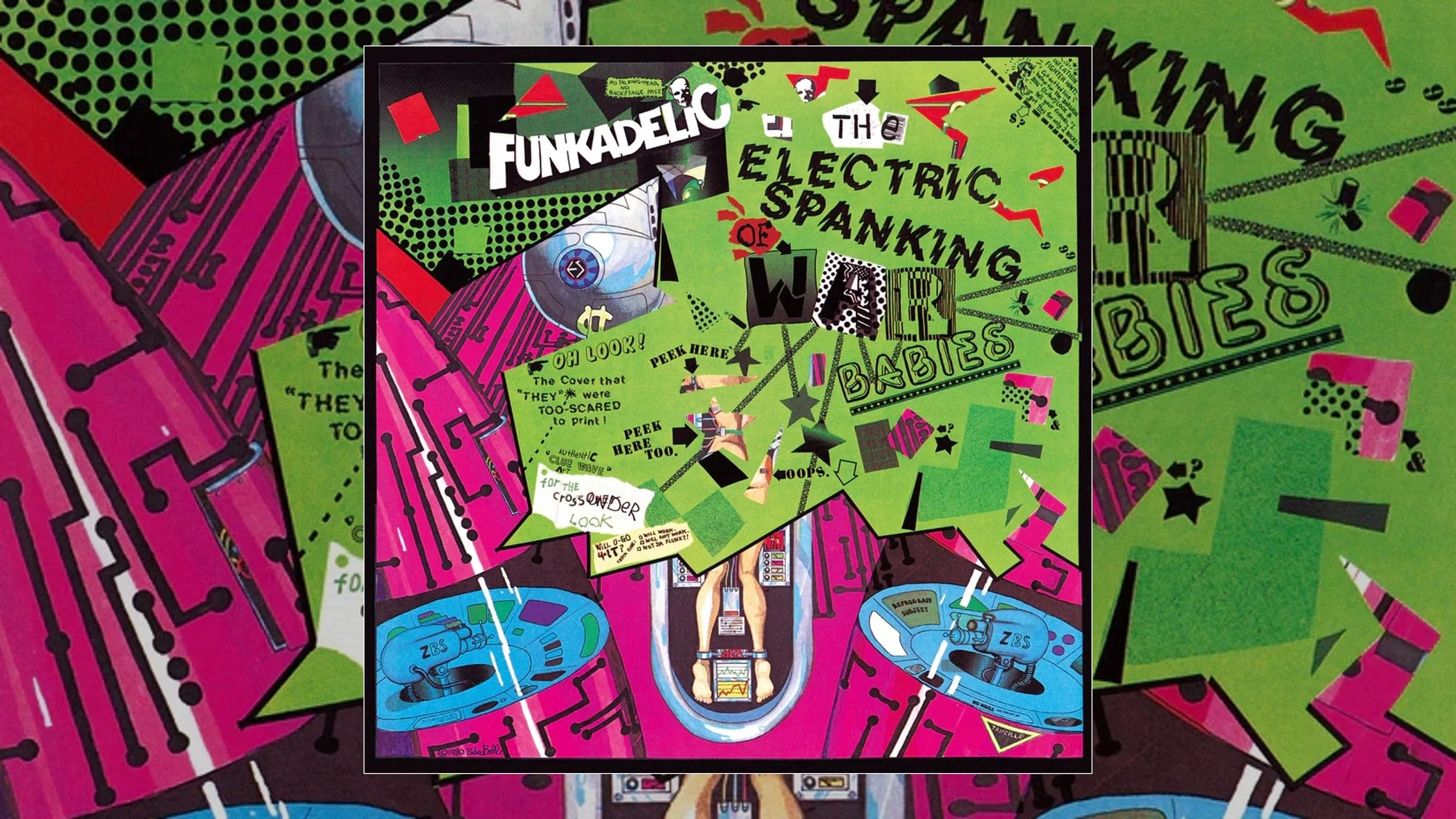
Happy 45th Anniversary to Funkadelic’s twelfth studio album The Electric Spanking of War Babies, originally released April 14, 1981.
[Editor’s Note: The Electric Spanking of War Babies is not currently available in authorized form via major streaming platforms, hence the absence of embedded audio in this article.]
By the early 1980s, the Parliament-Funkadelic mothership was leaking oil and rapidly losing altitude. No one was more aware of the situation than George Clinton, the architect and central creative force behind the collective. But he was still making efforts to keep the lurching behemoth airborne.
And make no mistake, Parliament-Funkadelic had grown to become a massive endeavor, employing countless musicians and personnel, and generating hundreds of hours of music. “Between Parliament, Funkadelic, and all of our spin-off acts, there were almost 40 albums in all,” Clinton wrote in his 2014 memoir Brothas Be Like, Yo George, Ain’t That Funkin’ Kinda Hard On You? “You could stack them, and the pile would be too high to get your hands—or you head—around.”
But the P-Funk was also an unwieldly undertaking. Members of the group would leave over money or creative disagreements, then return to the fold. And while that meant the group was incubating lots of talent, it led to a lack of continuity for both the Parliament and Funkadelic bands. The liner notes of Parliament-Funkadelic albums during the late 1970s and early 1980s often listed dozens of contributors. Further complicating matters was Clinton’s crack habit, which he has admitted clouded his judgement when it came to music.
Then in late 1980/early 1981, another Funkadelic album was released. However, it had nothing to do with Clinton. Three former members of the original Parliaments (a few of which had come back to Parliament-Funkadelic and left again) recorded and released an album that’s most frequently referred to as Connections and Disconnections (1980) (a.k.a. Who Is a Funkadelic?). Clinton wrote that “what little I heard made me think that it was neither as good nor as bad as people said it was.”
In the midst of this soup of crack haze and messy interpersonal dealings, Funkadelic cobbled together The Electric Spanking of War Babies, released 45 years ago. It ended up as the final statement for the Parliament-Funkadelic entity for the next three decades. It’s a mostly forgotten release, associated with none of the group’s well-known late period material. However, its originality is oft ignored and as a whole, the project is thoroughly underappreciated.
Putting together an album can be a tricky, complicated business. There is zero correlation between the smoothness of the recording process and the quality of the final project. In-studio harmony can lead to a brilliant output, aimless claptrap, or anything in between. In-studio chaos can lead to an incoherent mess, madcap brilliance, or anything in between.
Clinton himself is of a decidedly mixed mind about the album. “[I]t wasn’t exactly what I wanted,” he wrote. “The recording process was long and spread out … and as we wrapped it, I realized that I hadn’t been in any shape to brings things into proper focus. The sound was too thin … There were some arrangements that were too busy. I’m not sold on the way that the album was sequenced.”
Much of Clinton’s issues seem to have their genesis with the group’s tensions with Warner Bros., the imprint that had hosted Funkadelic since the mid-1970s. Clinton originally envisioned Electric Spanking as a double album, but the label balked, leaving him with a good deal of unused material. The development was another entry in Clinton and Parliament-Funkadelic’s increasingly long list of grievances with the label.
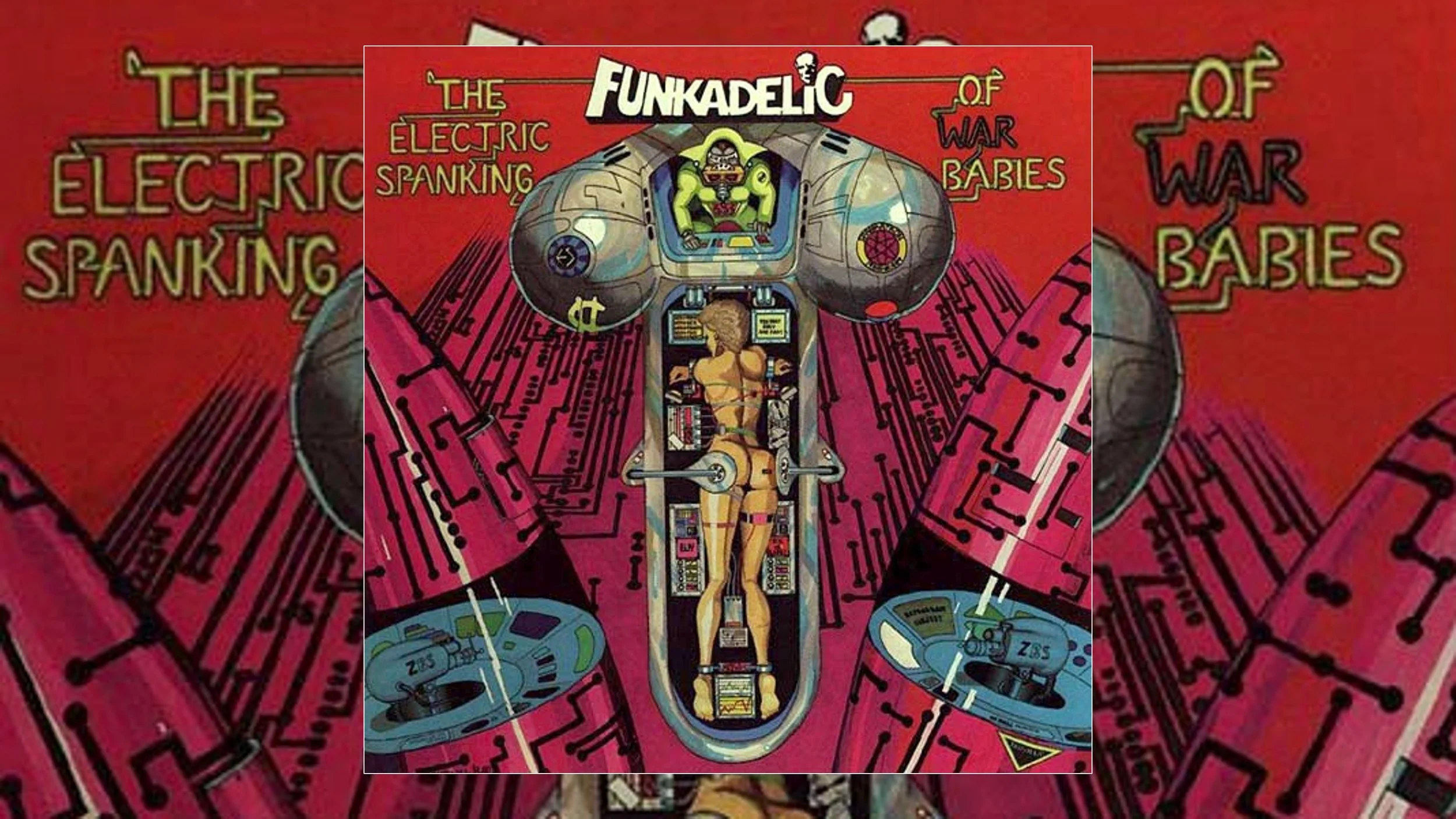
The original, uncensored cover artwork for The Electric Spanking of War Babies
The album’s cover art became another point of contention. The original drawing, created by famed Funkadelic artist Pedro Bell, featured a naked woman, shown from behind, wired into a large, phallic shaped spaceship. Or, as Clinton wrote in his memoir, a “military-industrial-complex sex toy.” Warner Bros. refused to approve the image, leading to Bell exaggeratedly censoring it placing jagged green blocks over the cartoon to strategically cover the risqué portions.
Still, Clinton wrote, “I love that album. I love the title. I love the concept.” He explained that Electric Spanking explored “the darker side of patriotism: the idea was that the government promotes their own agenda through mass media, which was electronically manipulating and beating up the brains of the baby boomers.”
There are certainly frequent allusions to media distraction and manipulation, particularly on the title track. The theme of corporatization of the news is central, along with networks’ unscrupulous partnerships with the government to advance a militaristic agenda. Which I really wish wasn’t so fucking relevant right about now.
Electric Spanking isn’t an upper-tier Funkadelic album, but it’s still entertaining and creative. Funkadelic was sonically moving in new and interesting directions. There are songs on here that didn’t sound like anything they recorded before. It’s an often-messy effort, but it’s never boring.
Funkadelic channels its vintage spirit on the opening two tracks. The album begins with its title track, in which they speak about the sensory overload they experience while trying to wrap their minds around the world’s events. The song’s refrain, “You can walk a mile in my shoes, but you can't dance a step in my feet” is a genuinely great P-Funk-ism. The group continues with the electricity/power theme on “Electro Cuties,” which is driven by complex, overlapping guitar work by Michael Hampton and Jerome Ali.
Electric Spanking really finds its next gear on “Funk Get Stronger,” which sounds unlike anything that has ever appeared on a P-Funk album. The song is an ode to the resilience of funk music, and, by extension, Funkadelic itself. Musically, it’s a weird concoction that features a mix of surreal guitars, chirping synths, layers of percussion, and stuttering drums. The song is the brainchild of a whole host of funk legends: it was produced by Clinton, Sly Stone, and Bootsy Collins. Collins lends his distinctive vocals to the song’s intro, while Roger Troutman, best known as the frontman of Zapp, plays rhythm guitar, bass, and the Moog synth.
The other version of the song, dubbed the “Killer Millimeter Longer Version,” also appears on the album, and it’s more conventional funk. This incarnation was produced by Stone, who also lends his vocals to the track. It’s a shock to hear his once-deep and resonant bass tones reduced to a thin raspy whisper, but well over a decade of drug abuse and hard living will do that. Still, “Killer Millimeter” has many of the traditional trappings of a Family Stone song, which stands to reason, as it features the group’s horn section and Stone playing a watery keyboard groove. The muted reinterpretation of the Beatles’ “She Loves You” that closes the track is a leftfield choice, but it does work.
“Brettino’s Bounce” is a brief instrumental entry, featuring the talents of percussionist Larry Fratangelo (Brettino is his son). I would hazard that the three-and-a-half-minute track was inspired by Fratangelo’s contributions to the aforementioned “Funk Gets Stronger.” Regardless, it’s an eclectic mash of styles and instrumentations, as he lays African drums and Bahamian Junkanoo-inspired rhythms behind disembodied whistles and trills.
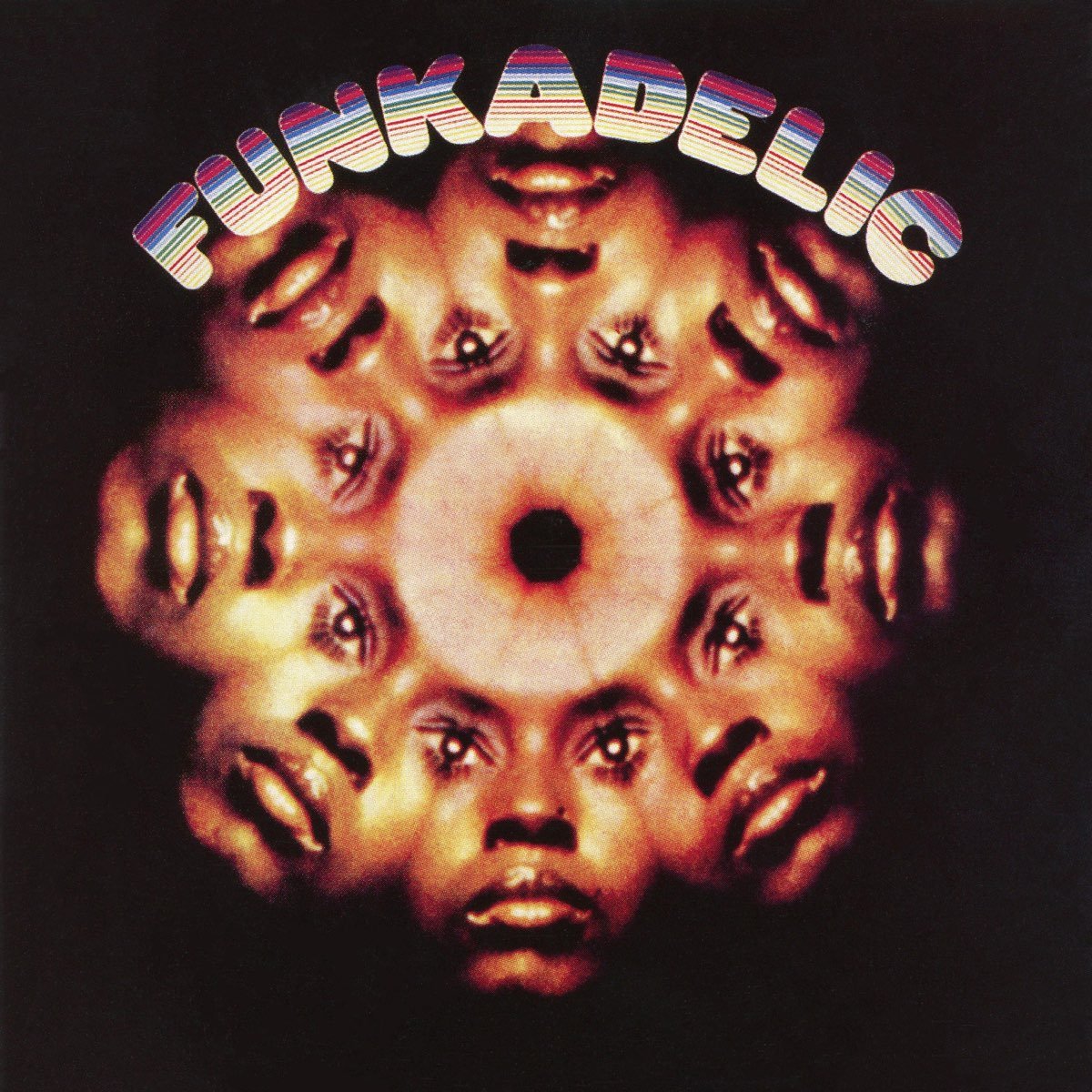
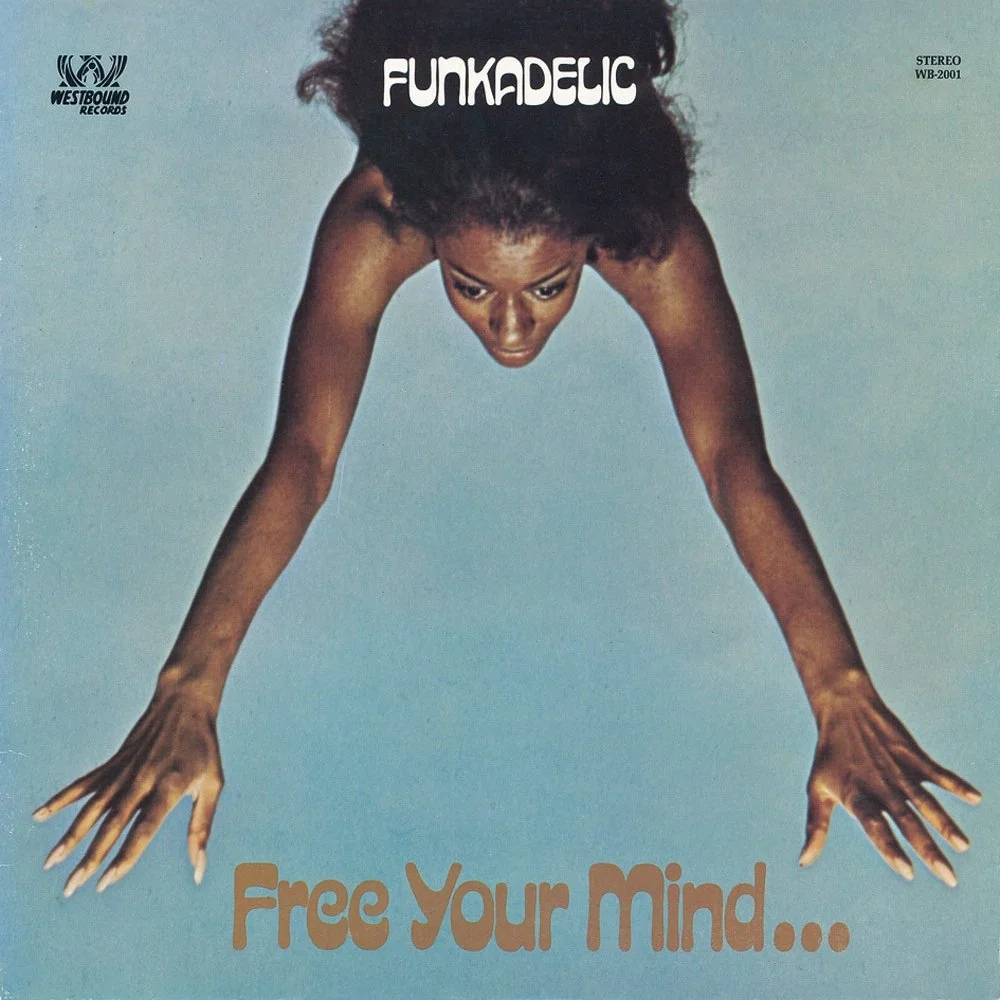
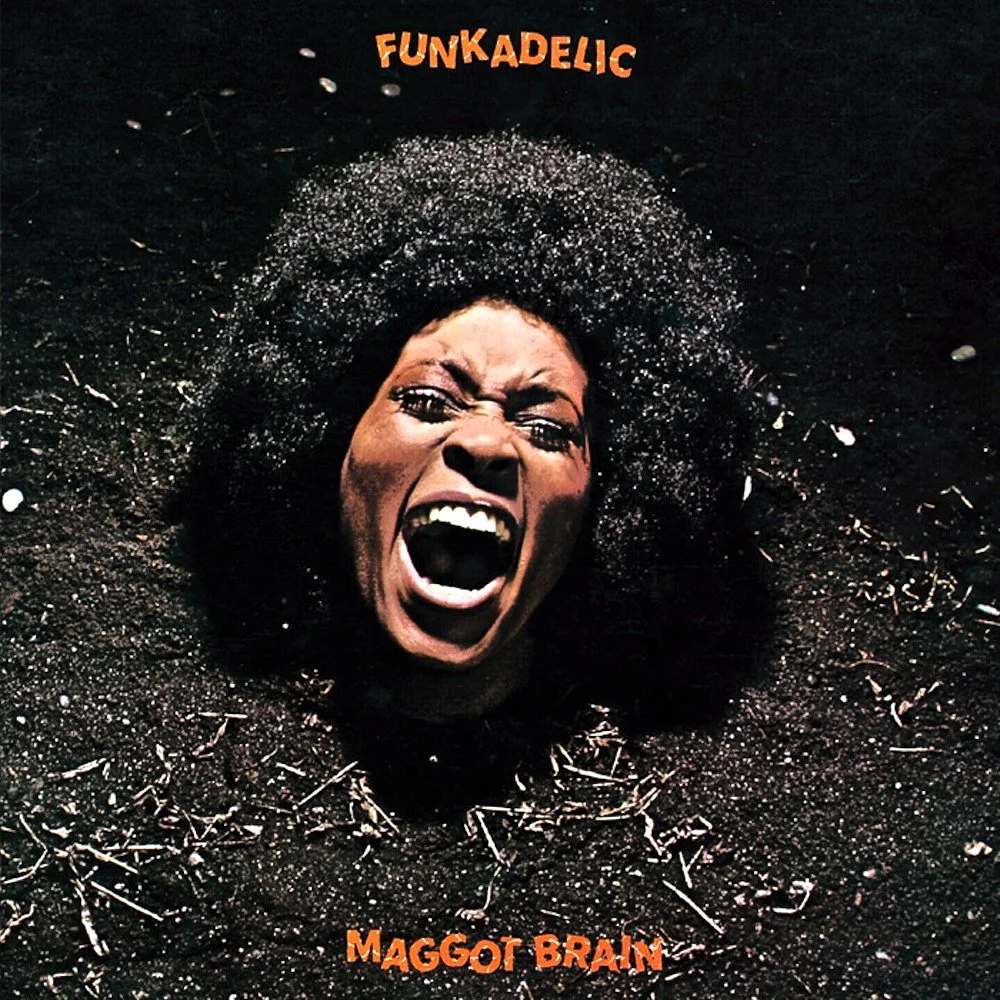
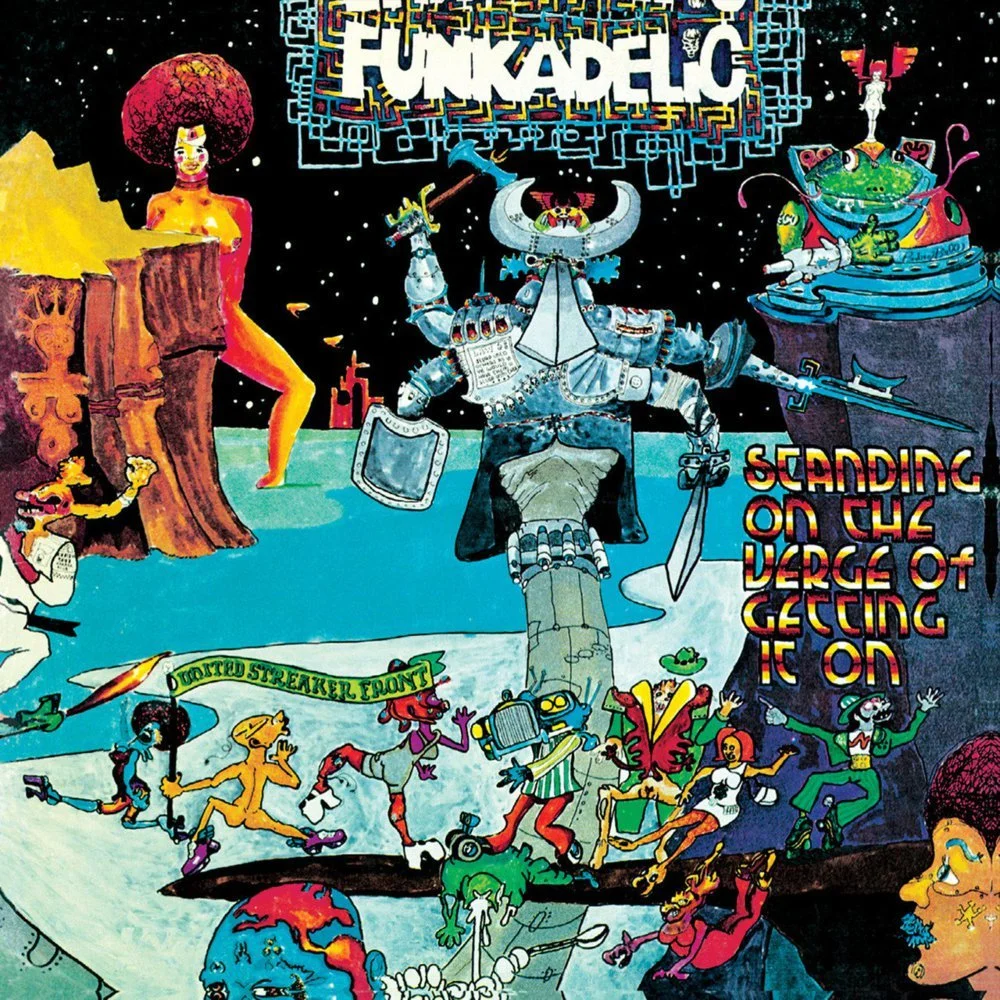
Enjoying this article? Click/tap on the album covers to explore more about Funkadelic:
The light and airy “Shockwaves” is pleasant reggae-influenced jam. Vocalist Donnie Sterling croons in faux patois about escaping the problems and stress of the United States into the “third world,” where he can enjoy the grooves carefree. “Oh, I” is an upbeat, densely packed party track, with Gary Shider singing about his obsession and love affair with a starlet, who he may or may not be stalking.
The album ends with “Icka Prick,” Clinton’s commentary on the characterization of sex in popular culture at the dawn of the 1980s. The free love era was loooooong gone by then, and puritanical prudishness was on the rise. So Funkadelic responded by recording this blatantly and cartoonishly dirty romp, encouraging his listeners to “discuss disgusting.” It’s hard to take Clinton seriously as he talks about Steel-Driving Man John Henry lifting “weights with his tits” and “doing push-ups with his clit,” while lamenting that there “ain’t no decent dick in Detroit.” The ridiculousness is all very much intentional, as Clinton mocks the idea that sex should be a source of shame.
Electric Spanking was not a critical or commercial success. Clinton asserts that Warner Bros. initially only ordered 95,000 copies to be pressed, which was an odd choice for a group who’s last few efforts were certified Platinum. As Funkadelic began its tour to support the album, Clinton recognized things were no longer working. “[A]fter a show in Detroit,” he wrote. “I suspended operations for both Parliament and Funkadelic.”
Except it didn’t end. Within a year, Clinton signed a solo deal with Capitol Records. By the end of 1982, he’d released his first official solo album, Computer Games. It was a Funkadelic album by another name: many of the personnel who played on Electric Spanking, as well as many other Parliament-Funkadelic veterans, contributed to Computer Games. The album also featured “Atomic Dog,” which was originally recorded during the Electric Spanking sessions, and would go on to be one of the biggest hit songs ever associated with Clinton.
Near the close of 1983, Clinton put together the P-Funk All Stars, comprised of many of the Parliament-Funkadelic alumni, to release Urban Dancefloor Guerillas. Funkadelic proper wouldn’t put out another full length of newly recorded material for over three decades, when they released their thus far “final” album First Ya Gotta Shake the Gate (2014).
In its prime, Funkadelic was an utterly bizarre and hugely important entity. They went from an acid-fueled bluesy funk rock group to a party-themed funk band, with countless shifts in between and after. They launched countless careers and pioneered all sorts of musical concepts. Their influence is still felt nearly half a century later. The group faced adversity, sometimes from outside and sometimes of their own creation, and always bounced back in some form. The funk always grows stronger.
